By Miranda Niemas, Nursing Student (BSN candidate)
This guide is currently pending review by a licensed registered nurse.
Last updated: October 13, 2026
CPOT Pain Scale: Nursing Guide for Critically Ill Adult ICU Patients
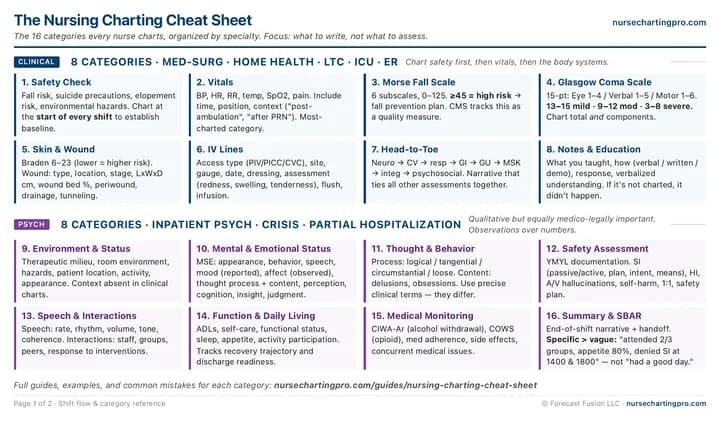
Get the free Nursing Charting Cheat Sheet
- All 16 charting categories, clinical and psych, with what to write for each
- Morse, Braden, Glasgow Coma Scale and SBAR at a glance
- The charting mistakes that cost nurses their licenses
Your patient just came off the vent at 0700 after 4 days of intubation. The day shift handed off a CPOT of 5 with no documented intervention. By 0900 the patient is moaning continuously, guarding the chest tube site, and pulling at the IV. I had a similar handoff in my critical-care rotation last semester and could not have told you on the spot whether 5 was a stop-and-act score or a watch-and-recheck score. This guide breaks down each of the 4 CPOT items, what the scores look like at the bedside in both intubated and non-intubated phases, why CPOT and BPS are not the same tool, and what a defensible CPOT chart entry includes.
Why This Matters
Regulatory bodies: Society of Critical Care Medicine (SCCM) - 2018 PADIS Clinical Practice Guidelines, American Association of Critical-Care Nurses (AACN), The Joint Commission - Pain Assessment and Management Standards, CMS Hospital Conditions of Participation - Pain Management
- Validation of the critical-care pain observation tool in adult patients — Gelinas C, Fillion L, Puntillo KA, Viens C, Fortier M. Am J Crit Care. 2006;15(4):420-427 (2006)
- Clinical Practice Guidelines for the Prevention and Management of Pain, Agitation/Sedation, Delirium, Immobility, and Sleep Disruption in Adult Patients in the ICU (PADIS) — Devlin JW, Skrobik Y, Gelinas C, et al. Society of Critical Care Medicine. Crit Care Med. 2018;46(9):e825-e873 (2018)
- Critical-Care Pain Observation Tool (CPOT) — MDCalc (2024)
- R3 Report Issue 11: Pain Assessment and Management Standards for Hospitals — The Joint Commission (2017)
What CPOT is and when to use it
The 4 CPOT items
What each item scores at the bedside, with the specific behaviors that distinguish 0, 1, and 2.
Item 1 - Facial expression (0 to 2)
Item 2 - Body movements (0 to 2)
Item 3 - Muscle tension (0 to 2)
Item 4 - Compliance with the ventilator OR vocalization (0 to 2)
Charting the total and the items
How nurses document a CPOT score in the ICU
The score is the easy part. Documenting it in a way that drives titration and reassessment is the part that matters.
CPOT vs BPS vs FLACC vs PAINAD and the 0 to 10 numeric scale
Picking the right tool for your patient is more important than picking one you already know.
Self-report (0 to 10 numeric or pointing to a card) first
CPOT for non-self-reporting adult ICU patients (intubated or extubated)
BPS as the parallel adult ICU tool
FLACC for pediatric and cognitively impaired patients
PAINAD for non-verbal patients with advanced dementia
CPOT in NurseChartingPro
Common Mistakes
Charting CPOT without the current RASS
A CPOT score in isolation does not tell the next nurse whether the patient is comfortable or whether the score reflects sedation depth. RASS context is what makes the CPOT interpretable. A low CPOT at RASS -4 is not the same clinical picture as a low CPOT at RASS 0, and the chart should reflect the difference.
Scoring vocalization on an intubated patient
Item 4 on CPOT swaps based on airway status. Intubated patients score compliance with the ventilator. Extubated patients score vocalization. Recording vocalization on an intubated patient (or vice versa) is a tool-misuse error that shows up in chart audits.
Treating a CPOT of 3 or 4 as "fine" because the patient is sedated
A CPOT of 3 or higher is the published threshold for unacceptable pain. Continuing the same regimen because the patient is "sedated" misses the point: the patient is sedated AND in pain, and the right move is analgesia first, not more sedation. SCCM 2018 PADIS specifically calls out the analgesia-first approach.
Scoring muscle tension on a paralyzed patient
Muscle tension is meaningless under continuous paralysis. Recording 0 on the muscle-tension item misrepresents the assessment and can hide undertreated pain. Document that CPOT is not applicable, and use physiologic surrogates and BIS while the patient is paralyzed.
Skipping reassessment after the IV opioid bolus
IV opioid reassessment is a clinical and a legal requirement. A bolus given without a documented reassessment score is an incomplete pain management record and a common ICU survey finding. The reassessment also tells the provider whether the bolus was effective and whether the continuous infusion should be re-titrated.
Mixing CPOT with the 0 to 10 numeric scale in the same entry
CPOT and the 0 to 10 numeric scale are different instruments with different validation populations and different score ranges (CPOT is 0 to 8, not 0 to 10). Writing "4/10 (CPOT)" conflates them and makes chart audit and trend tracking harder. The total is on a 0 to 8 range, but the scale is CPOT, not numeric.
Case Example
Scenario
You are the day shift cardiothoracic ICU nurse. Mrs. Patel was extubated at 0700 after an uneventful CABG x4. She is on a fentanyl PCA at 25 mcg q10min lockout with no basal, plus scheduled acetaminophen 1 g PO q6h. Day shift charted CPOT 2 at 0800 with RASS 0. At 1000, you walk in to do a scheduled assessment. She is on 2 L nasal cannula, sitting at 30 degrees, with her hands rubbing the sternal incision through the gown.
Chart Entry
Pain assessment 1000:

CPOT total: 4
- Facial expression: 2 - sustained grimace, brow lowered, eyelids tightly closed during deep breath
- Body movements: 1 (protection) - rubbing the sternal incision through the gown, cautious slow movements when shifting position, will not let me reach across the chest tube
- Muscle tension: 1 - tense, mild resistance to passive elbow flexion
- Vocalization: 0 - no moaning or crying out, but pursed lips with each deep inspiration

Clinical context: extubated at 0700, RASS 0, fentanyl PCA at 25 mcg q10 PRN with no basal, acetaminophen 1 g PO at 0900. Last PCA demand 0945, two unsuccessful attempts (lockout). Sternal incision intact, dressing dry, chest tubes draining serosanguineous, output WNL.

Intervention: PCA basal infusion ordered and started by provider at 1010 (10 mcg/h continuous on top of demand). Patient coached on PCA timing and incentive spirometer pre-medication. Reassess at 1040.

Reassessment at 1040: CPOT 2 (Face 1 - mild brow lowering during deep breath, Body movements 1 - guarding without rubbing, Muscle tension 0, Vocalization 0). RASS 0. Tolerating incentive spirometer at 1500 mL with coaching. Continue PCA + basal; reassess at 1130 and PRN with each PCA demand pattern check.
Key points from above chart entry
- Item breakdown documented:
- All 4 item scores are listed individually so the next nurse sees the pain presents as facial-and-body-movement guarding, not as agitation or vent dyssynchrony.
- Vocalization (not vent compliance) because she is extubated:
- Item 4 is vocalization, not ventilator compliance, because the patient was extubated at 0700. The chart names the airway status so the tool-choice for item 4 is documented.
- RASS paired with every CPOT:
- A CPOT 4 at RASS 0 reads as significant pain in a fully alert patient. A 4 would mean something different at RASS -3. The chart pairs them at every measurement.
- PCA pattern shows the patient is asking but not getting through:
- Two unsuccessful PCA attempts in the lockout window plus a CPOT of 4 is the signal that demand-only is undertreating; the basal addition is the right titration step. The provider notification and the new order are in the chart.
- Reassessment within 30 minutes of the analgesic change:
- PCA basal started at 1010, reassess at 1040 - within the 30-minute post-intervention window. The reassessment score is the documentation that closes the loop.
Pro Tips
- Always pair CPOT with the current RASS and the airway status: A CPOT without a RASS and an airway note is a number with no scale. Document RASS and intubated-vs-extubated at every assessment. The airway status is what tells the next nurse whether item 4 is ventilator compliance or vocalization, and the RASS is what makes the score interpretable against the sedation depth.
- Score during a stimulus, not just at rest: Pain in a sedated or post-op patient often shows up only during a stimulus: turning, suctioning, dressing change, deep breathing, incentive spirometer. If you score CPOT only at rest, you may miss the procedural pain that drives the analgesic regimen. Score during the stimulus and document the trigger ("CPOT 5 during incentive spirometer"), then again at rest after the intervention.
- Use CPOT through extubation, not just up to it: CPOT is built to bridge the extubation transition: the same 4-item structure follows the patient by swapping vent compliance for vocalization. Many post-op cardiac and trauma patients have undertreated pain in the first few hours after extubation because the team mentally switches off the ICU pain tool when the tube comes out. Keep the same scale; that is what the tool was designed for.
- Document CPOT as not applicable on paralyzed patients: On a continuous paralytic, the muscle-tension item is uninformative and the vent-compliance item is partially confounded by the paralytic itself. Document "CPOT not applicable, patient on continuous neuromuscular blockade" and use physiologic surrogates plus BIS or processed EEG. Resume CPOT scoring when the paralytic is held for the daily neuro check or stopped.
- Pair every IV opioid CPOT with a reassessment within 30 minutes: The reassessment score is what closes the clinical and legal loop. Document the intervention time, the reassessment time, and the new CPOT plus RASS. An IV opioid given without a documented reassessment score is a survey finding waiting to happen, and in the ICU it is also an analgesic-titration moment that can prevent the next stimulus from spiking the score again.
Step by Step
- Confirm CPOT is the right tool for this patient: If the patient can mouth a number, point to a card, or blink reliably to a yes-or-no scale, use a self-report tool instead. If the patient cannot self-report and is in the adult ICU, CPOT is appropriate. If on continuous paralysis, document CPOT not applicable.
- Note the current RASS and the airway status: Document the Richmond Agitation-Sedation Scale (RASS) score at the time of the CPOT assessment, plus whether the patient is intubated or extubated. The two scores are read together; the CPOT is not interpretable without the sedation context, and the airway determines whether item 4 is ventilator compliance or vocalization.
- Observe the patient for one full breath cycle, ideally during a stimulus: Watch the face, the body, and either the ventilator waveforms (intubated) or any vocalization (extubated). Pain in a sedated or post-op patient often shows up only during a stimulus (suctioning, turning, dressing change, deep breathing), so include the trigger in the chart.
- Score each of the 4 items 0 to 2: Facial expression, body movements, muscle tension, and either compliance with the ventilator (intubated) or vocalization (extubated) each get a 0, 1, or 2 based on the published rubric.
- Sum the items for a total of 0 to 8: Total 0 to 2 = no pain to mild pain. 3 or more = unacceptable pain warranting analgesic review. The response at each score from 3 to 8 follows unit protocol.
- Intervene and reassess: For scores 3 and above, apply a pain intervention per your facility's ICU pain protocol, such as an as-needed (PRN) IV opioid, a continuous-infusion rate adjustment, a nonpharmacologic measure, or provider notification. Reassess the CPOT within the window appropriate to the intervention (15 to 30 minutes for IV opioid bolus) and document the new score plus the current RASS plus the airway status.
Frequently Asked Questions
- What does a CPOT score of 3 mean?
- A CPOT of 3 is the published threshold for unacceptable pain. It means the patient's pain behaviors across the 4 items add up to a level that should prompt a review of the analgesic regimen, an intervention if clinically appropriate, and a reassessment within the IV opioid window (15 to 30 minutes after a bolus). A 3 is not a "wait and see" score; it is a score that should drive a decision.
- Is CPOT only for intubated patients?
- No, CPOT works on both intubated and non-intubated adult ICU patients. Item 4 swaps based on airway status: intubated patients score compliance with the ventilator, extubated patients score vocalization. The same 0 to 8 range and the same threshold of 3 or higher apply before and after extubation, which keeps the trend continuous through the airway transition.
- How is CPOT different from BPS?
- CPOT uses 4 items on a 0 to 8 range, while the BPS (Behavioral Pain Scale) uses 3 items on a 3 to 12 range; both are behavioral pain tools for adult ICU patients who cannot self-report. CPOT was originally validated in cardiac surgery patients and adapts to extubation by swapping ventilator compliance for vocalization in item 4. BPS was originally validated in mechanically ventilated patients, with the BPS-NI (Behavioral Pain Scale for non-intubated patients) providing the parallel non-intubated scale. The 2018 Society of Critical Care Medicine (SCCM) pain, agitation/sedation, delirium, immobility, and sleep disruption (PADIS) guidelines name both tools as having the strongest validity and reliability; most facilities adopt one or the other, not both. The choice is a facility policy decision more than a clinical one.
- How is CPOT different from the numeric 0 to 10 pain scale?
- CPOT is an observational tool, where the nurse rates 4 behavioral items, while the numeric 0 to 10 scale is a self-report tool, where the patient states their pain intensity. The score ranges are also different (CPOT is 0 to 8, not 0 to 10), so the numeric values are not interchangeable. Self-report is preferred when the patient can mouth a number, point to a card, or blink reliably; CPOT is a fallback for patients who cannot self-report. Do not use both tools on the same patient at the same time or mix their scores in a single chart entry.
- Why do I need to chart RASS with every CPOT?
- You chart the RASS (Richmond Agitation-Sedation Scale) with every CPOT because a deeply sedated patient may not grimace, move, tense the muscles, or react to the ventilator even when in pain. A CPOT of 0 at RASS -4 is not the same clinical picture as a CPOT of 0 at RASS 0. The 2018 Society of Critical Care Medicine (SCCM) PADIS guidelines and most ICU pain protocols expect both numbers paired in the chart so the next nurse and the provider can interpret the pain finding against the sedation depth.
- Can CPOT be used on a patient with continuous neuromuscular blockade?
- No, CPOT cannot be scored validly on a patient with continuous neuromuscular blockade. The muscle-tension item is uninformative under continuous paralysis, and the body-movements and ventilator-compliance items are partially affected by the paralytic. Document "CPOT not applicable, patient on continuous neuromuscular blockade" and use physiologic signs (heart rate, blood pressure trends, lacrimation) plus a processed electroencephalogram (EEG) sedation monitor, such as the bispectral index (BIS) or SedLine, per facility policy. Resume CPOT scoring when the paralytic is held for the daily neuro check or stopped.
Get the free Nursing Charting Cheat Sheet
- All 16 charting categories, clinical and psych, with what to write for each
- Morse, Braden, Glasgow Coma Scale and SBAR at a glance
- The charting mistakes that cost nurses their licenses
Chart faster with Nurse Charting Pro
Tap through your assessments during the shift and get a draft of your note to review at clock-out. Your notes are cleared from your phone at the end of your shift.
Related Guides
- Clinical nursing chartingThe 8 clinical charting categories, including where pain scores fit in the shift.
- BPS pain scale documentationThe parallel adult ICU behavioral pain tool. BPS scores 3 items on a 3 to 12 range and is the alternative to CPOT in many adult ICUs. Use BPS or CPOT, not both.
- PAINAD pain scale for advanced dementiaThe behavioral pain tool for non-verbal advanced-dementia patients in med-surg, long-term care, and memory care. Different population, different range (0 to 10), same documentation rhythm.
- FLACC pain scale for pediatric and cognitively impaired patientsThe behavioral pain tool for children ages 2 months to 7 years and for cognitively impaired patients outside the adult ICU. Different population, different range (0 to 10), same documentation rhythm.
- Richmond Agitation-Sedation Scale documentationCPOT is interpretable only against the current RASS. The RASS guide covers the sedation-depth side of the pain-and-sedation pairing every adult ICU charts together.
- Skin and Wound charting (pain block)CPOT is selectable in the pain block of the Skin and Wound assessment in NurseChartingPro; see the full pain-documentation walkthrough for the structured-field flow.