By Miranda Niemas, Nursing Student (BSN candidate)
This guide is currently pending review by a licensed registered nurse.
Last updated: October 13, 2026
Clinical Nursing Charting: The Complete Guide for Every Specialty
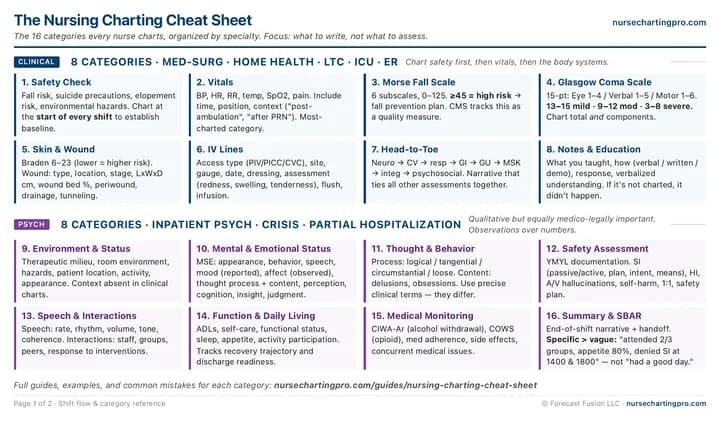
Get the free Nursing Charting Cheat Sheet
- All 16 charting categories, clinical and psych, with what to write for each
- Morse, Braden, Glasgow Coma Scale and SBAR at a glance
- The charting mistakes that cost nurses their licenses
Your shift on the clinical unit starts in a few hours and you're not sure what you're supposed to chart on every patient. Maybe you're a psych nurse covering a med-surg shift. Maybe you're a new grad. Maybe you're a student on your first clinical rotation. Clinical nursing charting has eight categories, and once you know the eight, the rest is just practice. Here's the overview.
How to Chart Vital Signs Correctly: Nursing Documentation Tips
Vitals are the category clinical nurses chart most often. Amy and Miranda work through a full set on camera, including the context that makes each number defensible.
Why This Matters
Regulatory bodies: Centers for Medicare & Medicaid Services (CMS), The Joint Commission, State Nurse Practice Acts
- CMS Conditions of Participation - Medical Record Services — Code of Federal Regulations (42 CFR §482.24) (2024)
- National Patient Safety Goals — The Joint Commission (2025)
- Principles of Nursing Documentation — American Nurses Association (ANA)
What Counts as "Clinical" Nursing Charting
The 8 Categories Every Clinical Nurse Documents
These 8 categories encompass approximately 95% of what a clinical nurse documents during any given shift. Master these categories to establish a framework applicable to any clinical specialty.
Safety Check
Vitals
Morse Fall Scale
Glasgow Coma Scale
Skin & Wound (Braden Scale + Wound Assessment)
IV Lines
Head-to-Toe Assessment
Notes & Education
How Clinical Charting Differs from Psychiatric Charting
Both specialties chart by category, but the categories differ along with the voice used.
Common Mistakes
Charting "Normal" Without Specifying Your Assessment
"Normal" does not constitute an assessment; it represents a conclusion. The chart must detail what you assessed and your findings. A surveyor reading "WNL" cannot determine whether you evaluated two systems or ten.
Copying Documentation from Previous Shifts
Copy-paste charting raises red flags for auditors because it implies the assessment wasn't performed. Even when findings are similar, document them anew each shift with current-shift details.
Total score without component breakdown
A total score alone fails to inform the care team which specific risk factors contribute to the score. The care plan relies on the component breakdown.
Late Entries Without Time Stamps
Late entries are legal and sometimes unavoidable, but they must clearly indicate both the time of the event and the time of documentation. Unmarked late entries may appear as falsification.
Missing the Reassessment After Intervention
Completing the intervention cycle requires a follow-up assessment. Surveyors and risk managers specifically look for this reassessment, as it demonstrates whether the intervention was effective or not, and what actions were taken next.
Case Example
Scenario
You're the day shift RN on a 6-patient med-surg assignment. Mr. Okafor is post-op day 2 from a right total knee replacement, admitted for pain control and early mobility. Your shift runs from 0700 to 1900.
Chart Entry
0800 - Full start-of-shift assessment: Braden 18 (low risk), Morse 55 (high risk - history of falling + ambulatory aid + secondary diagnosis). Vitals: BP 132/78, HR 76, RR 16, SpO2 97% RA, temp 98.4°F, pain 6/10 right knee. Surgical site: staples intact, edges approximated, dressing CDI, no erythema, minimal serous drainage. IV: 20g right forearm, site without redness or swelling, NS at 75mL/hr. Head-to-toe: lungs CTA, heart RRR, abdomen soft NT, bowel sounds active, skin warm dry.

1000 - Pain reassessment: Oxycodone 10mg PO given at 0830. Pain now 3/10; patient reports "much better." Ambulated 50 feet in the hallway with a rolling walker and PT assist, steady gait, no SOB.

1200 - Vitals: BP 128/74, HR 72, RR 14, SpO2 98%, pain 4/10. Lunch: ate 80% of meal. Safety round: bed in low position, call light within reach, non-skid footwear on.

1400 - Safety round and vitals: BP 130/76, HR 74, RR 16, SpO2 97%, pain 5/10. Patient sat in a chair for 45 minutes and tolerated it well. Reminded to call for assistance before ambulating.

1600 - Vitals and wound reassessment: Surgical site unchanged from 0800. Pain 4/10. Started narrative note for end-of-shift.

1800 - SBAR handoff to night shift: "Mr. Okafor in 412, 68 year old, POD 2 right TKR. Had a good day - ambulated 50 feet with PT this morning, pain controlled at 3-5/10 on current regimen. Morse 55, high fall risk, using rolling walker. Surgical site clean, no signs of infection. IV running, site good. No concerns - continue current plan."
Key points from above chart entry
- 0800 Assessment:
- Covers all 8 categories in one pass: safety (Morse), vitals, wound, IV, head-to-toe, and scoring scales.
- 1000 Reassessment:
- Shows the intervention-response cycle: pain med given → reassessment → improvement documented.
- Safety Rounds:
- Documented at 1200 and 1400 - shows continuous safety monitoring, not just the start-of-shift baseline.
- 1800 SBAR:
- Concise handoff that hits all the key points: who, what happened today, current status, and plan.
Pro Tips
- The 0800 Assessment Sets the Baseline for Everything: Take the time to conduct your start-of-shift assessment carefully. Every subsequent entry references this assessment. A thorough 0800 assessment ensures that the rest of your shift's charting consists only of updates and changes from the baseline.
- Chart in Real-Time as Much as Possible: Document clinical data - vital signs, pain scores, and wound assessments - at the moment for the most accurate results. Although batch charting at the end of a shift is legal, it often results in lower quality. During my clinical rotation, I carried a folded paper in my scrub pocket to jot down quick observations between assessments, then transferred them to the chart.
- Learn the five scoring scales in under a minute each: Braden, Morse, GCS, pain, CIWA, and RASS serve as clinical equivalents to the psychiatric mental status exam. Each scale is standardized and allows for trend analysis. Once you can score them quickly, your charting speed doubles since you won't need to look up subscale definitions each time. For sedation depth specifically, the RASS documentation guide covers the -5 to +4 scale and the score-intervene-reassess loop used in ICU and procedural sedation contexts.
- If You Don't Know What to Chart, Chart What You Observed: Observations remain a safe choice. For example, "Patient grimacing when repositioned, guarding right knee" accurately reflects what you saw. Interpreting observations, such as stating that the "patient appears to be in pain," requires more clinical judgment. When in doubt, describe what you see.
- The 8 Categories Correspond to 8 Surveyor Questions: During Joint Commission surveys, surveyors ask specific questions about each category. Documenting each category thoroughly every shift protects the unit as a whole, not just you personally.
Step by Step
- Complete safety check first: Start every shift by verifying and documenting the patient's safety status: fall risk precautions in place, bed position, call light in reach, and any special safety measures.
- Obtain and document vital signs: Obtain a full set of vital signs and document the time, position, and any relevant context. Note any significant changes from the previous shift.
- Score applicable assessment scales: Use the Morse Fall Scale, Braden Scale, Glasgow Coma Scale, and any other required scoring tools. Document the total score along with the individual component scores.
- Perform head-to-toe assessment: Systematically assess each body system. Document findings using specific language; avoid vague terms like "normal" or "WNL" (within normal limits) without detail.
- Assess wounds, IV sites, and specialty areas: Document the wound status, IV site condition, and any specialty assessments related to the patient's diagnosis or treatment plan.
- Document education and care coordination: Document any patient teaching performed, discharge planning discussed, and communication with other care team members.
- Reassess after every intervention: After giving a medication, performing a procedure, or implementing a care plan change, document the reassessment and the patient's response.
- Complete end-of-shift narrative and SBAR handoff: Summarize events from the shift, changes from baseline, and outstanding items. Provide the SBAR (Situation, Background, Assessment, Recommendation) handoff to the oncoming nurse.
Frequently Asked Questions
- What are the 8 clinical nursing charting categories?
- The 8 clinical nursing charting categories are safety check, vitals, Morse Fall Scale, Glasgow Coma Scale, skin and wound (Braden Scale and wound assessment), IV lines, head-to-toe assessment, and notes and education. These categories are consistent across med-surg, home health, long-term care, intensive care, and emergency department settings.
- How is clinical charting different from psychiatric charting?
- Clinical charting focuses on quantitative data, including vital signs, scoring scales, lab values, and wound measurements. In contrast, psychiatric charting emphasizes observational data such as behavior, thought processes, mood, and affect. Both types use structured category frameworks, but the specific categories differ. Clinical charting includes 8 categories, while psychiatric charting has a distinct set of 8.
- How long should a full clinical assessment take to chart?
- During your first few shifts, anticipate spending 30-45 minutes on a complete start-of-shift assessment covering all 8 categories. By your 20th shift, this time will decrease to about 15-20 minutes. Experienced nurses can finish a standard assessment in under 10 minutes. Repetition enhances speed, not shortcuts.
- Do I need to chart all 8 categories on every patient?
- No, you do not need to chart all 8 categories on every patient. Chart safety checks, vitals, and head-to-toe assessments for all patients. The other categories depend on the patient and setting; for example, a patient without an IV does not require IV documentation, and the Glasgow Coma Scale (GCS) typically applies only to patients with neurological concerns or altered consciousness. Your facility's policy specifies which categories are required for which patients.
Get the free Nursing Charting Cheat Sheet
- All 16 charting categories, clinical and psych, with what to write for each
- Morse, Braden, Glasgow Coma Scale and SBAR at a glance
- The charting mistakes that cost nurses their licenses
Chart faster with Nurse Charting Pro
Tap through your assessments during the shift and get a draft of your note to review at clock-out. Your notes are cleared from your phone at the end of your shift.
Related Guides
- Nursing Charting Cheat SheetAll 16 categories (clinical + psych) in a single scannable reference.
- Psychiatric Nursing ChartingThe psych counterpart - different categories, same framework.
- SBAR Nursing HandoffLearn to give a clinical handoff using the SBAR framework.
- Glasgow Coma Scale ChartingComprehensive guide on GCS scoring and documentation.
- Skin & Wound ChartingBraden Scale, wound measurements, and infection screening.
- Safety check and hourly rounding documentationUse the 4 P's framework to document every safety round.
- Vital signs documentation guideDocumenting vitals efficiently involves trending and reporting abnormalities.
- Morse Fall Scale scoring and documentationAll 6 subscales, risk thresholds, and intervention bundles.
- IV site assessment and insertion documentationDocument peripheral IV, central line, and complications.
- Head-to-toe assessment documentationUse the WDL framework to document all 10 body systems.
- Patient education and nursing notesThe teach-back method, discharge teaching, and narrative notes.
- Clinical SBAR exampleA complete med-surg SBAR handoff includes trending vital signs.
- RASS documentationSedation scoring (-5 to +4) for ICU and procedural sedation. The same score-intervene-reassess pattern as Braden, Morse, and GCS.
- CPOT pain scaleBehavioral pain scoring for critically ill adults who cannot self-report.
- BPS pain scaleBehavioral pain scoring for intubated, ventilated adult ICU patients.
- PAINAD pain scalePain scoring for non-verbal patients with advanced dementia.
- FLACC pain scalePain scoring for young children and other patients who cannot self-report.
- Barthel IndexScoring independence in the 10 activities of daily living for rehab and long-term care.
- Objective vs subjective data in nursingWhat counts as objective and subjective data, and how to chart each one.
- What WDL means in nursingWhat a WDL click states, and what to chart when a body system is not within defined limits.