By Miranda Niemas, Nursing Student (BSN candidate)
This guide is currently pending review by a licensed registered nurse.
Last updated: October 13, 2026
Braden Scale Scoring and Wound Documentation for Nurses
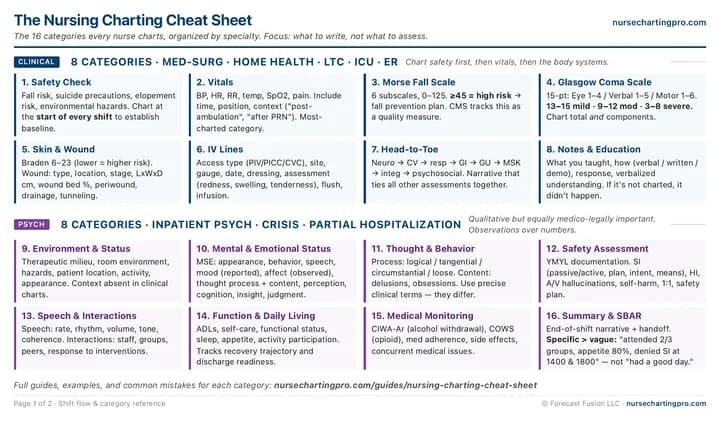
Get the free Nursing Charting Cheat Sheet
- All 16 charting categories, clinical and psych, with what to write for each
- Morse, Braden, Glasgow Coma Scale and SBAR at a glance
- The charting mistakes that cost nurses their licenses
Braden Scale scoring looks simple on paper - 6 subscales, add them up, get a risk level. Then you try to score your first patient and realize the subscales are harder than they look. Is this patient "occasionally moist" or "very moist"? "Walks occasionally" or "chairfast"? I was stuck on my first three Bradens during my rotation. Here's the framework that finally let me score them in under 90 seconds once I'd done a few.
Why This Matters
Regulatory bodies: Centers for Medicare & Medicaid Services (CMS), The Joint Commission, National Pressure Injury Advisory Panel (NPIAP)
- The Braden Scale for Predicting Pressure Sore Risk — Bergstrom N, Braden BJ et al. Nurs Res. 1987;36(4):205-210 (1987)
- Pressure Injury Prevention Clinical Practice Guideline — National Pressure Injury Advisory Panel (NPIAP) (2019)
- Increased bacterial burden and infection: NERDS and STONEES — Sibbald RG, Woo K, Ayello EA. Adv Skin Wound Care. 2006;19(8):447-461 (2006)
- Hospital-Acquired Conditions (HACs) - Pressure Ulcer Quality Measures — Centers for Medicare & Medicaid Services (2024)
- Preventing Pressure Ulcers in Hospitals: A Toolkit — Agency for Healthcare Research and Quality (AHRQ)
What the Braden Scale Measures
How to score each subscale
Each subscale features 3 or 4 descriptive levels. Use the standardized descriptors rather than your interpretation of what "moderate" means.
Sensory perception (1-4)
Moisture (1-4)
Activity (1-4)
Mobility (1-4)
Nutrition (1-4)
Friction and shear (1-3)
Braden Risk Interpretation and Intervention Thresholds
Wound Documentation - The 6 Components
A complete wound assessment has 6 components. Document each one every time you assess the wound.
Wound Type and Stage
Wound Measurements
Wound Bed Composition
Wound Edges
Exudate
Periwound Skin
NERDS and STONEES - Infection Identification
Common Mistakes
Documenting Braden Total Without Subscale Scores
A Braden score of 14 can indicate very different clinical situations. Poor mobility combined with poor nutrition requires different interventions than issues related to moisture and friction. The subscales guide the selection of appropriate interventions.
Scoring based on the patient's usual status, not current state
Braden measures risk RIGHT NOW, not the patient's baseline. A normally ambulatory patient who is currently bedfast has the pressure injury risk of a bedfast patient.
Wound Measurements Without Consistent Orientation
Specifying orientation allows the next nurse to reproduce the measurement accurately. Consistency is essential for tracking whether the wound is improving or worsening.
Wound Bed Composition That Doesn't Total 100%
Wound bed percentages must total 100%. Any deviation represents a mathematical error that undermines the credibility of the assessment.
"Wound healing well" as the only documentation
"Healing well" is an opinion. The strong version is observable data. Opinions can't be trended or legally defended; measurements can.
Missing the Braden on Admission
The Braden assessment serves as an admission evaluation at most institutions. A gap between admission and the first Braden score indicates a survey finding and poses a litigation risk, suggesting that the patient's pressure injury risk was not assessed promptly.
Case Example
Scenario
You're the day shift nurse on a medical floor. Mrs. Wallace was admitted yesterday from an extended care facility for pneumonia. She has a history of CVA with residual right-sided weakness and is chairfast at baseline. A Stage 2 sacral pressure injury was noted on the admission skin assessment. You are performing your 0800 Braden and wound assessment.
Chart Entry
0800 Braden Scale Assessment: Braden 11 (high risk) - Sensory 3, Moisture 3, Activity 2, Mobility 2, Nutrition 2, Friction 2.
• Sensory 3: responds to voice but cannot always communicate discomfort (right-sided neglect post-CVA)
• Moisture 3: episodes of incontinence overnight; skin moist twice during the last 8 hours
• Activity 2: chairfast, unable to bear weight independently
• Mobility 2: unable to reposition self; requires maximum assistance for turns
• Nutrition 2: ate 40% of breakfast; on an oral diet, poor appetite since admission
• Friction 2: requires moderate assistance for transfers; potential for sliding

Interventions per high-risk bundle: Q2h turning initiated. Pressure-redistributing mattress in place. Heel protectors applied bilaterally. Nutrition consult placed. Offloading sacrum during chair sitting. Next Braden reassessment at 2000 or with a change in status.

0800 Wound Assessment - Sacrum: Stage 2 pressure injury, sacral. 2.8 cm × 1.9 cm × 0.2 cm depth (head to foot × side to side). No undermining or tunneling. Wound bed 100% pink granulation - no slough, no eschar. Wound edges attached, no epibole. Periwound skin intact with minimal erythema (approximately 0.5 cm border). Scant serous exudate, no odor. Pain 2/10 at rest, 4/10 with repositioning - pre-medicated with acetaminophen 650mg PO at 0730. NERDS/STONEES: 0/5 NERDS criteria positive, 0/7 STONEES criteria positive. No signs of infection. Hydrocolloid dressing reapplied per wound care orders.
Key points from above chart entry
- Braden with clinical reasoning:
- Each subscale includes the score AND the clinical observation that justifies it - makes the assessment defensible.
- Score-to-intervention link:
- The intervention section directly connects the Braden 11 (high risk) to the specific bundle implemented.
- Complete wound assessment:
- All 6 components documented: type/stage, measurements with orientation, bed composition, edges, exudate, and periwound.
- NERDS/STONEES explicit:
- Infection screening documented as specific criteria counts, not just "no infection."
- Pain documented:
- Wound-related pain at rest and with repositioning, plus pre-medication - demonstrates proactive pain management.
Pro Tips
- Score the Braden at the End of Your Assessment, Not the Start: Once you complete your head-to-toe assessment, you will have all the necessary information: sensory status, moisture, activity level, mobility, nutritional intake, and friction risk. The gait and mobility you observed also feed the Morse Fall Scale. Scoring while you gather data can lead to errors.
- Re-measure wounds the same way every time: Same tape position, same anatomical reference points, same head-to-foot and side-to-side orientation. Consistency is what makes measurements trendable. An inconsistent measurement technique makes it impossible to track healing.
- Take wound photos if your institution allows them: A photo combined with measurements provides stronger documentation than measurements alone. Many EHRs now support wound photography. If yours does, use it; a picture with a measurement ruler in the frame represents the standard.
- NERDS is Superficial, STONEES is Deep: These acronyms identify different types of wound infections. Mixing them up misidentifies the infection pattern and can lead to inappropriate treatment. NERDS (3/5 positive) indicates a superficial bacterial burden, while STONEES (3/7 positive) signifies a deep and surrounding tissue infection.
- Braden 18 is still "mild risk," not "no risk": It's easy to dismiss a higher Braden score as not needing intervention. Even patients scoring 15-18 (mild risk) benefit from standard prevention measures: pressure-redistributing surfaces and regular repositioning. "Not at risk" doesn't start until 19 or above.
Step by Step
- Score each Braden subscale using standardized descriptors: Assess and score all 6 subscales: sensory perception (1-4), moisture (1-4), activity (1-4), mobility (1-4), nutrition (1-4), and friction/shear (1-3). Base scores on the patient's current state, not baseline.
- Calculate total and determine risk level: Add the 6 subscales (range 6-23). Map the total to the risk level: severe ≤9, high 10-12, moderate 13-14, mild 15-18, not at risk ≥19. Implement the intervention bundle per your facility's protocol.
- Assess the wound using all 6 components: Assess the wound by documenting the type and stage, measurements (length × width × depth, with orientation), wound bed composition (totaling 100%), edges, exudate characteristics, and periwound skin condition.
- Screen for infection using NERDS/STONEES: Evaluate the NERDS criteria (5 items) for superficial infection and the STONEES criteria (7 items) for deep infection. Document the specific criteria that are positive.
- Document the complete assessment with interventions: Document the Braden score and all subscales, the wound assessment including all 6 components, the interventions implemented, and the time for the next scheduled reassessment.
Frequently Asked Questions
- What is the Braden Scale used for?
- The Braden Scale predicts pressure injury risk. It is a 6-subscale tool (sensory perception, moisture, activity, mobility, nutrition, friction/shear) with total scores from 6 to 23. Lower scores indicate higher risk. Most US hospitals require a Braden assessment on admission and each shift for at-risk patients.
- What Braden score is considered high risk?
- A Braden score of 10-12 indicates high risk. A score of 9 or below indicates severe risk. However, thresholds and intervention bundles vary by facility; always follow your facility's specific protocol.
- How do you measure a wound correctly?
- Measure a wound's length (head to foot), width (side to side), and depth in centimeters. Document undermining and tunneling using clock position and depth. Always use the same anatomical orientation and measurement technique to ensure measurements are trendable.
- What does NERDS stand for in wound care?
- NERDS stands for Non-healing wound, Exudate increasing, Red friable granulation, Debris in the wound, and Smell, the five signs of superficial wound infection. If 3 of 5 criteria are positive, superficial bacterial burden is suspected. STONEES is the companion tool for deep or surrounding tissue infection.
Get the free Nursing Charting Cheat Sheet
- All 16 charting categories, clinical and psych, with what to write for each
- Morse, Braden, Glasgow Coma Scale and SBAR at a glance
- The charting mistakes that cost nurses their licenses
Chart faster with Nurse Charting Pro
Tap through your assessments during the shift and get a draft of your note to review at clock-out. Your notes are cleared from your phone at the end of your shift.
Related Guides
- SBAR Nursing HandoffWound status and Braden trends play a crucial role in any skin-related SBAR.
- Glasgow Coma Scale ChartingPair with wound assessment for comprehensive head-to-toe documentation in med-surg and neuro patients.
- Nursing Charting Cheat SheetAll charting categories appear in one scannable reference.
- Clinical Nursing Charting: The Complete GuideAssessing skin and wounds forms a core category in clinical charting. Explore how Braden scoring integrates into the overall framework.
- charting mistakes that risk your licenseUndocumented pressure injuries that are present on admission create a CMS HAC liability, representing one of the most costly documentation gaps.