AI medical scribes and AI nursing notes tools are everywhere now, and many claims sound too good to be true. "Generate a complete nursing note in seconds!" "AI that charts for you!" Meanwhile, your compliance officer sends emails about not putting patient data into ChatGPT, and your nursing school barely mentioned AI documentation. You find yourself wanting to save time on charting while fearing the loss of your license. This page provides an honest breakdown of what these tools actually do, the real HIPAA risks, and how to evaluate any AI scribe or charting tool before using it.
Video coming soon — subscribe to be notified when new episodes drop.
Why This Matters
Regulatory bodies: HIPAA Privacy Rule (45 CFR Part 164), HIPAA Security Rule (45 CFR Part 164), Office of the National Coordinator for Health IT (ONC), Institutional IT and Compliance Policies
AI-assisted documentation intersects healthcare regulation, data privacy law, and institutional policy. The HIPAA Privacy Rule governs the use and disclosure of protected health information (PHI); sending patient data to an AI tool constitutes a disclosure that must be covered by a Business Associate Agreement (BAA). The HIPAA Security Rule requires administrative, physical, and technical safeguards for electronic PHI, applying to any software that interacts with patient data. The ONC's Health IT framework establishes interoperability and safety standards that increasingly encompass AI-generated clinical content. The FDA has expressed interest in regulating clinical decision support tools, though most documentation-only AI tools currently fall outside FDA jurisdiction. The AMA's policy on augmented intelligence in medicine emphasizes that AI should enhance, not replace, physician and clinician judgment. For nurses, the most relevant aspect is your institution's IT and compliance policy: even a HIPAA-compliant tool may be prohibited if your employer's IT department has not approved it. Using an unauthorized tool with patient data, regardless of the tool's compliance posture, can violate policy and potentially breach HIPAA.
HIPAA Privacy Rule — U.S. Department of Health and Human Services (HHS) (2024)
The phrase "AI nursing notes" describes various types of tools. Understanding the three main categories will help you evaluate any product you encounter.
Ambient Listening Tools
These tools use a microphone (on a phone, badge, or room device) to record the nurse-patient encounter, then employ speech recognition and AI to generate a note from the audio. The appeal is clear: you talk to your patient as usual, and the tool produces documentation. However, the HIPAA concern is significant: the tool records a clinical encounter and transmits audio to a cloud server for processing. These tools require a signed BAA with the vendor, explicit patient consent per your facility's policy, and IT department approval. The audio data must encrypt in transit and at rest, and the vendor's data retention policies must comply with HIPAA. Ambient tools are gaining traction in physician documentation but are less common in nursing workflows, where charting is more structured and less narrative-driven.
Structured-Input-to-Narrative Tools
These tools allow you to select clinical findings from structured options (checkboxes, dropdowns, toggle selections), then use AI to generate a professional narrative note based on your selections. You serve as the clinical decision-maker, assessing the patient and choosing the findings. The AI's role involves formatting and language generation, not clinical assessment. NurseChartingPro falls into this category: you select findings in the app, and the AI generates a narrative note. NCP stores PHI locally on the device with AES-256 encryption and destroys the encryption key at the end of the shift. The chart data model has no fields for patient name, Medical Record Number (MRN), or date of birth, so structured selections sent to the AI carry no direct identifiers; free-text fields you type are transmitted verbatim and are treated as PHI for facility deployments under a Business Associate Agreement and Zero Data Retention configuration. However, NCP has limitations: the AI output is only as accurate as your selections, the generated note must undergo review before use, and the tool does not integrate directly with hospital EHR systems. The structured-input approach is generally safer from a HIPAA perspective because the tool does not handle free-text patient narratives or audio recordings - but "generally safer" does not equate to "automatically compliant." You still need to verify the tool's data handling.
A critical HIPAA warning: never paste patient information into consumer AI tools like ChatGPT, Google Gemini, or Claude. These tools lack a BAA with your healthcare organization, and any PHI you enter constitutes a HIPAA violation, regardless of how good the output appears. This is the most common AI-related HIPAA mistake nurses make today.
Template and Boilerplate Generators
These tools use AI to generate standard phrases, sentence starters, or complete template notes that you then customize for your patient. Some integrate into EHR systems as "smart phrases" or "auto-text" generators. The AI does not work with your specific patient's data; it generates generic clinical language for you to adapt. The HIPAA risk is lower because no PHI enters the AI system, but the clinical risk differs: generic templates can promote copy-paste documentation that fails to reflect the individual patient's actual findings. Template tools save time on formatting but do not address the core documentation challenge of capturing what you actually assessed.
HIPAA Compliance: The 3-Question Test
Before using any AI tool with patient information, ask these three questions. If you cannot answer "yes" to all three, do not use the tool with PHI.
Is Patient Data Sent to the Cloud?
Determine whether the tool processes data locally on your device or sends it to a remote server. If data leaves your device, you disclose it to a third party, triggering HIPAA requirements. Some tools process everything locally, ensuring no data leaves the device. Others send data to a cloud API for processing, while some only transmit de-identified data. The answer matters because it dictates the level of HIPAA coverage required. Local-only processing offers the safest architecture from a HIPAA perspective, but even local tools must encrypt stored data and protect against unauthorized access. If the tool sends any data to a server, proceed to question 2.
Is There a Signed Business Associate Agreement?
If the tool sends PHI to a third-party server, the vendor must have a signed BAA with your healthcare organization (not with you personally - with the covered entity). A BAA is a legal contract that requires the vendor to protect PHI according to HIPAA standards, report breaches, and limit data use. Without a BAA, any PHI sent to the vendor is an unauthorized disclosure. Many AI tool vendors will claim they are "HIPAA-compliant" on their website. This is not the same as having a signed BAA with your specific organization. The BAA must be executed between the vendor and your employer's legal/compliance team.
Has Your Employer Authorized the Tool?
Even if a tool is genuinely HIPAA-compliant and has a signed BAA, your hospital's IT and compliance policies may not permit its use. Most healthcare organizations maintain an approved software list, and using unapproved tools, even with good intentions, can violate institutional policy and jeopardize your employment. Before installing or using any AI charting tool, consult your compliance officer or IT department. This step takes five minutes and protects you from a policy violation that could affect your job and your license.
What AI Can Actually Do (and What It Cannot)
Setting realistic expectations about AI charting tools protects you from over-reliance and unnecessary fear.
What AI Can Do
AI excels at formatting and generating language. It can take structured clinical data - your assessment findings - and produce a grammatically correct, professionally worded narrative note. It flags missing documentation elements to ensure completeness. By using standardized language across notes, it maintains consistency. Additionally, it saves time by eliminating the manual typing of repetitive documentation structures. These capabilities address significant pain points in nursing documentation, particularly the time burden of charting, which studies estimate consumes 25-40% of a nurse's shift.
What AI Cannot Do
AI cannot assess a patient. It was not present in the room, did not see the wound, hear the lung sounds, or observe the patient's affect. AI lacks the ability to exercise clinical judgment; it cannot determine that a VIP score of 2 means the IV should be relocated or that a patient's flat affect combined with social withdrawal suggests a safety concern. AI cannot catch clinical errors in your assessment; if you select the wrong finding, it will generate a polished note containing incorrect information. AI cannot guarantee compliance with your facility's documentation standards, which may differ from its training data. Furthermore, AI cannot take responsibility for the note; the documentation is yours, your name is on it, and you are accountable for its accuracy. Every AI-generated note must undergo your review, and you must edit it if necessary before it becomes part of the patient's medical record.
Nurse scribes and point-of-care documentation
Two terms get used alongside "AI nursing notes" that mean specific things worth pinning down before you evaluate any tool.
What a nurse scribe actually is
A nurse scribe is a role, not a product. Traditionally a medical scribe was a human (often a pre-med or paramedic) who followed a physician during patient visits and entered notes into the chart so the clinician could focus on the patient. Nurse scribe usage is narrower: some ER and clinic settings employ scribes to keep up with nursing documentation during high-volume shifts. When a vendor says "AI nurse scribe" or "AI medical scribe for nurses," they mean software that tries to fill that same documentation-in-real-time role - typically by listening to the encounter (ambient listening tools from the categories above) or by generating a note from structured input you select during the visit. The question to ask any AI scribe is the same one you would ask a human scribe: who is accountable for the note, and does the output match what actually happened in the room.
Point-of-care documentation vs end-of-shift charting
Point-of-care (POC) documentation means charting at the bedside while the event is still fresh - ideally while the patient is still in front of you. End-of-shift or retrospective charting is the opposite: you save your notes until 1830 and try to reconstruct what happened across 12 hours from memory, from your brain sheet, and from the chart. The difference is not preference; POC documentation produces more accurate notes, fewer missed findings, fewer late charting addenda, and better legal defensibility. The trade-off is obvious: POC charting slows the bedside workflow unless the documentation tool is fast enough to keep up with patient contact.
How AI fits into the POC workflow
This is where AI scribe and AI nursing notes tools make their real value argument: they try to close the gap between "chart at the bedside" and "spend 10 minutes at a workstation typing a narrative." An ambient listening tool records the interaction and generates a draft note the nurse edits and signs before leaving the room. A structured-input-to-narrative tool (like NurseChartingPro) lets the nurse tap findings during the assessment and generates a polished narrative within seconds - still at the bedside, still before the next patient. Both categories aim at the same goal: POC-quality documentation without the POC time cost. The safety and HIPAA questions from the 3-question test above still apply to every one of these tools, regardless of how fast the note generation feels.
The 5-Question Evaluation Checklist
Evaluate any AI charting tool using these five questions before you proceed. This framework applies regardless of the specific tool, vendor, or category.
1. HIPAA compliance - Does the tool handle PHI? If so, does the vendor have a signed BAA with your organization? Is data encrypted during transit and at rest? What is the data retention policy?
2. Employer authorization - Has your IT department and compliance officer approved this tool for use with patient data? Is it included on your organization's approved software list?
3. Data handling - Where does the data go? Is it processed locally or sent to a cloud server? If cloud-based, which server, in which country, and who has access? Is patient data used to train the AI model? Can you delete data upon request?
4. Output quality - Does the AI-generated note accurately reflect your clinical findings? Is the language suitable for your specialty and setting? Does the output require significant editing, or is it usable with minor review? Does it adhere to your facility's documentation format?
5. Accountability - What occurs if the AI generates an incorrect or misleading statement that you miss during review? Who holds liability? Does the tool include a mechanism for flagging uncertain or low-confidence outputs? Is there a clear audit trail showing which content was AI-generated versus manually entered?
If a tool fails on questions 1 or 2, stop there. If it passes the first two but struggles on questions 3-5, proceed with significant caution and keep your compliance officer informed.
Common Mistakes
Using ChatGPT or Consumer AI with Real Patient Data
❌Weak: Pasting a patient's assessment into ChatGPT and asking it to "write a nursing note for this patient."
✅Strong: Using an approved, HIPAA-compliant tool authorized by your organization, or writing the note manually.
Consumer AI tools like ChatGPT, Google Gemini, and Claude do not have a Business Associate Agreement (BAA) with your healthcare organization. Entering any patient information into these tools constitutes an unauthorized disclosure of PHI, which violates HIPAA. Although the output may appear professional, the process of generating it breaches federal law. This mistake is currently the most common AI-related HIPAA violation in healthcare.
Assuming "AI-powered" Means "HIPAA-compliant"
❌Weak: Installing an AI charting app based solely on claims of being "built for healthcare" and "secure."
✅Strong: Consult your compliance officer, verify BAA status, confirm IT approval, and review the tool's data handling documentation before use.
Marketing language does not determine compliance. Many tools claim a healthcare focus without the necessary infrastructure, agreements, or policies for HIPAA compliance. Verify compliance by checking the BAA status with your organization and confirming IT authorization.
Letting AI Replace Clinical Thinking
❌Weak: Accepting an AI-generated note without reviewing it because "the AI is likely correct."
✅Strong: Reviewing every AI-generated note against your actual assessment findings, correcting any inaccuracies, and approving the final version before submission.
AI generates text based on patterns rather than clinical judgment. If you select the wrong finding, the AI will confidently produce an incorrect note. If the AI invents a detail (adds something you did not select), the note may appear professional but contain fabricated information. Your name is on the note, so review everything.
Not Checking Institutional IT Policy Before Installing a Tool
❌Weak: Downloading an AI charting app on your personal phone and using it during your shift without telling anyone.
✅Strong: Always check with IT and compliance before installing any tool that will access patient data, even on a personal device.
Most healthcare organizations have acceptable use policies that govern what software can be used with patient data. Using an unauthorized tool - even a good one - can result in disciplinary action, regardless of the tool's own compliance posture. Five minutes with your compliance officer can save your job.
You heard about a new AI charting app called "SmartNurse Notes" from a coworker. It promises to "generate complete nursing notes from voice recordings in 30 seconds." Before installing it, you apply the 5-question evaluation checklist.
Chart Entry
Evaluation: SmartNurse Notes

Question 1 - HIPAA compliance: The app records voice audio during patient encounters and sends it to a cloud server for AI processing. The website says "HIPAA-ready" but does not mention a signed BAA. Searched the vendor's legal page - no BAA template available, no mention of BAA process. RED FLAG: PHI (voice recordings of patient encounters) is sent to a cloud server without a clear BAA framework.

Question 2 - Employer authorization: Checked with charge nurse - this app is not on the hospital's approved software list. IT department has not evaluated it. Compliance officer has not reviewed it. RED FLAG: Unauthorized tool.

Question 3 - Data handling: The privacy policy states that "de-identified data may be used to improve our AI models." It does not specify how de-identification is performed, whether recordings are deleted after processing, or where servers are located. RED FLAG: Vague data handling with potential model training on clinical audio.

Question 4 - Output quality: Cannot evaluate - did not install the app because it failed Questions 1 and 2.

Question 5 - Accountability: Cannot evaluate - did not install the app.

Decision: DO NOT INSTALL. Too many red flags. PHI would be sent to an unauthorized cloud service without a BAA, and the tool is not approved by the organization. Reported the app to the compliance officer for awareness in case other staff members are using it.
Key points from above chart entry
Stopped at Question 2:
The checklist is designed to stop early if the first two questions fail. Evaluating output quality or accountability is unnecessary for a tool that cannot be used legally or per policy.
"HIPAA-ready" is not "HIPAA-compliant":
Marketing language like "HIPAA-ready," "built for healthcare," or "secure" does not guarantee that the vendor has a signed BAA with your organization. Only a signed BAA satisfies the HIPAA requirement for third-party PHI disclosure.
Reported to compliance:
If you identify a tool that other staff members might be using inappropriately, reporting it to compliance protects your colleagues from an inadvertent HIPAA violation, rather than being a whistleblower.
Voice recordings are PHI:
Any recording of a clinical encounter contains PHI by definition. The patient's voice, their symptoms, and their responses to assessment questions are all protected health information that cannot be sent to an unauthorized third party.
Model training on clinical data:
If a vendor uses clinical data to train their AI models, that data use must be disclosed and covered by the BAA. Vague language about "de-identified data" for "service improvement" raises concerns - proper de-identification under HIPAA requires either expert determination or safe harbor methods, and most vendors do not specify which they use.
Pro Tips
💡
Consult Your Compliance Officer Before Using Any AI Tool: Consulting your compliance officer is the most protective action you can take. A five-minute conversation will clarify whether a tool is approved, if a BAA is in place, and whether any institutional restrictions exist. If the response is "I don't know," it indicates that the tool is "not yet approved."
💡
Local-only processing offers the safest architecture: Tools that process and store data entirely on your device, without sending PHI to a cloud server, present the lowest HIPAA risk profile. When no PHI leaves the device, third-party disclosure and BAA requirements for the AI processing itself do not apply. Although this does not ensure automatic compliance - the stored data still requires encryption and access controls - it significantly reduces the largest category of risk.
💡
Never Paste PHI into Consumer AI Tools: ChatGPT, Google Gemini, Claude, Copilot, and other consumer AI tools lack a BAA with your healthcare organization. Entering any patient information - names, diagnoses, assessment findings, medications, or anything that could identify a patient - into these tools constitutes a HIPAA violation. No exceptions exist. If you want to practice with AI tools, use only fictional patient data.
💡
Always review AI-generated output before using it: Review every AI-generated note against your actual assessment findings before including it in the patient's record. AI can produce plausible-sounding text that may contain errors, omissions, or fabricated details. As the clinician of record, your name appears on the note. Read it, edit it if necessary, and approve it deliberately.
💡
Structured-input tools are most aligned with good charting practice: Tools that require selecting specific clinical findings, rather than recording or transcribing free-form speech, reinforce systematic assessment habits. You must think through each finding and select it deliberately, mirroring the structured assessment process that leads to effective documentation. The AI then manages the formatting and language - the aspects of charting that consume time but do not require clinical judgment.
Frequently Asked Questions
Are AI nursing notes HIPAA-compliant?
Whether AI nursing notes are HIPAA-compliant depends on the specific tool. "AI nursing notes" refers to a category rather than a single product, and compliance varies widely across tools. Key factors include whether the tool sends protected health information (PHI) to a cloud server (and if so, whether a Business Associate Agreement, or BAA, is in place with your organization), whether data is encrypted in transit and at rest, the vendor's data retention and model training policies, and whether your employer has authorized the tool. Tools that process data locally on-device without sending PHI to a server present the lowest risk profile. Conversely, tools that transmit audio recordings or patient data to cloud servers require a signed BAA and approval from your IT department. No tool is automatically HIPAA-compliant simply because it is marketed to healthcare.
Can AI replace nursing documentation?
No, AI cannot replace nursing documentation. AI can assist with documentation by formatting structured data into narrative notes, checking for completeness, and saving time on repetitive charting tasks. However, AI cannot assess patients, exercise clinical judgment, or take responsibility for the accuracy of a note. The nurse remains the author of record and is accountable for every statement in the documentation. AI-generated notes must undergo review and approval by the nurse before they become part of the medical record. Consider AI as a documentation tool, similar to speech-to-text or smart phrases; it aids in the mechanical aspects of charting but does not replace the clinical thinking behind it.
What is the safest type of AI charting tool?
From a HIPAA and data privacy perspective, the safest type of AI charting tool processes and stores all patient data locally on the device, without sending protected health information (PHI) to a cloud server. This approach eliminates the risk of unauthorized third-party disclosure and reduces Business Associate Agreement (BAA) requirements. However, "safest" does not imply "automatically safe"; even local-only tools must encrypt stored data and implement access controls. Among tools that do send data to a server, structured-input-to-narrative tools, which allow you to select findings for the AI to generate the note, are generally safer than ambient listening tools that record audio, as they handle less sensitive data types. Always verify with your compliance officer, regardless of the tool's architecture.
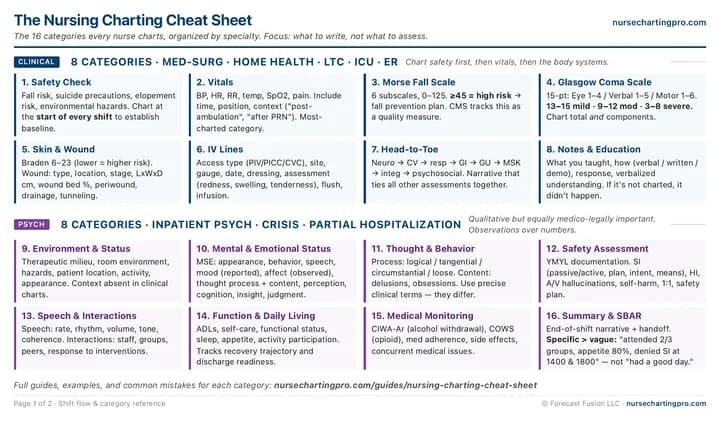
Get the free Nursing Charting Cheat Sheet
All 16 charting categories, clinical and psych, with what to write for each
Morse, Braden, Glasgow Coma Scale and SBAR at a glance
The charting mistakes that cost nurses their licenses
Tap through your assessments during the shift and get a draft of your note to review at clock-out. Your notes are cleared from your phone at the end of your shift.