You stare at the narrative note text box at the end of your shift, wondering whether you need to repeat everything you just charted in structured fields. I felt the same way - I would spend 20 minutes rewriting my vital signs, assessment checkboxes, and medication administration times into paragraph form. It felt redundant because it was. The narrative note serves a different purpose than structured fields, and once you understand this difference, the text box becomes less intimidating.
Video coming soon — subscribe to be notified when new episodes drop.
Why This Matters
Regulatory bodies: American Nurses Association (ANA), The Joint Commission, State Nurse Practice Acts
The narrative nursing note tells the "story" of the shift. Structured fields capture discrete data points - vital signs, assessment checkboxes, medication times - but fail to convey clinical reasoning, context, or the connections between events. Regulators expect both types of documentation. The ANA's Principles of Nursing Documentation establish that nursing records must reflect the nursing process, including assessment, planning, intervention, and evaluation. The Joint Commission standards require documentation to support continuity of care across transitions. State Nurse Practice Acts define documentation as a legal duty; your note serves as your professional account of what happened and what you did about it, including the reasoning. When a chart is reviewed months or years later, structured fields display the data, while the narrative note reveals the nurse's judgment.
Structured fields and narrative notes serve different purposes, and writing a good shift summary begins with understanding their boundaries. Structured fields capture discrete, searchable data such as vital sign values, assessment checkboxes, medication administration times, fall risk scores, and wound measurements. These fields let other clinicians and quality teams extract specific data points without sifting through paragraphs of text; billing systems pull from the same fields. In contrast, the narrative note conveys the meaning behind the data, including clinical reasoning, the timeline of events, and the connections you made as the nurse at the bedside. For example, if a patient's blood pressure trended up, and you repositioned them, rechecked in 15 minutes, and it came back down, the structured fields display two BP readings. The narrative illustrates the clinical decision-making that occurred in between. The rule is to avoid duplicating structured data in the narrative. If the vital signs are already charted in their own fields, do not rewrite them in the note. Instead, reference them when relevant to the story: "BP elevated at 1030, see vitals flowsheet; repositioned and rechecked at 1045 with improvement" - then move on. The narrative adds context rather than copies.
The 5 Elements of a Narrative Note
Every end-of-shift narrative note must include these five elements. While the order can vary, all five should be present.
Shift Overview
Begin with the patient's identity, the shift you're covering, and the patient's general status at the start. This approach immediately orients the reader. Include the patient's disposition (voluntary/involuntary for psych, ambulatory/bed rest for clinical), level of care, and any standing monitoring orders such as Q15 checks, 1-to-1 observation, or enhanced observation. If the patient remained stable and unchanged from the previous shift, state that. If any changes occurred at shift start, mention them. Establishing this baseline provides context for everything that follows. Keep this section to 1-2 sentences.
Key Events
Document anything that deviated from the expected plan of care, time-stamped. A pain spike that required PRN intervention. A behavioral escalation. A new order from the provider. A fall. A family meeting. A change in diet or activity level. If nothing happened - the patient was stable all shift with no changes in condition or plan - you still say that, because "uneventful" is clinically meaningful information. The key events section is where chronological time-stamping matters most. "At 1030, patient reported..." is far more useful than "during the shift, patient reported..." Specificity protects you and informs the next nurse.
Assessment Findings
Summarize the relevant clinical or behavioral findings from your shift, focusing on what changed or what's clinically significant. You're not rewriting the full assessment - the structured fields already have that. You're pulling out the findings that tell the story: "Mental status exam notable for flat affect and psychomotor retardation, unchanged from prior shift" or "Surgical site clean, dry, and intact with no signs of infection; pain well controlled at 3/10 at rest." Link the findings to the patient's trajectory. Are they improving, stable, or declining? That one-sentence summary is often the most valuable line in the entire note.
Interventions and Response
For every key event, document what you did and how the patient responded. This is where the nursing process is - assessment led to intervention, intervention led to outcome. If you gave a PRN medication, document the indication, the time, and the follow-up assessment. If you de-escalated a behavioral situation, document the techniques used and whether they were effective. If you notified the provider, document who you contacted, what you reported, what orders were given, and whether you carried them out. The response piece is the part most notes miss. "Administered Tylenol 650mg PO at 1030" is an intervention. "Administered Tylenol 650mg PO at 1030 for pain 7/10; reassessed at 1100, pain reduced to 3/10, patient resting comfortably" is the complete clinical picture.
Plan for Next Shift
Conclude with what the oncoming nurse needs to know to ensure a safe handoff. Include pending orders, upcoming procedures, expected provider callbacks, monitoring changes, discharge planning updates, and unresolved family concerns. Write the plan section with the perspective of what you would want to know if you were walking in cold. Handoff priorities belong here - items that cannot wait until the next nurse reads through the entire chart. If the patient is on enhanced observation, clarify why. If a medication was held, indicate when it should be reconsidered. If a family member is expected to visit and has specific concerns, flag it. This section serves as the bridge between your shift and the next.
Chronological vs. By-System
Two common structures exist for organizing a narrative note, and the right choice depends on the shift. A chronological structure presents the shift as a timeline: it begins with the start-of-shift status, follows with events in order, and concludes with the end-of-shift plan. This approach works best when the shift features a clear sequence of events - such as a change in condition, an intervention, a response, and a follow-up. The story has a natural arc, and chronological order preserves it. In contrast, a by-system structure organizes the note by body system or assessment domain: cardiovascular, respiratory, neurological, pain, psychosocial, and safety. This method suits complex patients with multiple active problems that lack a single timeline, such as an ICU patient or a patient with several concurrent issues where chronological order would jump confusingly between topics. Most general med-surg and psych notes function better chronologically because the shift typically involves one or two main events worth narrating. Complex ICU and multi-system patients often benefit from by-system organization. There's no rule against mixing the two; a chronological note with a by-system summary paragraph at the end serves as a reasonable hybrid for a busy shift.
What to Include vs. What to Leave Out
The narrative note should provide clinical context without duplicating the structured record.
Include in the Narrative
Document clinical changes and their timeline. Describe the interventions you performed and the patient's response. Explain your clinical judgment and reasoning - why you took specific actions. Note provider notifications and the resulting orders. Include communication with the patient and family that affected the plan of care. Record anything that deviates from the expected course. Update discharge planning. Highlight handoff priorities for the oncoming nurse.
Leave Out of the Narrative
Avoid routine vital signs already documented in the flowsheet (reference them if relevant, but do not rewrite them). Omit medication administration times already recorded in the MAR. Exclude assessment checkbox data present in the structured assessment. Do not include personal opinions about the patient's character or personality. Instead of subjective judgments about whether the patient is "difficult" or "non-compliant," describe the observed behavior. Use exact quotations from the patient sparingly and only when the specific wording is clinically relevant (for example, direct quotes of suicidal statements are appropriate; direct quotes of casual conversation are not).
Observation-based Language
The same rule applies across all clinical documentation: describe what you observed, not what you interpreted. "Patient was agitated" represents an interpretation. In contrast, "Patient pacing in hallway, raised voice, clenching fists" constitutes an observation. Observations are defensible in court and useful for the next nurse. Interpretations are opinions that another nurse might dispute. This distinction is particularly important in behavioral descriptions and pain assessments. Instead of saying "patient was drug-seeking," write "patient requested PRN pain medication 4 times during shift; see pain reassessment documentation." Rather than stating "patient was non-compliant with treatment," write "patient declined morning medications, stating 'I don't want to take those.' Provider notified." You can still include your clinical judgment; that belongs in the assessment findings section. Frame it as your assessment, not as a character trait of the patient. For example, "Assessed as escalating toward behavioral emergency based on pacing, raised voice, and refusal to return to room" is clinical judgment stated professionally, while "Patient was being difficult and aggressive" is not.
Common Mistakes
Repeating structured field data in the narrative
❌Weak: Vitals at 0800: BP 122/78, HR 76, RR 18, SpO2 98%, Temp 98.4. Vitals at 1200: BP 118/74, HR 72, RR 16, SpO2 99%, Temp 98.2. Vitals at 1600: BP 120/76, HR 74, RR 18, SpO2 98%, Temp 98.6. Medications administered: Metoprolol 25mg PO at 0900, Lisinopril 10mg PO at 0900...
✅Strong: Vital signs remained stable throughout the shift - see flowsheet. Morning medications were administered per MAR without issue. The narrative emphasizes the pain management concern that developed mid-shift (see Key Events below).
The narrative adds context and clinical reasoning. Copying data from structured fields into paragraph form wastes your time and the reader's. Reference the structured data and spend your words on what it means.
"Patient had a good shift" as the entire note
❌Weak: Patient had a good shift. No complaints. Resting comfortably.
✅Strong: Patient stable throughout shift. Disposition: voluntary, cooperative with treatment plan. No changes in condition or plan of care. Monitoring: Q15 checks maintained, patient accounted for at all checks. Plan: continue current orders, no pending issues for night shift.
Even a stable, uneventful shift has elements worth documenting: disposition, monitoring compliance, and confirmation that the plan of care is unchanged. "Good shift" is subjective and gives the next nurse nothing to work with.
Writing the Narrative at the End of Shift from Memory
❌Weak: I think the patient said something about pain around... maybe 11? And I gave him something for it. The doctor was called at some point in the afternoon.
✅Strong: At 1030, the patient reported sharp R knee pain 7/10 with ambulation. PRN Tylenol 650mg PO administered at 1035. Reassessed at 1100: pain 3/10, ambulating independently. Provider notified at 1415 regarding persistent mild swelling; ordered ice and elevation, continue monitoring.
Memory becomes unreliable after a 12-hour shift. Without jotting down notes during the shift, your narrative will lack the time-stamps, specifics, and sequence that enhance its usefulness. Take brief notes throughout the shift and write the narrative based on those notes.
Missing a Change in Condition
❌Weak: Patient resting quietly at end of shift. Vital signs within normal limits.
✅Strong: At 1400, the patient became increasingly confused and unable to state the date (oriented x3 at the start of the shift, now oriented x1). Vital signs rechecked: BP 158/92, HR 98. Provider notified at 1410; ordered STAT CT head and basic metabolic panel. Results pending at shift change - flagged as handoff priority.
Documenting a change in condition is crucial in a narrative note. If the patient's status changed during your shift and your note does not reflect it, the medical record has a gap. Include the change, your assessment, your intervention, and the current status.
Using interpretive language ("difficult and non-compliant")
❌Weak: Patient was difficult and non-compliant throughout the shift. Refused to cooperate with staff.
✅Strong: Patient declined morning medications at 0900, stating "I don't want to take those - they make me feel sick." Education provided regarding medication purpose and side effects. Patient continued to decline. Provider notified at 0930; order changed to alternative medication. Patient accepted alternative at 1000 without further concerns.
Labeling a patient as "difficult" or "non-compliant" can be subjective and may negatively impact their future care. Document specific behaviors you observed, the patient's stated reasons if provided, your interventions, and the outcomes. This approach is factual, defensible, and clinically useful.
Case Example
Mr. ChenAge 68 — post-op day 2, R total knee arthroplasty
fictional patient
Scenario
You're the day shift nurse (0700-1900) for Mr. Chen, a 68 year old on post-op day 2 after right total knee arthroplasty. He started the shift stable, with pain controlled at 2/10 on his current regimen. At 1030, he reported a sharp pain spike to 8/10 during ambulation in physical therapy. You intervened with PRN medication and reassessed; the issue stayed managed for the rest of the shift. By the end of the shift, he's stable, with pain controlled and ambulating with a walker.
Chart Entry
Day shift 0700-1900. Mr. Chen, 68, post-op day 2 R total knee arthroplasty. Patient started the shift alert, oriented x4, and in no acute distress. Pain remained controlled at 2/10 at rest on the current regimen (Norco 5/325 Q6H scheduled). Surgical site clean, dry, and intact with no signs of infection; mild expected edema R knee. Compression device in place.

At 1030, patient reported sharp R knee pain 8/10 during PT ambulation session. The PT session paused. Ice applied to R knee, and the leg elevated. PRN oxycodone 5mg PO administered at 1040 per standing order. Reassessed at 1115: pain reduced to 4/10 at rest and 5/10 with gentle ROM. Patient tolerated an abbreviated PT session at 1300 with pain at 3/10 using a walker for 50 feet in the hallway. No dizziness, steady gait, and no fall risk concerns during ambulation.

Provider notified at 1130 regarding the pain spike with PT. Verbal order received: add ice PRN post-PT sessions, continue the current pain regimen, and reassess the need for scheduled dose adjustment at rounds tomorrow. Order read back and confirmed.

End of shift: patient resting comfortably, pain at 2/10 at rest. Vital signs stable - see flowsheet. Intake adequate, voiding without difficulty. Surgical site unchanged.

Plan for night shift: monitor pain level overnight, especially with repositioning. PT scheduled again at 0900 tomorrow - pre-medicate 30 minutes prior per provider. Continue ice post-activity. Watch for signs of increasing edema or wound changes at the surgical site. Provider rounding in the AM to reassess the pain management plan.
Key points from above chart entry
Shift overview:
Sets the baseline in two sentences: who, what day post-op, pain level, and wound status. No vitals recopied from the flowsheet.
Key event with intervention and response:
The 1030 pain spike is documented with timestamps, intervention (ice, PRN med), and reassessment showing improvement. This is the clinical reasoning the structured fields can't capture.
Provider notification:
Documents who was notified, what was reported, what orders were received, and read-back confirmation. This is a complete provider communication record.
Plan for next shift:
Specific, actionable items: pre-medicate before PT, ice post-activity, what to watch for, and when the provider is rounding. The oncoming nurse knows exactly what to prioritize.
Pro Tips
💡
Take Brief Notes Throughout the Shift: Keep a folded piece of paper or a note on your phone with time-stamps for significant events. Document the time, what happened, and your actions. Your end-of-shift narrative will require 5 minutes instead of 20 because you will work from notes rather than memory. Destroy any paper notes at the end of the shift, as they contain PHI.
💡
Time-stamp Every Significant Event: If something changed, document when it changed. "At 1030" is infinitely more useful than "during the shift" or "this afternoon." Time-stamps create a defensible timeline if the chart is ever reviewed. They also help the next nurse understand the sequence of events without guessing.
💡
Summarize, don't rewrite: The narrative summarizes clinical reasoning and events rather than duplicating the structured record. Reference structured data when relevant ("vital signs stable - see flowsheet") and focus on context, judgment, and plan. If you find yourself retyping numbers from the flowsheet, stop and redirect.
💡
Write the plan considering what you want to know: As the oncoming nurse entering this patient's room for the first time, consider what information you would want within the first 60 seconds. This forms your plan section. Include pending orders, critical observations, expected provider follow-ups, and any time-sensitive matters. If you wouldn't want to encounter it unexpectedly, include it in the plan.
💡
Keep routine shift notes under 400 words: A stable, uneventful shift does not need a 600-word narrative. Hit all 5 elements - shift overview, key events (or lack thereof), assessment summary, any interventions, plan - and move on. Longer notes aren't better notes. If you need more than 400 words, the shift probably wasn't routine, and the length is justified by actual events.
Frequently Asked Questions
What goes in a narrative note vs. structured fields?
Structured fields capture discrete, searchable data such as vital sign values, assessment checkboxes, medication times, and fall risk scores. In contrast, the narrative note details clinical reasoning, the timeline of events, connections between findings, provider communications, and the plan for the next shift. Avoid duplicating structured data in the narrative; instead, reference it when relevant and focus your words on providing context and judgment.
How long should a shift summary be?
Aim to keep a shift summary for a routine, uneventful shift under 400 words. Hit all 5 elements (shift overview, key events, assessment findings, interventions and response, plan for next shift) and move on. If the shift had significant events (a change in condition, multiple interventions, provider calls), the note will naturally be longer, and that is appropriate. Length should be driven by what happened, not by a desire to appear thorough.
Should the narrative be chronological or organized by system?
Whether the narrative should be chronological or organized by system depends on the shift. Chronological works best when there is a clear sequence of events: a change in condition, an intervention, a response. By-system works better for complex patients with multiple active problems that do not share a single timeline (like patients in the intensive care unit). Most general med-surg and psych notes work well chronologically. You can also use a hybrid: chronological for events, with a by-system summary paragraph at the end.
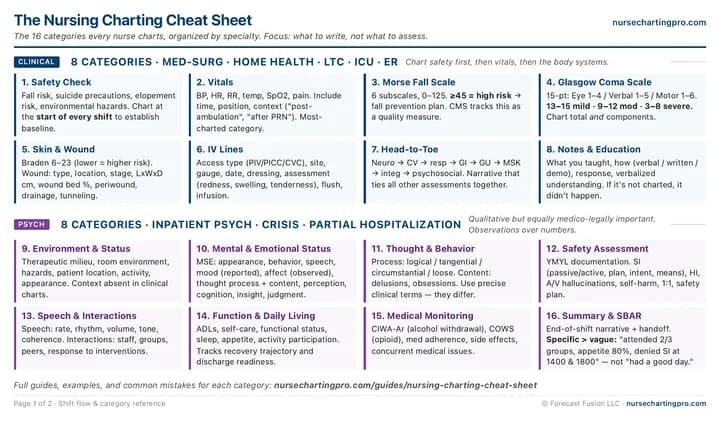
Get the free Nursing Charting Cheat Sheet
All 16 charting categories, clinical and psych, with what to write for each
Morse, Braden, Glasgow Coma Scale and SBAR at a glance
The charting mistakes that cost nurses their licenses
Tap through your assessments during the shift and get a draft of your note to review at clock-out. Your notes are cleared from your phone at the end of your shift.