By Amy Niemas, RN-BC, BSN, MSW, Clinical Content Director · Psychiatric Registered Nurse
Last updated: October 13, 2026
Psychiatric Nursing Charting: Everything You Need to Document on a Psych Unit
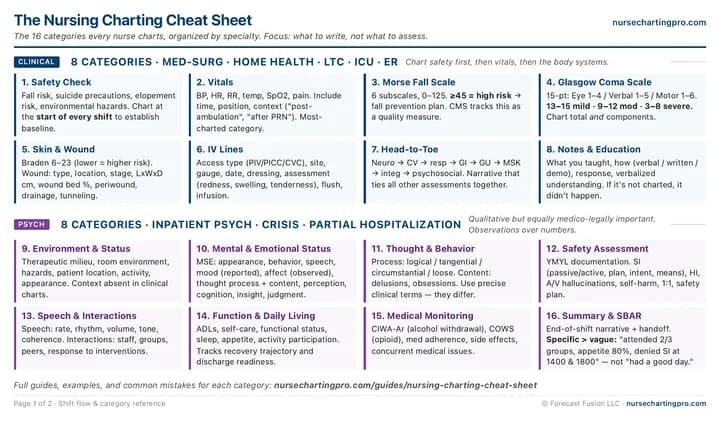
Get the free Nursing Charting Cheat Sheet
- All 16 charting categories, clinical and psych, with what to write for each
- Morse, Braden, Glasgow Coma Scale and SBAR at a glance
- The charting mistakes that cost nurses their licenses
Is Psych Nursing Right for You? A Psych Nurse Answers
Amy, a psych nurse with 11 years in the field, talks through why she chose psychiatric nursing, the violence question and what actually keeps you safe on a unit, and the traits that make someone good at psych.
Why This Matters
Regulatory bodies: Centers for Medicare & Medicaid Services (CMS), The Joint Commission - Behavioral Health Standards, State Mental Health Codes
- CMS Conditions of Participation for Psychiatric Hospitals — Code of Federal Regulations (42 CFR §482.60-62) (2024)
- Behavioral Health Care Accreditation Standards — The Joint Commission (2025)
- Practice Guideline for the Psychiatric Evaluation of Adults — American Psychiatric Association
- Psychiatric-Mental Health Nursing Scope and Standards — American Psychiatric Nurses Association (APNA) (2022)
What Makes Psychiatric Charting Different
Psychiatric charting relies on observation-based language rather than measurement-based language. This adjustment poses the most significant challenge for nurses transitioning from other medical or clinical specialties.
The 8 Psych Charting Categories
Each category provides an overview here. The detailed guides linked from each section include full details, examples, and common mistakes.
Environment & Status
Mental & Emotional Status
Thought & Behavior
Safety Assessment (the Most Important Category)
Speech & Interactions
Function & Daily Living
Monitoring
Summary & SBAR Handoff
Medication Compliance Tracking
Psychiatric medication compliance is a critical documentation category.
The "Observation vs. Interpretation" Rule
This is the single most important concept in psych charting, and the thing a med-surg nurse floating to psych most needs to learn.
Common Mistakes
Charting Interpretations as Observations
"Agitated," "manipulative," and "noncompliant" are interpretive labels. They are subjective and challengeable. The strong version documents the same situation using observable behaviors and direct quotes - a surveyor or attorney cannot argue with what the patient actually said and did.
Missing Safety Assessment at Required Intervals
Gaps in safety assessment documentation during an active SI protocol represent the most actionable finding on a behavioral health survey. If a patient elopes or self-harms during an undocumented gap, the lack of documentation indicates the absence of the intervention, and the lack of care received.
Using vague descriptors without behavioral specifics
"Calm and cooperative" could describe a sleeping patient or a patient actively engaging in care. The strong version paints a picture that another nurse reading the chart at 3 AM would understand.
Not Quoting the Patient for Significant Statements
Direct quotes are defensible and clinically useful. The phrase "expressed ambivalence" interprets the patient's words. A quote allows each subsequent reader to make their own assessment.
Incomplete 1:1 Observation Documentation
1:1 observation documentation must reflect your actual observations during each check, rather than merely stating your presence. The chart should clearly demonstrate your assessment of the patient's status and safety during every observation interval.
Pro Tips
- When in doubt, quote the patient: Direct quotes in chart entries provide defensible and clinically useful documentation. For example, "Patient stated 'I want to go home but I know I need to be here'" conveys much more strength than saying "patient expressed ambivalence about treatment." Quotes capture nuances that summaries often lose.
- Document behaviors, not diagnoses: You don't diagnose - you observe. "Patient paced for 20 minutes, checked the locked door three times, stated 'I need to get out of here'" is good charting. "Patient appears anxious and manipulative" is not. Let the behaviors speak for themselves. Making diagnoses is out of the scope of nursing practice.
- Safety assessment is the one category that you cannot skip: It needs to be done every shift with every patient and also documented at the intervals that your facility's protocol requires. Gaps in safety documentation are the #1 adverse finding on psych unit surveys. If you are running behind on charting, chart safety first and everything else second.
- Use the MSE in the same order every time: Appearance, behavior, speech, mood, affect, thought process, thought content, cognition, insight, judgment. In that order, every assessment. Consistency makes the MSE trendable over time - you can see changes from shift to shift when the format is the same.
- Specificity is always stronger than brevity: "Patient was calm" is weak. "Patient sat in recliner chair in dayroom for 45 minutes, watching TV, made no verbal statements, is breathing quietly, with no motor agitation" is strong. On a psych unit, the extra 10 seconds of specific charting is the difference between a defensible record and a questionable one.
- Document medication refusals in the patient's own words: "Refused 0800 medications, stated 'I don't like how they make me feel'" is much stronger documentation than "refused medications." The quote shows you assessed the reason and creates a foundation for the education you provide next.
Step by Step
- Complete safety assessment first: Begin each shift with a screening for suicidal ideation, homicidal ideation, and hallucinations. Document the patient's responses with direct quotes when they are clinically significant.
- Perform the Mental Status Exam: Document appearance, behavior, speech, mood, affect, thought process, thought content, cognition, insight, and judgment. Use the same order every time for consistency.
- Document environment and milieu: Document the patient's location, activity, and any environmental factors relevant to the therapeutic milieu. The context is unique to psych documentation.
- Observe and chart group and social interactions: Record speech patterns, group therapy participation, peer interactions, and responses to therapeutic interventions, including specific behavioral observations.
- Record functional status and daily living: Chart activities of daily living (ADLs), self-care, sleep patterns, appetite, and engagement in unit activities. Track changes from shift to shift as indicators of recovery or decline.
- Complete medical monitoring if applicable: Score the Clinical Institute Withdrawal Assessment for Alcohol, revised (CIWA-Ar) or the Clinical Opiate Withdrawal Scale (COWS) if the patient is being monitored for withdrawal. Document medication compliance, side effects, and concurrent medical issues.
- Reassess safety at required intervals: Document safety reassessments per your facility's protocol. Note any changes in ideation, plan, intent, or means. Update precaution level if needed.
- Write end-of-shift narrative and SBAR: Summarize your shift with safety status, behavioral observations, treatment participation, and any changes. Give the SBAR (Situation, Background, Assessment, Recommendation) handoff, prioritizing safety over vital signs.
Frequently Asked Questions
- What is the difference between psychiatric and clinical nursing charting?
- The main difference is that clinical charting records measurements (vital signs, scoring scales, lab values, and wound measurements), while psychiatric charting records observations such as behavior, thought process, mood, affect, and therapeutic interactions. Both use structured categories, but the categories differ. For a clinical nurse moving to psych, the main adjustment is shifting from measurement-based to observation-based charting.
- What is the most important category in psych charting?
- Safety assessment is the most important category in psych charting. It carries the most legal weight, is the most frequently audited category on behavioral health surveys, and has the most direct impact on patient outcomes. It needs to be done every shift, with every patient, and at the intervals that your facility's protocol requires. There are no exceptions.
- What does the Mental Status Exam (MSE) include?
- The MSE follows a standard order: appearance, behavior, speech, mood (what the patient reports), affect (what you observe), thought process, thought content, perception, cognition, insight, and judgment. This structured framework serves as the psychiatric equivalent of a head-to-toe assessment, documenting a patient's psychological presentation at a specific point in time.
- Should I use the word "manipulative" in psych charting?
- No, do not use the word "manipulative" in psych charting. It is an interpretation, not an observation. Instead, document the specific behavior: "Patient asked three different staff members for an extra snack after being told by the charge nurse that additional snacks are not available per dietary order." Observable behaviors are defensible. Labels are challengeable.
Get the free Nursing Charting Cheat Sheet
- All 16 charting categories, clinical and psych, with what to write for each
- Morse, Braden, Glasgow Coma Scale and SBAR at a glance
- The charting mistakes that cost nurses their licenses
Chart faster with Nurse Charting Pro
Tap through your assessments during the shift and get a draft of your note to review at clock-out. Your notes are cleared from your phone at the end of your shift.
Related Guides
- Nursing Charting Cheat SheetAll 16 categories (clinical + psych) for quick reference.
- Clinical Nursing ChartingThe clinical counterpart - different categories, same framework.
- CIWA-Ar DocumentationAlcohol-withdrawal scoring - the quantitative category that connects psych and clinical charting.
- COWS DocumentationOpioid-withdrawal scoring. Withdrawal monitoring is common on both psychiatric and medical units.
- SBAR Nursing HandoffThe universal SBAR framework adapts for psych-specific handoffs.
- Milieu and environment documentationDocument the therapeutic milieu and the awake/asleep gate.
- Mental status exam documentationAll 10 MSE components, including examples, and the distinction between mood and affect.
- Thought process and behavior chartingTangential vs. circumstantial, delusions, hallucinations, and observation-based language.
- SI/HI documentation and safety planningThis category represents the highest stakes: SI documentation, 1:1 observation, and safety plans.
- Speech and interactions documentationDocument the 5-dimension speech framework and group participation.
- ADL and functional status chartingDocument Activities of Daily Living with levels of independence.
- End-of-shift narrative notesLearn to write a shift summary that integrates all psychiatric categories.
- Psychiatric SBAR handoff exampleSBAR adapted for psych - mental status, safety, and legal status.
- PHQ-9 documentationThe 9-item depression screen used across psych admissions and primary care; covers item 9 escalation and severity bands.
- GAD-7 documentationThe 7-item anxiety screen most often paired with PHQ-9; covers severity bands and primary-care handoff.
- C-SSRS documentationThe Columbia Suicide Severity Rating Scale - the structured suicide risk screen used after a positive PHQ-9 item 9 or per unit safety protocol.
- Objective vs subjective data in nursingHow to chart the patient's own words apart from what you observe.
- SI/HI/AVH documentationWhat SI/HI/AVH means and how to chart a denial, a positive finding, and NSSI.