You are reading this because you made a charting mistake - or think you did - and have encountered law firm pages that suggest your license is already at risk. However, it's almost certainly not. Most charting mistakes do not end careers, though a few specific ones can. Let's separate the real risks from the anxiety so you can sleep tonight.
Video coming soon — subscribe to be notified when new episodes drop.
Why This Matters
Regulatory bodies: State Boards of Nursing, HHS Office of Inspector General, The Joint Commission, Centers for Medicare & Medicaid Services (CMS)
Nursing board disciplinary actions follow predictable patterns, primarily involving substance use, criminal convictions, falsification, and patient harm. The annual rate of discipline on a nursing license is less than 1% nationally. Pure documentation errors, which do not result in patient harm and lack a pattern, rarely trigger board action on their own. Nurses who lose their licenses for "charting" almost always fall into one of four specific categories: falsification, missed safety interventions, undocumented refusals, or ignored changes in condition. Board actions typically require a pattern rather than a single incident.
This page provides general information about nursing documentation and is not legal advice. If you face a specific complaint, investigation, or legal matter, consult a licensed attorney or nurse attorney in your state.
Yes, charting errors can threaten a nursing license. No, they almost certainly haven't threatened yours.
Nursing boards exist to protect patients, not to punish nurses. The threshold for board action is "practice-threatening" - the board has to believe the nurse poses a risk to future patients. A single charting mistake, without patient harm, without a pattern, without other concerning factors, almost never meets that threshold. The nurses who lose licenses for documentation issues almost always have additional factors: substance use, prior disciplinary history, a patient harm event, criminal charges, or a pattern of similar errors across many shifts. If your worry is "I made one mistake last shift," your risk is proportionately low. If your worry is "I've been making the same mistake for months and now there's an incident," the picture is different - talk to a nurse attorney or your union.
The Charting Mistakes That Matter
Four categories of charting errors that lead to board actions.
1. Falsification
Documenting events that didn't occur, altering records after the fact to conceal an error, copy-pasting another nurse's assessment as your own, or charting for a shift you didn't work constitutes falsification. Falsification is fraud, and fraud is a board-level offense in every US state. What counts: charting that a medication was given when it wasn't, charting that vitals were taken when they weren't, or signing off on another nurse's work as your own. What does NOT count: correcting an error with a clearly marked correction, late-charting that is honestly timestamped, or realizing you forgot something and adding it with proper time notation. The Texas Board of Nursing explicitly categorizes lying and falsification as conduct warranting disciplinary action up to license revocation. The California Board of Registered Nursing lists falsification of records as a recommended basis for license revocation.
2. Failing to Document Safety Interventions
The patient was on fall precautions but there's no documentation of those precautions being followed. The patient had SI precautions but there's no documentation of the observation intervals. If a patient is harmed and there's no documentation that the nurse implemented the required safety measures, the absence of documentation is treated as the absence of the intervention. "If it isn't charted, it didn't happen" is the legal standard, and it applies most consequentially in safety. This is the #1 category where small omissions matter - a single missed 1:1 observation entry during an SI protocol can be career-threatening if a patient elopes or self-harms during that gap. Document the structured suicide risk screen used at admission and on positive findings (commonly the C-SSRS, often triggered by a positive PHQ-9 item 9) along with the bedside response from the safety assessment guide.
3. Not Documenting Patient Refusals
A patient refused a medication, treatment, or procedure, and the nurse did not document the refusal, the education provided, or the follow-up. Undocumented refusals look like undelivered care, and undelivered care looks like neglect. The template that protects you: "Patient refused [X] at [time]. Patient stated '[direct quote].' Nurse educated patient on [rationale]. Patient acknowledged education but declined. [MD notified / reassessment scheduled / follow-up plan]." That single habit - documenting refusals with the full template - protects nurses more often than any other charting practice.
4. Missing Critical Changes in Condition
When the patient's condition changes, the nurse must notice, document the change, notify the physician, and document the notification. Sentinel event categories - failure to rescue and delayed escalation - often trace back to missed or undocumented condition changes. Document EVERY significant change in condition: the time, what you noticed, what you did about it, and the physician's response. This is why trending (vitals, GCS, pain scores) matters; trends demonstrate that you noticed.
The charting mistakes that don't actually matter
Calibration. These are things nurses panic about that almost never trigger board action.
Typos. Nurses are not fired or disciplined for typos. Correct them when you notice them.
Late entries. Legal if properly marked (e.g., "late entry for 1200 shift, documented at 1800"). Routine and expected.
Imperfect language. "Patient appears comfortable" is not elegant, but it's not a board-level offense.
Slow charting. 45 minutes to chart a full assessment on your third shift is normal. Speed comes with reps.
Needing to ask your preceptor. Asking for help is the opposite of a problem.
Forgetting a minor field and noticing later. Go back and add it with proper time notation. Boards do not punish nurses for correcting their own errors.
One bad shift where everything felt rushed. Single incidents, in the absence of patient harm, almost never reach a board.
How to Write Documentation That Protects You
Four practical rules transform routine charting into medico-legal protection.
Rule 1 - Chart in Real-Time
Real-time documentation is more accurate, more defensible, and reduces the chance of "I think I gave that medication at noon but I'm not sure." End-of-shift charting is legal but every hour of delay degrades your memory. Chart the facts while they're facts, not reconstructions.
Rule 2 - Be Specific, Not Vague
"Patient ambulated 50 feet in hallway with rolling walker, steady gait, no shortness of breath" versus "patient ambulated." "BP 142/88, trending upward from 128/76 this morning" versus "BP elevated." Specificity is the difference between "this nurse noticed" and "this nurse wrote something generic."
Rule 3 - Document Refusals with the Full Template
Include refusal, the patient's words, education provided, the patient's acknowledgment, and the follow-up plan. This single charting habit protects nurses more effectively than any other. Make it a routine practice.
Rule 4 - Write Like a Lawyer Is Reading It
Not because a lawyer probably will read your chart (they probably won't). Because the discipline of writing that way produces defensible documentation for the much more likely readers: the next nurse, the surveyor, the risk management team. Specificity + observation language + time stamps + direct quotes = the four elements of defensible charting.
Real Enforcement Examples from Public Records
Explore actual board-level charting problems. These cases are drawn from public enforcement records.
Case 1 - Falsified home visit documentation (Texas BON): A licensed vocational nurse documented wound care for a home health visit that never occurred. The nurse either created or had someone else create false documentation of the visit. The Texas Board of Nursing imposed sanctions including stipulations, mandatory remedial education, and a $250 fine. The documentation problem: an entire visit was fabricated in the chart. The lesson: falsification - even of a single visit - triggers board action.
Case 2 - Falsified records connected to a patient fall (Michigan, 2024): Tessy I. Idusuyi, a nurse in Ingham County, faced charges for falsifying medical records related to the fall of a resident under her care at a medical facility. The case was referred to the HHS Office of Inspector General. The documentation problem: after a patient safety event (a fall), the medical records did not accurately reflect what happened. The lesson: falsification after a patient harm event is treated as a criminal matter, not just a board matter.
Case 3 - Falsified neurological assessments after a patient death (Michigan, 2023): Patricia Lynn Nash, a registered nurse at a Taylor nursing home, faced two counts of intentionally placing false information on medical records. She falsified neurological assessment documentation for a patient who had previously suffered a fall and later died. The case was prosecuted by the Michigan Attorney General. The documentation problem: fabricated clinical assessments that never occurred, discovered during a post-mortem review. The lesson: falsified assessments - especially after a patient safety event with a bad outcome - are treated as criminal conduct, not just a documentation error.
These public enforcement records share a common thread: falsification, not ordinary documentation errors. The nurses who faced these consequences didn't make typos or chart late; they documented events that never happened.
If you are worried about a specific incident
Practical next steps based on your current situation.
Disclaimer: This section provides general information and is not legal advice. For your specific situation, consult a licensed attorney in your state.
If the incident just happened and nobody has said anything yet, document what you remember while it's fresh, privately for your own records (not in the chart retroactively unless you are making a proper late entry). Avoid discussing it casually with coworkers and do not alter the original chart.
If your manager has pulled you in for a conversation, listen, ask clarifying questions, and refrain from admitting or denying anything until you understand what is being asked. You may have rights under your union contract or employment agreement to have representation during the conversation.
If you receive a notice of investigation from the state board, do not respond without consulting a nurse attorney. Most state nursing associations offer low-cost or free initial consultations. Your malpractice insurance (Berxi, NSO, or equivalent) may include legal representation.
If you are facing a civil lawsuit, your malpractice insurance should be your first call.
Prevention - the frameworks that make these mistakes harder
This site focuses on prevention. Here are the most important places to start.
For safety assessment documentation (the #1 category where gaps cost licenses): see the Safety Assessment Charting guide.
For change-in-condition documentation: see the Summary & Narrative Charting guide.
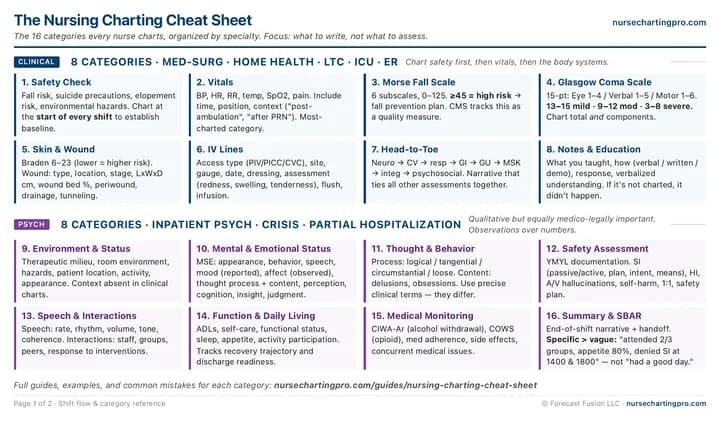
For the complete charting framework: see the Nursing Charting Cheat Sheet - all 16 categories in one scannable reference.
For specialty-specific coverage: Clinical Nursing Charting (8 clinical categories) and Psychiatric Nursing Charting (8 psych categories).
Structured charting frameworks make the dangerous mistakes - the ones catalogued on this page - harder to make accidentally. They don't make them impossible, but they make the categories visible and the gaps obvious before they become problems.
Common Mistakes
Confusing a Correction with Falsification
❌Weak: Fearing that fixing a charting error counts as "altering records."
✅Strong: Making a clearly marked correction: "Correction: previous entry stated left arm; correct site is right arm. Error noted and corrected at 1430."
Corrections and falsification differ fundamentally. A correction transparently fixes an honest error, while falsification creates or alters records to conceal what actually happened. Boards clearly distinguish between the two.
Assuming a single mistake will trigger a board investigation
❌Weak: Catastrophizing after a late entry or missed field.
✅Strong: Understanding that board actions typically require patterns, patient harm, or specific categories of misconduct - not isolated minor errors.
The NCSBN reports that the annual rate of discipline on nursing licenses is less than 1% nationally, with the overwhelming majority involving substance use or criminal convictions. Documentation errors without harm almost never lead to board actions.
Not Documenting a Refusal at All
❌Weak: The patient refused morning medications. The nurse moved on to the next patient without charting the refusal.
✅Strong: Patient refused metoprolol 25mg PO at 0800. Patient stated: "That pill makes me dizzy." Nurse educated on importance of blood pressure management. Patient acknowledged but declined. Provider notified at 0815, no new orders at this time. Will reassess at 1200.
An undocumented refusal appears identical to undelivered care. Completing the refusal template takes only 60 seconds and serves as the most frequently used charting habit for license protection.
Altering a Record After a Patient Safety Event
❌Weak: Revising the chart after a patient fall to include documentation that "should have been there."
✅Strong: If you need to add information after an event, use a proper late entry: "Late entry for 1400: [additional information]. Documented at 1630 after patient fall at 1600."
Adding information after a safety event is not inherently wrong - but it MUST be done transparently as a clearly-marked late entry. Undisclosed retroactive changes to a chart after an adverse event are the textbook definition of falsification.
Ignoring a Condition Change Due to Uncertainty
❌Weak: You notice a vital sign trend but hesitate to document it because you're unsure of its significance.
✅Strong: Document the observation: "BP trending upward over 4 hours: 128/76 at 0800, 136/82 at 1200, 148/90 at 1600. MD notified of trend at 1610, awaiting orders."
You don't need to be certain about the significance of a change to document it. Documenting the trend and notifying the provider represents the standard of care. Failing to document and allowing the patient to deteriorate can lead to malpractice claims.
Case Example
Public Record ExamplesAge 0 — Real enforcement cases, not a fictional patient
fictional patient
Scenario
This page uses real public enforcement records rather than a fictional example. The cases cited in the "Real enforcement examples" section above come from HHS OIG enforcement actions and state board disciplinary records. Refer to the topical section for full case summaries.
Chart Entry
Refer to the "Real enforcement examples from public records" section above for complete case summaries from Texas BON and two Michigan cases (HHS OIG / Michigan AG). Each case illustrates a specific category of documentation falsification that triggered enforcement action.
Key points from above chart entry
Texas BON Case:
Falsified home visit documentation - the entire visit was fabricated.
Michigan Case:
Falsified records after a patient fall - criminal charges filed.
Michigan Case (Nash):
Falsified neurological assessments after a patient fall and death - criminal charges.
Pro Tips
💡
Buy Your Own Malpractice Insurance: Consider Berxi, NSO, or a similar provider. Your employer's coverage protects the employer, not you. Individual coverage typically costs $100-$200 per year and covers legal fees if you face a board action or lawsuit. Obtaining your own malpractice insurance significantly enhances your license protection.
💡
Document Refusals as if a Court is Watching: Use the refusal template - refusal, patient's words, education, acknowledgment, and follow-up plan - as a crucial habit that consistently protects nurses. Make this process automatic. It takes just 60 seconds and could save your career.
💡
Push Back Quietly on Batch Charting Culture: If your unit's culture dictates that everyone charts at the end of the shift, recognize that real-time charting proves more defensible. You don't need to confront the culture; instead, chart your own patients in real-time. This approach results in more accurate and defensible charts.
💡
When something unusual happens, document it immediately: Don't wait for end of shift. A specific time and specific details are worth more than a polished narrative written 6 hours later. Memory decays fast. The chart should reflect what you knew when you knew it.
💡
If you ever feel pressured to falsify, escalate immediately: Falsification represents a category of charting error that can end careers with near-certainty. If a supervisor or colleague pressures you to sign off on documentation you didn't create or to chart something that didn't happen, escalate the issue to your manager, ethics committee, or union. Document the pressure you experience. Never sign off on false documentation.
Step by Step
Chart in real-time, not at end of shift: Documenting assessments, interventions, and findings as they occur enhances accuracy. Delays of even an hour can degrade this accuracy.
Use specific, observable language: Describe what you saw and heard, including any measurements. Use specific numbers and times alongside direct patient quotes rather than vague summaries.
Document every patient refusal with the full template: Record what was refused, the patient's stated reason (in their words), the education you provided, and the follow-up plan including provider notification.
Document every significant change in condition: Document the time, your observations, your actions, who you notified, and their response. Trending data, including vitals and scores, makes changes visible.
Never chart something that did not happen: If you missed an assessment or intervention, document what you did and explain why. A gap with an explanation is far better than a fabricated entry.
Make corrections transparently: Use clearly marked corrections that include accurate information. Avoid deleting or overwriting original entries. A transparent correction shows an honest fix, not a cover-up.
Review your charting before shift end: Review gaps in safety documentation, missing reassessments, and undocumented refusals. Omissions in these categories carry the most weight.
Get your own malpractice insurance: Individual coverage ($100-$200/year) provides legal representation if you face a board investigation or lawsuit. Your employer's coverage protects them, not you.
Frequently Asked Questions
Can you actually lose your nursing license for a charting mistake?
Yes, you can lose your nursing license for a charting mistake, but only for specific categories of mistakes: falsification, failing to document safety interventions, not documenting patient refusals, and missing critical changes in condition. Typos, properly marked late entries, slow charting, and imperfect language almost never trigger board action. Board discipline typically involves patterns of behavior or patient harm rather than isolated errors.
What is the difference between a charting correction and falsification?
A correction transparently fixes an honest error by clearly marking what was wrong and providing the accurate information. In contrast, falsification involves creating or altering records to conceal what actually happened. Boards, surveyors, and courts clearly distinguish between the two. Corrections serve as evidence of quality assurance, while falsification constitutes fraud.
What should I do if I think I made a serious charting error?
If you think you made a serious charting error and no one has raised the issue yet, write down what you remember privately for your own records. Avoid altering the original chart retroactively unless you are making a properly marked late entry. Refrain from discussing the matter casually with coworkers. If your manager has initiated a conversation or you have received a notice from the state board, consult a nurse attorney before responding.
Do I need malpractice insurance as a nurse?
Yes, individual malpractice insurance is worth having as a nurse. Your employer's coverage protects the employer but does not protect you personally. Individual malpractice insurance, such as Berxi or Nurses Service Organization (NSO), typically costs $100-$200 per year and provides legal representation if you face a board investigation, civil lawsuit, or disciplinary action.
Get the free Nursing Charting Cheat Sheet
All 16 charting categories, clinical and psych, with what to write for each
Morse, Braden, Glasgow Coma Scale and SBAR at a glance
The charting mistakes that cost nurses their licenses
Tap through your assessments during the shift and get a draft of your note to review at clock-out. Your notes are cleared from your phone at the end of your shift.