On the inpatient psych unit, your patient comes up from the ED with a comprehensive C-SSRS already on the chart. Your job at the shift assessment is the brief reassessment, knowing what the comprehensive screen captured, and starting immediate safety measures if your reassessment turns positive. I have walked through this scenario more times than I can count; the consistent thing that protects both the patient and the chart is keeping the bedside reassessment direct, the language non-euphemistic ("thoughts of killing yourself," not softer phrasing), and the safety response immediate. This guide explains what the C-SSRS captures and how the bedside reassessment fits. It does not replace facility policy, clinical judgment, or the C-SSRS Training Module from Columbia Lighthouse Project; complete the official training before independent administration.
Video coming soon — subscribe to be notified when new episodes drop.
Why This Matters
Regulatory bodies: 988 Suicide and Crisis Lifeline (federally designated), Joint Commission - National Patient Safety Goal 15.01.01 (Suicide Risk Reduction), Columbia Lighthouse Project (instrument owner and training source), Centers for Medicare & Medicaid Services (CMS)
A positive C-SSRS is one of the most important findings a nurse can read on or document in the chart. The federally designated 988 Suicide and Crisis Lifeline (call or text 988, chat at 988lifeline.org) is the default outpatient and discharge handoff resource and should appear in every C-SSRS chart entry that includes a discharge or community-handoff plan. Posner and colleagues developed the C-SSRS in 2011 and validated it across three multisite studies in adolescents and adults; the Columbia Lighthouse Project distributes the instrument and the free training. Joint Commission NPSG 15.01.01 (effective July 1, 2019) requires accredited behavioral health care organizations to document an evidence-based risk assessment, a documented overall risk level, and a mitigation plan for any positive screen; the R3 Report Issue 18 (the implementation guidance for that standard) lists the C-SSRS as one of the validated screening tools that meet the requirement. The instrument is a screen, not a diagnosis. The Behavior section is where charting most often falls short, because the questions ask about lifetime history (a prior attempt, prior preparatory acts, prior NSSI) and the answers stay with the patient. A "yes" answer captured at any point becomes a permanent part of the patient's documented history, because the event itself does not un-happen. The ideation questions are different: they assess the current state, and a patient who endorsed active ideation at one encounter may screen negative at the next. That is why pulling a patient's prior C-SSRS results into the next admission matters as much as completing a fresh ideation assessment. Nothing in this guide overrides the escalation rules, observation-level decisions, or unit-specific safety protocols documented in your facility's policy or in the safety assessment guide; this page covers the instrument mechanics and the documentation pattern, not the clinical decision rules that follow a positive screen.
The C-SSRS (Columbia Suicide Severity Rating Scale) is a structured suicide risk screening instrument that walks the clinician through two sections: 5 Suicidal Ideation questions and 5 Suicidal Behavior categories. Posner and colleagues validated the instrument in 2011 through three multisite studies involving adolescents and adults. The Columbia Lighthouse Project distributes both the instrument and free training. Clinicians widely adopt it across psychiatric inpatient units, emergency departments, primary care, schools, and clinical-trial protocols.
Multiple versions of the instrument exist, and your facility's choice depends on the setting and patient population. The Screener is the brief version most bedside nurses encounter; it includes the 5 ideation gateway questions, the 5 behavior categories, and a brief intensity rating. The full Risk Assessment Page incorporates protective factors, lethality of past attempts, and a structured risk-tier output; in most inpatient settings, the full Risk Assessment Page is completed by the admitting provider, social worker, or nurse practitioner, not bedside nursing staff. The Lifetime/Recent version asks ideation over the past month and behavior over the lifetime, with a past-3-month follow-up on any positive behavior (the validation window from the 2011 Posner study). The Since Last Visit version focuses only on the period since the last C-SSRS administration; this is the shorter follow-up version used at subsequent shift assessments and outpatient follow-up visits, so the patient is not re-asked about lifetime history every shift. The Pediatric version is for patients under 18 and adapts the language for adolescents; this guide focuses on adult administration, leaving pediatric C-SSRS out of scope.
Printed item count varies by template. The Columbia Screener has 5 ideation items plus the behavior section. Some EHRs, the Veterans Administration CPRS for example, split the plan-and-intent item into two yes/no questions (plan, then intent). The clinical content is the same in both layouts. If you open another nurse's C-SSRS note and see six ideation items rather than five, that is the same instrument with the plan and intent split.
Follow the version specified by your unit policy. Document which version was administered (e.g., "C-SSRS Screener, Lifetime/Recent") so the next reader can interpret the timeframe accurately. A "negative" Since Last Visit screen does not imply a "negative" Lifetime screen, and failing to name the version in the chart entry forces the next reader to guess.
Who Administers the C-SSRS in Inpatient Care
In most US inpatient settings, the comprehensive C-SSRS Risk Assessment is completed by the admitting provider, the consulting social worker, or a nurse practitioner, typically within 24 hours of admission per institutional policy aligned with Joint Commission and CMS expectations. Bedside nursing staff most often work with a brief ideation screen at admission and at subsequent shift reassessments: the gateway questions (question 1, wish to be dead; question 2, active thoughts of killing yourself) and, when positive, the bedside follow-up about plan, intent, and access to means. The full Behavior section (actual attempt, interrupted, aborted, preparatory, suicide) and the intensity ratings are part of the comprehensive assessment in the provider's H&P or social work consult note, not in the routine nursing assessment.
This page describes the full instrument so nurses can read what is on the chart, recognize what a positive screen captures, and know what to look for during shift reassessment. It is also written for the nurses who do administer the comprehensive C-SSRS in their roles: psychiatric ED nurses, behavioral health consult nurses, certain consult-liaison roles, and many outpatient psych practices. Match the depth of your administration to your role and your facility policy. If your unit's protocol says "complete C-SSRS at admission" and a provider has already done it, your job is the brief reassessment, not re-administering the full instrument every shift.
When the brief reassessment is positive, especially when the patient endorses active intent (question 4) or a specific plan and intent (question 5), initiate immediate safety measures within nursing scope: 1:1 observation per unit policy, environmental precautions, sharps and medication restriction. The provider notification is not a precondition for the safety measures; it triggers orders, documentation, and the next-level assessment. Notify the provider and document the notification, but do not wait for a return call before keeping the patient safe.
Make the provider call a warm handoff. Give a verbal report in person or by phone that names four things: the highest endorsed item, the patient's direct quote, the safety measures already in place, and the timeframe for the comprehensive evaluation. The Veterans Administration CPRS Screener prints this expectation on every positive screener: "Warm handoff for CSRE." When the patient endorses intent or a worked-out plan, this verbal handoff is the standard of care. Sending an order set or writing a referral without speaking to the provider does not meet that standard.
The 5 Ideation Questions, Walked Top Down
The Ideation section begins with two gateway questions. If both responses are negative, the clinician moves to the Behavior section. If question 2 is positive, the clinician proceeds to questions 3, 4, and 5 in order.
Question 1 - Wish to Be Dead
Use the official C-SSRS Screener wording: "Have you wished you were dead or wished you could go to sleep and not wake up?" The patient endorses a wish to be dead or to fall asleep and not wake up, without considering killing themselves. This question addresses passive ideation. A "yes" response here triggers the rest of the ideation section in many institutional protocols, even though question 2 serves as the technical gateway, because passive ideation is a documented clinical concern.
Question 2 - Non-Specific Active Suicidal Thoughts
Use the official C-SSRS Screener wording: "Have you actually had any thoughts of killing yourself?" Use these exact words; do not paraphrase or soften the question. Direct phrasing is the validated probe, and a clinician who paraphrases ("any thoughts of hurting yourself" or "thoughts of not wanting to be here") is asking a different question than the one Posner and colleagues validated. The patient endorses general thoughts of wanting to end their life or kill themselves, without specific methods, intent, or plan during the assessment period. Question 2 is the gateway: a "yes" response triggers questions 3, 4, and 5; a "no" response along with a "no" on question 1 concludes the ideation section and directs the clinician to the Behavior section.
Question 3 - Active Ideation with Methods (No Plan, No Intent)
Use the official C-SSRS wording: "Have you been thinking about how you might do this?" The patient has considered at least one method during the assessment period but has not developed a specific plan with time, place, or details, and reports no intent to act. Document the method the patient describes in their own words. In the chart, write the finding in clinical language ("active ideation with method, no plan, no intent; patient mentioned overdose on home medications without further detail") rather than as a question-number reference ("endorsed question 3"). A question-number alone does not stand on its own in a defensible chart entry; the clinical description does.
Question 4 - Active Ideation with Some Intent, No Specific Plan
Official C-SSRS wording: "Have you had these thoughts and had some intention of acting on them?" The patient endorses thoughts about killing themselves AND reports some intent to act on those thoughts, even without a fully formed plan. The distinction between question 3 and question 4 is intent, not plan. A positive response to question 4 is a documented escalation point in most institutional protocols; document the patient's words, initiate immediate safety measures within nursing scope (1:1 observation per unit policy, environmental precautions), and notify the provider. The provider notification is for orders and the next-level assessment; the safety measures do not wait on the return call. Many EHR templates print an alert when this question is answered yes: "this POSITIVE answer requires same-day completion of a Suicide Risk Evaluation-Comprehensive." Treat a positive response to this question as a same-day evaluation trigger, not a routine notification.
Question 5 - Active Ideation with Specific Plan and Intent
Official C-SSRS wording: "Have you started to work out or worked out the details of how to kill yourself? Do you intend to carry out this plan?" The patient endorses a specific plan with details fully or partially worked out AND some intent to carry it out. This is the most severe ideation item, and on most units a positive response to question 5 means the patient is placed on 1:1 observation immediately, before the provider call-back. Document the plan in the patient's words, the access to means as the patient describes it, the timeframe the patient identifies, the immediate safety measures you initiated, and the provider notification.
Some templates split this question into two yes/no items. The Veterans Administration CPRS is the standard example: one item for the plan ("Have you started to work out or worked out the details of how to kill yourself?"), one for intent ("If yes, at any time in the past month did you intend to carry out this plan?"). The clinical content is the same in both layouts. Capture both pieces in the chart, the worked-out method and the intent. On the CPRS template both items generate the same-day-evaluation alert; treat either positive as a same-day trigger.
Charting the Highest Endorsed Question
A defensible chart entry names the highest item the patient endorsed in clinical language, not in question-number shorthand. For example: "C-SSRS Screener, Lifetime/Recent: patient endorsed active suicidal ideation with method (no plan, no intent); denies ideation with intent or specific plan." This is more useful than "C-SSRS positive" or "endorsed question 3" because the next reader can immediately see the severity the patient described without having to look up a question number. Use the C-SSRS structure to organize your interview; use plain clinical language to write the chart.
The 5 Behavior Categories (Comprehensive C-SSRS)
This section describes the Behavior portion of the comprehensive C-SSRS Risk Assessment. In most US inpatient settings, this section is administered by the admitting provider, social worker, or nurse practitioner, not by bedside nursing staff. Bedside nurses who do not administer the comprehensive instrument should still understand what these categories capture, because the results live in the chart and inform the level of safety reassessment expected each shift. Behavior questions ask about lifetime events; a "yes" stays yes because the event itself does not un-happen. The wording shown below is the official probe wording from the adult Columbia C-SSRS Baseline/Screening (Version 1/14/09), which has used direct phrasing such as "kill yourself" and "end your life" since the original 2009 publication. The Columbia Children's Baseline/Screening (Version 6/23/10) offers softer alternative wording (for example, "make yourself not alive anymore") as developmentally appropriate phrasing for pediatric administration; that pediatric phrasing is out of scope for this adult-focused guide.
Actual Attempt (with NSSI Sub-Question)
The Behavior section opens with the actual attempt probes from the adult C-SSRS: "Have you made a suicide attempt? Have you done anything to harm yourself? Have you done anything dangerous where you could have died? What did you do?" An actual attempt is a potentially self-injurious act committed with some wish to die, regardless of whether injury occurred. Even if the act was interrupted in a way that produced no harm, intent is what classifies it. The clinician follows up to differentiate suicidal intent from non-suicidal self-injurious behavior (NSSI) using the instrument's NSSI sub-question: "Or did you do it purely for other reasons / without ANY intention of killing yourself (like to relieve stress, feel better, get sympathy, or get something else to happen)?" If the patient endorses self-injury without suicidal intent, the chart entry is "Non-Suicidal Self-Injurious Behavior (NSSI), no actual attempt." This distinction matters: NSSI and suicidal behavior differ conceptually and clinically, and conflating them misleads the next reader.
Interrupted Attempt
Official adult C-SSRS wording: "Has there been a time when you started to do something to end your life but someone or something stopped you before you actually did anything?" The patient took steps toward an attempt but was stopped by an external circumstance (someone removed the means, the means failed, or an external event prevented completion). A classic example is a person with pills in hand who is stopped from ingesting; once the pills are ingested, it becomes an actual attempt rather than an interrupted one.
Aborted or Self-Interrupted Attempt
Official adult C-SSRS wording: "Has there been a time when you started to do something to try to end your life but you stopped yourself before you actually did anything?" The patient took steps toward an attempt and stopped themselves before any self-destructive behavior occurred. The structural difference from an interrupted attempt is that the patient stopped rather than being stopped by something external. Both carry clinical weight and are documented separately.
Preparatory Acts or Behavior
Official adult C-SSRS wording: "Have you taken any steps towards making a suicide attempt or preparing to kill yourself (such as collecting pills, getting a gun, giving valuables away or writing a suicide note)?" Preparatory acts include anything beyond verbalization or thought: assembling a method (buying pills, purchasing a firearm) or preparing affairs (giving things away, writing a suicide note, finalizing wills). Preparatory acts without an attempt still represent imminent risk and are documented as such.
Suicide
The fifth Behavior category captures whether the patient died by suicide since the last assessment. This is not a question asked of the patient; it is recorded based on outcome. In a living-patient encounter, the entry is straightforward: "Suicide: not applicable, patient alive at assessment." The category exists in the instrument because clinicians also use C-SSRS retrospectively after a patient death.
Warning Signs, Risk Factors, and Protective Factors (Comprehensive Risk Assessment)
The comprehensive evaluation does not stop at ideation and behavior. It also captures three sections that frame the rest of the chart: warning signs, risk factors, and protective factors / reasons for living. The provider, social worker, or NP fills these in on the comprehensive C-SSRS or its equivalent. The bedside nurse reads them off the H&P or consult note and uses them to frame the rest of the shift.
Warning signs are what is currently present and can change between shifts. The Veterans Administration Comprehensive Suicide Risk Evaluation (CSRE) template lists them as: preparations for suicide, anger, anxiety, guilt or shame, hopelessness, sleep disturbance, escalating substance use. They drive the immediate safety plan.
Risk factors are the enduring picture: recent psychosocial stressors (housing instability, loss, financial crisis, relationship rupture), psychological conditions (active mood episode, psychosis, severe anxiety, substance use disorder), trauma history, access to lethal means. These travel with the patient across encounters and inform the chronic-risk picture rather than the acute response.
Protective factors and reasons for living are what is keeping the patient safe. The CSRE captures them as a checklist: engagement with health care, motivation for treatment, family relationships, significant other, child-related responsibilities, strong desire to live. This is not a soft "the nurse asked about family" line. It is part of the risk picture, and it shapes both the safety plan and the discharge plan. A patient with active ideation and a specific reason to live (a child, a treatment goal, a faith commitment) is in a different position than one with active ideation and nothing named.
At the bedside, ask the patient about protective factors and quote the answer in the chart ("patient identifies her 8-year-old daughter and her commitment to next week's outpatient therapy as her reasons for living"). The three-section pattern (warning signs, risk factors, protective factors and reasons for living) mirrors the CSRE structure and is a defensible way to organize the comprehensive entry.
Risk Stratification: What the Instrument Describes
The Screener does not produce a single numeric "risk score" like some other instruments. Instead, the chart entry compiles: (1) the highest endorsed ideation question, (2) any positive behavior categories, (3) recency (within the past 3 months is a documented risk window in the Posner 2011 validation), and (4) intensity of ideation (frequency, duration, controllability, deterrents, reasons for ideation, the subscales captured by the full instrument).
Many institutions categorize the resulting picture into three tiers: low (passive ideation only, no recent behavior), moderate or intermediate (active ideation with method but no plan or intent, no recent behavior), and high (intent or specific plan and intent, or any behavior in the past 3 months). Civilian charting commonly uses "moderate"; Veterans Administration and Department of Defense documentation uses "Intermediate" for the same middle tier. Your facility policy defines the specific term and the tier-to-action mapping. This page outlines what the instrument captures; the safety assessment guide and your unit's suicide prevention protocol detail the actions triggered by the chart entry, including observation level, sitter orders, environmental precautions, and provider notification.
Most comprehensive evaluations rate two dimensions, not one: Acute Risk and Chronic Risk. Each scored Low, Intermediate, or High with an "as evidenced by" rationale. This is the Veterans Administration and Department of Defense pattern, and most civilian inpatient psych units use the same. Acute risk is right now: current ideation severity, recent behavior, active warning signs, and access to means. Chronic risk is the longer picture: history of attempts, persistent risk factors, baseline lethality. The two diverge often. A patient with a remote prior attempt and stable functioning might be Low Acute / Intermediate Chronic. A patient with a worked-out plan today but no prior attempts might be High Acute / Low Chronic. Both ratings appear in the comprehensive note, and both feed the mitigation plan. Acute risk drives the immediate disposition (1:1, hold, transfer, environmental precautions); chronic risk drives the longitudinal plan (ongoing therapy, meds, peer support, follow-up frequency). State both ratings at handoff.
Many systems also have a high risk for suicide flag in the chart. In the Veterans Administration system, it is the Patient Record Flag Category I High Risk for Suicide. In civilian EHRs, it shows up as a banner, an alert, or a problem-list flag. The flag is set by the suicide prevention coordinator or the behavioral health consult team when the patient meets system-defined high-risk criteria, and it stays on the chart until those criteria are no longer met. The flag tells the next reader that the risk has been formally classified at the system level.
Descriptive language matters in suicide risk documentation. Chart "patient endorsed active ideation with method (no plan, no intent), no behavior in the past 3 months, consistent with the moderate risk tier described in our unit suicide prevention protocol" instead of "patient is moderate risk and requires Q15 observation." The first sentence describes what the instrument captured; the second prescribes a clinical action that may or may not align with unit policy at this hospital, on this shift, or for this patient.
C-SSRS vs. PHQ-9 Item 9 vs. ASQ vs. SAFE-T
Several validated suicide risk tools are in active clinical use, and they fit together rather than competing. PHQ-9 item 9 is a single-item screen for suicidality that is inside the depression screen; a positive item 9 is a documented escalation trigger in most protocols, and the standard escalation is to administer C-SSRS or another structured suicide risk instrument. The full PHQ-9 documentation pattern is covered in the related PHQ-9 documentation guide.
The Ask Suicide-Screening Questions toolkit (ASQ), developed by NIMH, is a 4-question screen designed for medical settings (ED, inpatient, outpatient) and is shorter than the full C-SSRS. ASQ is a brief screen that, when positive, also escalates to a fuller assessment such as C-SSRS. The Suicide Assessment Five-Step Evaluation and Triage (SAFE-T) is SAMHSA's framework for the clinical assessment that follows a positive screen and includes risk stratification and management planning. SAFE-T is widely cited in policy and training materials, but in practice the framework is built into whatever risk-assessment template your facility uses (often the comprehensive C-SSRS Risk Assessment Page or the Veterans Administration CSRE), so most bedside nurses interact with the underlying template rather than a standalone SAFE-T form.
C-SSRS is in the middle of this stack: it is the structured screening and assessment instrument that follows a positive PHQ-9 item 9 or ASQ, and that feeds into the SAFE-T management framework. For everyday inpatient psych and acute-care use, the most common pattern is PHQ-9 on admission, C-SSRS when item 9 is positive (or per unit protocol), and SAFE-T (or the equivalent risk-assessment section of your facility's template) for the resulting assessment and plan. The related safety assessment guide documents the bedside follow-up after any positive screen.
C-SSRS Documentation in NurseChartingPro
NurseChartingPro captures the suicidality flag in the Safety category. When the patient endorses any suicidal ideation, mark the yes/no flag on the safety assessment screen positive. The flag itself populates the chart automatically; do not re-enter the flag in the notes. In the Notes field, document the brief context that the flag does not capture on its own: as appropriate, the highest level of ideation endorsed in clinical language, the patient's direct quote, the immediate safety measures initiated, and the provider notification. The full comprehensive C-SSRS Risk Assessment (the Behavior section, the intensity scale, lethality of past attempts) is documented by the admitting provider, social worker, or NP in the H&P or in the consult note, not in routine nursing notes. The Notes pattern is: brief assessment outcome (negative, or positive at level X), patient quote on positive findings, safety measures initiated, and provider notified.
Common Mistakes
Skipping the Behavior Section When Ideation Is Negative (Comprehensive C-SSRS)
❌Weak: C-SSRS administered, ideation negative.
✅Strong: C-SSRS Screener, Lifetime/Recent administered. Ideation: gateway questions both negative. Behavior section: actual attempt negative, NSSI sub-question negative, interrupted attempt negative, aborted/self-interrupted negative, preparatory acts negative. No behavior in the past 3 months per patient.
This applies when administering the comprehensive C-SSRS (typically the admitting provider, social worker, or NP). The Behavior section asks about lifetime events; a patient with no current ideation can still report a prior attempt, prior NSSI, or prior preparatory acts. Skipping the behavior questions due to negative current ideation overlooks the historical risk data the instrument captures.
Charting "C-SSRS Positive" Without the Severity
❌Weak: C-SSRS positive.
✅Strong: C-SSRS Screener: patient endorsed active suicidal ideation with method (thinking about overdose on home medications), no plan, no intent. Behavior section per admitting H&P (completed by admitting provider). 1:1 observation initiated. Provider notified, awaiting consult.
A "C-SSRS positive" entry tells the next reader something was endorsed but not what or at what severity. The chart entry should describe the highest level of ideation endorsed in clinical language (for example, "active ideation with method") and the patient's direct quote. Question-number shorthand alone ("endorsed question 3") does not carry the chart. Action documentation (1:1 observation, provider notification, consult orders) belongs as its own sentences after the C-SSRS finding, not as a comma-joined tail of the finding sentence; the C-SSRS captures what the patient endorsed, the action sentences capture what the unit did in response.
Re-Asking About Lifetime History Every Shift
❌Weak: C-SSRS Lifetime/Recent re-administered at every shift assessment, including re-asking about prior attempts each time.
✅Strong: Comprehensive C-SSRS Lifetime/Recent completed on admission per H&P. Subsequent shift reassessments use the brief Since Last Visit ideation screen; lifetime behavior history pulled forward from prior chart entries rather than re-asked.
Re-asking about prior attempts every 12 hours is re-traumatizing and is not the intended use of the instrument. The comprehensive Lifetime/Recent assessment is typically completed once on admission; subsequent reassessments focus on current ideation and any new behavior since the last visit. Lifetime behavior history carries forward from the original chart entry.
Treating the C-SSRS as a Diagnosis
❌Weak: Patient shows high suicide risk per C-SSRS. Diagnosis: suicidality.
✅Strong: C-SSRS Screener: patient endorsed active ideation with intent to act, no behavior in the past 3 months. Findings consistent with the high risk tier outlined in our unit suicide prevention protocol. 1:1 observation initiated. Provider notified for clinical assessment.
The C-SSRS describes the pattern the patient endorsed; it does not establish a clinical diagnosis. "Suicidality" is not a DSM diagnosis. Document what the instrument captured and let the clinical interview that follows (completed by the provider) establish whatever diagnosis or formulation applies.
Confusing NSSI with Suicidal Behavior (Comprehensive C-SSRS)
❌Weak: Patient endorsed self-injury behavior. C-SSRS positive for behavior.
✅Strong: C-SSRS Behavior section: actual attempt negative. NSSI sub-question positive: patient describes a history of cutting forearms "to feel something, not to die," beginning at age 16, last episode 2 years ago. Interrupted, aborted, and preparatory all negative.
The Behavior section's lead question specifically asks about acts committed with some wish to die. The clinician then asks the NSSI sub-question to differentiate suicidal from non-suicidal self-injury. Charting NSSI under the actual attempt category mislabels the clinical history and may lead to an inappropriate intervention.
Treating a Positive Intent or Plan Response as a Routine Notification
❌Weak: Patient endorsed active ideation with intent. Provider contacted, awaiting return call.
✅Strong: C-SSRS Screener: patient endorsed active suicidal ideation with intent ("I really do want to die, I just have not done it yet"); plan and intent not endorsed. 1:1 observation initiated at 0945 per unit policy; sharps and personal items secured. Warm handoff to on-call psychiatrist by direct phone at 0950: highest endorsed item (active ideation with intent, no plan), verbatim quote, safety measures in place. Same-day comprehensive C-SSRS Risk Assessment requested per unit protocol; behavioral health consult ordered to bedside.
A positive response to intent (question 4) or plan and intent (question 5) is a same-day comprehensive-evaluation trigger in Joint Commission aligned protocols. The Veterans Administration CPRS Screener prints this expectation on every positive: "this POSITIVE answer requires same-day completion of a Suicide Risk Evaluation-Comprehensive." Sending a non-urgent page or message and waiting for a return call delays the comprehensive evaluation, delays the orders, and leaves the patient at higher risk in the gap. The chart entry should name the warm handoff and the same-day expectation, not just the message.
Bedside Reassessment Charted as "Denies SI" Alone
❌Weak: Patient denies SI.
✅Strong: Brief safety reassessment this shift: patient denies suicidal ideation, denies plan, denies access to means. No change from admission C-SSRS (Lifetime/Recent on file from admitting H&P). Patient verbalized understanding of safety plan. Q15 observation maintained per current order.
A bedside reassessment of "denies SI" alone does not show what was asked or that you screened the patient. Even when the brief reassessment does not re-administer the full instrument, the chart entry should name the question asked, the patient's response, and the relationship to the existing C-SSRS results on file. A surveyor cannot determine from "denies SI" whether any reassessment occurred.
Case Example
Mrs. ChenAge 38 — Postoperative day 1 after laparoscopic hysterectomy, transferred to med-surg overnight; admitting provider completed PHQ-9 (total 14, item 9 positive) and the comprehensive C-SSRS Lifetime/Recent at admission per unit policy
fictional patient
Scenario
I am the day shift med-surg nurse for Mrs. Chen, a fictional 38 year old transferred to my unit overnight after a laparoscopic hysterectomy. The admitting provider completed the PHQ-9 (total 14, item 9 marked "several days") and the comprehensive C-SSRS Lifetime/Recent at admission; both are documented in the H&P. The patient is alert, oriented, and hemodynamically stable, with pain 2/10, and is in no acute distress. As the receiving nurse, my job at the 1000 assessment is to review what is on the chart, do a brief suicidal ideation reassessment, document my findings alongside the existing C-SSRS, and confirm the safety measures the provider ordered are in place.
Chart Entry
1000 Brief Suicide Risk Reassessment:

Reviewed admitting C-SSRS (Lifetime/Recent, completed by admitting provider at 0230, see H&P): patient endorsed wish to be dead and active thoughts of killing herself without method, plan, or intent at admission. Behavior section negative (no prior attempt, no NSSI, no preparatory acts). Plan from H&P: Q15 observation, behavioral health consult ordered, environmental precautions in place.

Bedside suicidal ideation reassessment this shift:
Asked: "Are you having any thoughts of hurting yourself or wanting to die today?"
Patient stated: "Sometimes I think my family would be better off without me, especially since the diagnosis. But I am not thinking about how I would do anything."
Finding: passive ideation present, consistent with admission. Denies plan, denies intent, denies access to means (purse and personal items secured at admission per protocol). Patient identifies spouse, sister, and 8 year old daughter as reasons for living.

Safety measures verified in place: Q15 observation, sharps secured, medications double locked, no contraband found on intake. Spouse aware of admission and named as designated support contact.

Provider notified via secure message at 1015 of stable presentation; behavioral health consult still expected within 24 hours per H&P.

Plan: continue Q15 observation per current order; reassess suicidal ideation at 1400 and at shift handoff. Patient education: discussed coping skills and began working on a written safety plan with the patient; 988 Suicide and Crisis Lifeline (call or text 988, chat at 988lifeline.org) included in discharge education materials.
Key points from above chart entry
Comprehensive C-SSRS done by admitting provider, not the floor nurse:
The H&P shows the admitting provider completed the comprehensive C-SSRS (ideation, behavior, and intensity) at admission. The floor nurse reads what is on the chart and does the brief reassessment, not the comprehensive instrument.
Brief reassessment in clinical language, not question numbers:
The bedside reassessment uses plain clinical language ("passive ideation present, consistent with admission; denies plan, intent, means") rather than question-number shorthand. The question numbering is for the comprehensive form; the chart entry stands on its own clinical wording.
Patient quote captured verbatim:
When the brief reassessment is positive, the patient's direct quote is the strongest and most accurate piece of the chart entry. The next nurse, provider, or clinician who reads the chart can see what the patient actually said.
Safety measures verified, not re-decided:
The chart confirms the safety measures the provider ordered at admission are in place. The nurse did not "decide" the observation level; she verified it and would have escalated immediately if the brief reassessment had revealed a change.
Reassessment frequency specified:
Reassess at 1400 and at shift handoff is what closes the documentation loop. A positive screen with no documented reassessment is a significant safety issue (and a common audit gap), because the next nurse cannot tell whether the patient was checked again during the shift.
Patient education includes coping skills and 988:
Patient education on a positive suicide risk screen is more than handing over the 988 number. Discussing coping skills and beginning a written safety plan with the patient is the bedside RN scope, and that work belongs in the chart. The 988 Lifeline reference is part of the discharge handoff but is not a substitute for the inpatient response (consult, environmental precautions, observation level).
Pro Tips
💡
Initiate Safety, Then Notify the Provider: For a positive bedside reassessment, especially active ideation with intent or a specific plan, initiate the immediate safety measures within nursing scope (1:1 observation per unit policy, environmental precautions, sharps and medication restriction) immediately, then notify the provider. The provider call is for orders, documentation, and the next-level assessment, not a precondition for keeping the patient safe. Chart the safety measures and the time you initiated them, then chart the provider notification and the resulting orders.
💡
Use Patient Words, Not Question Numbers: A chart entry that quotes the patient ("I have thought about not being here anymore") is more clinically useful and more defensible than one that uses question-number shorthand ("patient endorsed question 2"). The patient's direct words let the next reader assess severity, tone, and intent in a way that a yes/no does not. Use the patient's words for any positive finding and use plain clinical language ("active ideation with method, no plan") for the level.
💡
Review the Prior C-SSRS Before You Reassess: When a patient is readmitted (or returns for an outpatient assessment), review the prior C-SSRS results from the chart before you talk to the patient. The behavior categories on the comprehensive C-SSRS are lifetime by default; a prior "yes" stays yes. Knowing what is already on the chart prevents you from re-asking lifetime questions the patient has already answered ("have you ever attempted suicide" is asked once at admission, not every shift), and it gives you a true longitudinal picture for the brief ideation reassessment you will do this shift. This guidance applies whether you are the floor RN reviewing the existing comprehensive C-SSRS before a shift reassessment, or a provider/clinician about to administer a new comprehensive C-SSRS at a follow-up encounter.
💡
Always Ask the NSSI Sub-Question (Comprehensive C-SSRS): When you are administering the comprehensive C-SSRS Behavior section (in most US inpatient settings this is the admitting provider, social worker, or NP, not the floor RN), always ask the NSSI sub-question to differentiate suicidal from non-suicidal self-injury. Patients with a history of NSSI may interpret the actual attempt question literally, answering "yes" without realizing the question is specifically about suicidal intent. Asking the differentiator out loud, "Or did you do it for other reasons, not at all to end your life?", clarifies this and leads to a more accurate chart entry.
💡
Document Reasons for Living, Not Just Risk: A risk picture without reasons for living is half a picture. A chart entry that says "active ideation with method, no plan, no intent" and stops there leaves out everything the patient has been holding onto. Ask directly: "What is keeping you safe so far?" or "What keeps you going?" Quote the answer. "Patient identifies her two children, her case manager, and her plan to move closer to her sister next month as her reasons for living" tells the next nurse and the provider something that "patient denies active intent" never could. The Veterans Administration CSRE lists the reason categories (family relationships, significant other, child responsibilities, motivation for treatment, strong desire to live); your bedside note can mirror that in plain prose. The discharge plan also depends on this. If the patient says her sister is what keeps her alive, the discharge plan involves the sister.
💡
Take the Free Training: Columbia Lighthouse Project offers free C-SSRS training in multiple formats: a 20-minute interactive online module, prerecorded webinars in 30 languages, live webinars, and in-person sessions. Training is not strictly required, but most institutions expect their nursing staff to complete it before independent administration. The training takes less time than the typical first-administration anxiety, and it makes the instrument feel routine the next time one of your patients has a positive PHQ-9 item 9.
Step by Step
Confirm whether you are doing the comprehensive C-SSRS or the brief reassessment: In most inpatient settings, the comprehensive C-SSRS is completed by the admitting provider, social worker, or nurse practitioner at admission. Bedside nurses do a brief ideation reassessment each shift, referring to the existing comprehensive C-SSRS on file. Match your administration to your role and facility policy. The remaining steps cover both paths.
For the brief bedside reassessment: ask the gateway questions in plain clinical language: Use direct language: "Are you having any thoughts of killing yourself or wanting to die today?" If positive, follow up with plan, intent, and access to means. Document the question you asked, the patient's verbatim response on positive findings, and the relationship to the existing C-SSRS results on file.
For the comprehensive C-SSRS: read the recall window verbally: For Lifetime/Recent, say: "I am going to ask you about your lifetime, with attention to the past month." For Since Last Visit, say: "I am going to ask you about the time since your last C-SSRS, which was [date]." The recall window aligns the score with validated thresholds; if a patient answers for a different timeframe, the score may not fit the published interpretation.
For the comprehensive C-SSRS: walk the 5 ideation questions: Ask the two gateway questions verbatim using the official C-SSRS wording. If both are negative, proceed to the Behavior section. If question 2 is positive, ask questions 3, 4, and 5 in order. Document each finding in clinical language (e.g., "active ideation with method, no plan, no intent") with the patient's direct quote on positive items, not as question-number shorthand.
For the comprehensive C-SSRS: assess the 4 asked behavior categories plus the NSSI sub-question: Assess the 4 asked behavior categories in order: actual attempt (including the question that separates it from non-suicidal self-injury, or NSSI), interrupted attempt, aborted/self-interrupted attempt, and preparatory acts. The fifth category, suicide (death by suicide since the last assessment), is recorded based on outcome and is not asked of a living patient; mark it negative for living-patient encounters. The 4 asked categories cover the patient's lifetime by default, with a past-3-month follow-up on any positive item, unless your version specifies a different recall window.
For the comprehensive C-SSRS: capture warning signs, risk factors, protective factors, and rate acute/chronic risk: Document warning signs (what is currently present: anger, hopelessness, sleep disturbance, escalating substance use, preparations), risk factors (psychosocial stressors, psychological conditions, access to lethal means, trauma history), and protective factors / reasons for living (engagement with care, family relationships, child responsibilities, strong desire to live). Most systems also rate Acute Risk and Chronic Risk separately (Low, Intermediate, High) with an "as evidenced by" rationale. Acute drives the immediate disposition; chronic drives the longitudinal plan.
Initiate immediate safety measures for any positive finding: Especially when the patient endorses active ideation with intent (question 4) or a specific plan and intent (question 5), initiate 1:1 observation per facility policy, environmental precautions (sharps secured, medications double locked), and any facility protocol step within nursing scope. Do not wait for the provider call-back to keep the patient safe. The provider notification is for orders, documentation, and next-level assessment.
Notify the provider with a warm handoff: Make the provider notification a warm handoff. Give a verbal report by direct phone, in person, or by secure video that names the brief reassessment finding (or comprehensive C-SSRS result), the patient's direct quote on positive items, and the safety measures you already started. When the patient endorses intent or a worked-out plan, ask for the same-day comprehensive evaluation explicitly and confirm the timeframe. The Department of Veterans Affairs (VA) Computerized Patient Record System (CPRS) Screener uses this term: "warm handoff for CSRE" (the Comprehensive Suicide Risk Evaluation). For a positive intent or plan response, sending an order set or writing a referral alone does not meet the standard. Include the findings in your SBAR (Situation, Background, Assessment, Recommendation) report at the next handoff. Your facility policy defines the specific notification threshold.
Schedule reassessment: Document the reassessment frequency in the chart entry. Most positive findings reassess at every shift handoff (and as needed if the clinical picture changes) until the behavioral health consult or follow-up plan is complete. A positive screen with no documented reassessment is a significant safety issue, because the next nurse cannot tell whether the patient was checked again during the shift.
Frequently Asked Questions
Is C-SSRS a diagnostic tool?
No, C-SSRS is a screening and risk-stratification tool, not a diagnostic instrument. The highest endorsed question and the behavior responses reflect the patient's reported pattern. The clinical interview that follows, completed by the provider, establishes any diagnosis or formulation. Document the C-SSRS findings, not a diagnosis derived from them.
Which version of the C-SSRS should I use?
Use the C-SSRS version your facility's policy specifies. Common acute-care patterns include: C-SSRS Screener, Lifetime/Recent at admission to capture historical baseline, and C-SSRS Screener, Since Last Visit at subsequent shift assessments to track changes during the encounter. The full Risk Assessment Page incorporates protective factors and lethality scoring and is typically completed by the admitting provider, social worker, or nurse practitioner rather than during every nursing assessment. A Pediatric C-SSRS is available for patients under 18; this guide focuses on adult administration.
What does a positive Question 4 mean for documentation?
A positive response to question 4 means the patient endorsed active suicidal ideation with some intent to act, without a fully formed specific plan. Document the patient's words verbatim, describe their access to means as they explained it, and note the actions taken according to your facility's suicide prevention protocol. Initiate immediate safety measures within nursing scope, notify the provider, and treat a positive question 4 as a same-day comprehensive evaluation trigger, not a routine notification. The specific observation level depends on your facility's policy and the safety assessment guide.
Do bedside nurses administer the comprehensive C-SSRS?
Usually not: in most US inpatient settings, bedside nurses do not administer the comprehensive C-SSRS. The comprehensive C-SSRS Risk Assessment is typically completed by the admitting provider, social worker, or nurse practitioner within 24 hours of admission. Bedside nurses most often do a brief ideation screen at admission and at shift reassessments and refer to the existing comprehensive C-SSRS in the history and physical (H&P). Nurses in psychiatric emergency department, behavioral health consult, and certain outpatient roles do administer the comprehensive instrument; the Columbia Lighthouse Project states that no mental health background or professional credential is required for use, though institutions typically expect nursing staff to complete the free Columbia training first.
What is the difference between C-SSRS and PHQ-9 item 9?
PHQ-9 item 9 is a single screening question about thoughts of self-harm inside the depression screen, while the C-SSRS is a structured suicide risk assessment that describes the pattern in detail. A positive item 9 typically triggers the C-SSRS in most protocols. The C-SSRS includes 5 ideation questions and 5 behavior categories. Item 9 detects the signal, while the C-SSRS describes it.
When does a positive screen require a same-day comprehensive evaluation?
In most Joint Commission aligned protocols, three positives trigger a same-day comprehensive C-SSRS Risk Assessment: intent (question 4), plan and intent (question 5), and any positive behavior within the past 3 months. The Department of Veterans Affairs (VA) Computerized Patient Record System (CPRS) Screener prints this alert on every one of them: "this POSITIVE answer requires same-day completion of a Suicide Risk Evaluation-Comprehensive." Same-day means the same day, not "by tomorrow morning" and not at the provider's next visit. If the comprehensive evaluation cannot happen within the shift, document the reason and the planned timeframe. Otherwise the gap between the positive screen and the comprehensive note is itself an audit risk.
How do I document if the patient refuses to answer?
When a patient refuses to answer C-SSRS questions, document the refusal verbatim, note which items were declined, and record the clinical decision that followed. You cannot score a declined item. Many institutions treat a declined ideation gateway question (question 1 or question 2) as a positive screen for safety reassessment, reasoning that a declined answer signals a safety concern. Follow your facility's specific protocol. Do not record a declined item as a "no" or carry forward a prior assessment instead of documenting the current refusal.
Get the free Nursing Charting Cheat Sheet
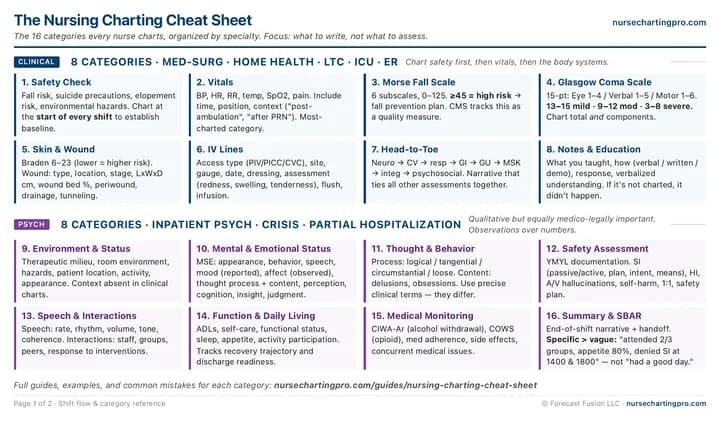
All 16 charting categories, clinical and psych, with what to write for each
Morse, Braden, Glasgow Coma Scale and SBAR at a glance
The charting mistakes that cost nurses their licenses
Tap through your assessments during the shift and get a draft of your note to review at clock-out. Your notes are cleared from your phone at the end of your shift.