By Miranda, Nursing Student (BSN candidate)

This guide is currently pending review by a licensed clinical nurse.

Last updated: April 11, 2026

Documenting a Mental Status Exam: A Nursing Guide
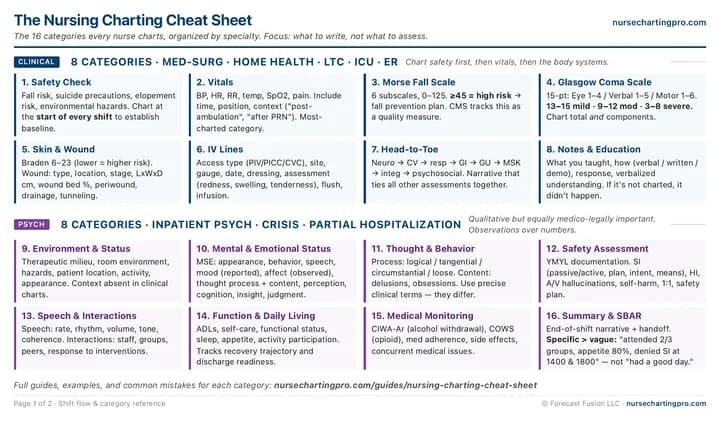
During my first psych clinical rotation, I stared at the chart entry for 20 minutes, cursor blinking, as I wondered how to describe what I had just observed in the patient interview. The preceptor rattled off all 10 MSE components effortlessly - appearance, behavior, speech, mood, affect, thought process, thought content, cognition, insight, judgment - but I had written down only three of them. This page provides the breakdown I wish I had that morning: what each component means, what to observe, and how to create a complete MSE entry when you put it all together.

Video coming soon — subscribe to be notified when new episodes drop.

Why This Matters

Regulatory bodies: Joint Commission Behavioral Health Standards, CMS Conditions of Participation, State Mental Health Codes

The Mental Status Exam serves as the foundational psychiatric assessment. Every inpatient psych admission, outpatient psychiatric evaluation, and behavioral health crisis encounter requires it. This exam functions as both a clinical tool and a legal document, creating an objective record of a patient's psychiatric presentation at a specific point in time. Joint Commission behavioral health standards mandate documented mental status assessments as part of the psychiatric evaluation. CMS Conditions of Participation require psychiatric facilities to maintain clinical records that include the patient's mental status. State mental health codes often specify that involuntary holds and commitment proceedings must reference documented MSE findings. When a case reaches court - such as during an involuntary commitment hearing, malpractice review, or competency evaluation - the MSE in the chart serves as evidence. If it is vague, missing, or contradicted by other documentation, the legal record weakens. In contrast, if it is specific, structured, and consistent, it holds up.
  1. Mental Status ExaminationStatPearls [Internet] (2024)
  2. The American Psychiatric Association Practice Guidelines for the Psychiatric Evaluation of AdultsAmerican Psychiatric Association (2016)
  3. Behavioral Health Care AccreditationThe Joint Commission (2025)
  4. "Mini-mental state": A practical method for grading the cognitive state of patients for the clinicianJ Psychiatr Res. 1975;12(3):189-198 (1975)

What the MSE Measures

The Mental Status Exam has been part of psychiatric practice since the mid-1800s, when European psychiatrists began systematically categorizing observable signs of mental illness. The modern 10-component format was standardized through decades of clinical refinement and is now the universal framework taught in medical, nursing, and psychology programs worldwide. The MSE captures a snapshot of the patient's current psychological functioning - not their history, not their diagnosis, not their prognosis. It answers the question: "What is this patient presenting right now, in this moment?" That's an important distinction. A patient's chart might say "Major Depressive Disorder," but today's MSE might show bright affect, goal-directed thought, and intact insight. The MSE documents what you observe, not what the diagnosis says you should observe. One thing that confused me early on: the MSE is not the same as the MMSE (Mini-Mental State Examination) or the MoCA (Montreal Cognitive Assessment). The MMSE and MoCA are scored cognitive screening tools - they give you a number (out of 30) that measures orientation, memory, attention, and executive function. The MSE is a broader, descriptive clinical assessment that covers cognition as one of its ten components but also includes mood, affect, thought process, thought content, and more. You might use the MMSE or MoCA as part of the Cognition section of your MSE, but they are not interchangeable.

How to Document Each Component

Each component has specific terminology and expectations. Observe these elements and document them for all ten components.

Appearance

Document what you see before the patient speaks. Note grooming and hygiene (well-groomed, disheveled, malodorous, clean but unkempt), clothing (appropriate for weather and setting, layered inappropriately, hospital gown), body habitus, distinguishing features (tattoos, scars, bandages), and the apparent age versus stated age. Be specific and objective - "wearing three winter coats indoors in July" conveys information, while "appearance unremarkable" provides none. Example: "Patient is a 29-year-old female who appears her stated age. She is wearing a hospital gown, hair uncombed, no makeup. Hygiene is fair - mild body odor noted. No visible injuries or self-harm marks on exposed skin."

Behavior

Psychomotor activity is crucial here: is the patient agitated (pacing, fidgeting, restless, unable to sit still) or retarded (slowed movements, delayed responses, minimal spontaneous movement)? Document eye contact (good, intermittent, avoidant, intense/staring), level of cooperation (cooperative, guarded, hostile, uncooperative), and any notable mannerisms or movements (hand-wringing, rocking, tics, tremors, catatonic features). Example: "Patient is seated in a chair, exhibiting psychomotor retardation - movements are slow, with minimal spontaneous gestures. Eye contact is intermittent, with frequent downward glances. Cooperative during the interview, but responses are delayed. No abnormal movements, tics, or tremors observed."

Speech

Consider four dimensions: rate (normal, rapid/pressured, slow), rhythm (regular, irregular), volume (normal, loud, soft/whispered), and tone (monotone, animated, tremulous). Also note articulation and fluency if relevant. Pressured speech - fast, hard to interrupt, driven - often indicates mania or hypomania. Poverty of speech (very little spontaneous speech, one-word answers) may suggest depression, psychosis, or cognitive impairment. Example: "Speech is slow in rate, low in volume, and monotone. Patient provides brief responses, often one to three words. No pressured speech. Articulation is clear, and language is fluent."

Mood

Mood is subjective - it's the patient's description of their emotional state. Ask directly: "How are you feeling today?" or "How would you describe your mood?" Then quote them. One common documentation error I've observed is nurses writing their own assessment of the patient's mood instead of using the patient's words. The NurseChartingPro app offers structured options (Calm, Depressed, Anxious, Agitated, Hypomanic/Manic, Irritable, Positive, Cooperative) as starting points, but always capture the patient's language when possible. Example: "Patient describes mood as 'tired and empty.'" Not: "Mood: depressed." The first reflects the patient's words; the second is your interpretation.

Affect

Affect is objective - it's your observation of the patient's emotional expression during the interview. Document the quality (bright, appropriate, labile, blunted, flat), range (full, restricted, constricted), and congruence with mood (congruent or incongruent). This complements mood: the patient expresses how they feel (mood), while you describe how they look and sound while expressing it (affect). The NurseChartingPro app provides five affect options: Bright, Appropriate, Labile, Blunted, and Flat. These correspond to the standard clinical spectrum from full emotional expression to absent emotional expression. Example: "Affect is blunted with a restricted range. Minimal facial expression changes throughout the interview. Tearful briefly when discussing family but quickly returned to a flat presentation. Affect is congruent with reported depressed mood."

Thought Process

Thought process describes how the patient thinks - the logical organization and flow of their ideas. The baseline is "linear and goal-directed" (ideas connect logically, the patient can follow a conversational thread, answers relate to the question asked). Deviations include: circumstantial (takes detours but eventually reaches the point), tangential (goes off on detours and never returns to the point), loose associations (ideas shift between unrelated topics without logical connection), flight of ideas (rapid shifting between loosely connected topics, often seen in mania), thought blocking (sudden stops mid-sentence, losing the train of thought), and perseveration (repeating the same word, phrase, or idea over and over). Example: "Thought process is linear and goal-directed. Patient answers questions directly without tangential detours. No evidence of loose associations, thought blocking, or perseveration."

Thought Content

Thought content refers to what the patient is thinking about. Document: suicidal ideation (SI) - active or passive, with or without plan/intent/means; homicidal ideation (HI) - with or without specific target; delusions (paranoid, grandiose, somatic, persecutory, referential); obsessions or compulsions; phobias; and preoccupations. SI and HI screening is mandatory - it must be part of every MSE on a psychiatric unit. Document what the patient reports and what they deny. "Denies SI/HI" is the minimum. Better: "Patient endorses passive suicidal ideation - 'I wish I wouldn't wake up' - but denies active SI, plan, intent, or access to means. Denies HI. No delusions elicited. Preoccupied with financial stressors." Example: "Patient endorses passive SI, stating 'I don't see the point anymore.' Denies active suicidal ideation, plan, intent, or access to lethal means. Denies homicidal ideation. No delusions, hallucinations, or paranoid ideation elicited. Patient is preoccupied with relationship stressors and housing instability."

Cognition

At minimum, document orientation (oriented x4: person, place, time, situation), attention and concentration (can the patient spell "world" backwards, count down from 100 by 7s), and memory (immediate, recent, and remote recall). If there's any question of cognitive impairment, a formal screening tool like the MMSE (Folstein et al., 1975) or MoCA can supplement this section. On an inpatient psych unit, a basic orientation check and attention assessment usually suffice unless cognitive decline is part of the clinical picture. Example: "Patient is oriented to person, place, time, and situation. Able to spell 'world' backwards with one error. Immediate recall intact (3/3 objects), delayed recall impaired (1/3 at 5 minutes). Remote memory intact - accurately recalls childhood events and recent hospitalization timeline."

Insight

Insight reflects the patient's awareness and understanding of their own illness and need for treatment. The traditional scale runs from good to fair to poor to absent. Good insight: "I know I have depression and I need to take my medication." Poor insight: "There's nothing wrong with me - my family made me come here." Absent insight: patient denies any psychiatric illness despite florid symptoms. Document the patient's actual statements about their condition and treatment - this is more useful than just the rating. Example: "Insight is fair. Patient acknowledges 'something is wrong' and that she 'probably needs help,' but is ambivalent about medication. States 'I don't want to be on pills forever.'"

Judgment

Judgment assesses the patient's ability to make reasonable decisions and anticipate consequences. You evaluate this through the interview itself (are their decisions and plans reasonable?) and sometimes through hypothetical scenarios ("What would you do if you found a stamped, addressed envelope on the ground?"). On a psych unit, judgment is often assessed through the patient's treatment decisions and discharge planning: Can the patient identify their triggers? Do they have a safety plan? Are their post-discharge plans realistic? Document concrete examples rather than just a rating. Example: "Judgment is impaired. Patient plans to discharge to the same living situation that precipitated the crisis, without identifying changes or safety strategies. When asked about her safety plan, she stated 'I'll just try harder.' Unable to articulate specific coping strategies or identify when to seek help."

Mood vs. Affect: The Distinction That Trips Up Most Students

The distinction between mood and affect often confuses students in MSE documentation, and I struggled with it for weeks. Here's the clearest way I've found to keep them straight: Mood is subjective; it reflects how the patient describes their feelings. You ask, they tell you, and you quote them. Mood belongs to the patient. Think of it as the weather report the patient provides: "I feel sad," "I'm anxious," "I feel fine." Affect is objective; it encompasses your observations of the patient's emotional expression during the interview. Affect belongs to you - it's your clinical observation. Consider it what you see when you look out the window: regardless of what the weather report states, you document what you actually observe. Congruence refers to whether the mood and affect match. If a patient states, "I feel great" (mood) while sitting motionless with a flat expression and monotone voice (affect), that's incongruent - and clinically significant. For example, congruence occurs when the patient reports feeling sad and presents with tearfulness and blunted affect. Incongruence appears when the patient claims to feel "fine" but is wringing their hands, avoiding eye contact, and speaking in a tremulous whisper. Always document both mood and affect, and note congruence or incongruence. Stating "Mood and affect appropriate" without further detail represents one of the most common documentation errors on psych units - it tells the reader nothing about what you actually observed.

Observation vs. Interpretation

The MSE records observations, not interpretations. This distinction matters for clinical accuracy and legal defensibility. Document what you see, hear, and what the patient reports - not what you think it means diagnostically. Weak (interpretation): "Patient is manipulative and attention-seeking." This judgment reveals more about the documenter's frustration than the patient's presentation. It's also not defensible in court - how do you measure "manipulative"? Strong (observation): "Patient requested to speak with the charge nurse three times during the shift. Made statements including 'No one is listening to me' and 'I need to talk to someone in charge.' When redirected to discuss concerns with the primary nurse, the patient raised their voice and struck the bedside table with an open hand." The observation version documents specific, verifiable behaviors. Another nurse could read it and know exactly what happened. The interpretation version documents an opinion that a different nurse might disagree with. Other common interpretation traps include: "Patient is in denial" (observation version: "Patient states 'I don't have a mental illness' and declines to discuss medication options"), "Patient is drug-seeking" (observation version: "Patient has requested PRN pain medication four times this shift at 2-hour intervals, each time reporting pain as 9/10"), and "Patient is noncompliant" (observation version: "Patient declined 0800 and 1200 doses of sertraline, stating 'It makes me feel worse'"). Every time you catch yourself writing an adjective that assigns motive, stop and replace it with the specific behavior you observed. The MSE becomes stronger when it reads like a transcript of what happened, not an editorial about what you think the patient is like.

Common Mistakes

"Mood/Affect Appropriate" with No Details

Weak: Mood and affect appropriate.
Strong: Mood: Patient states, "I'm feeling a little better today, less hopeless." Affect: Blunted with restricted range; occasional brief smile when discussing daughter's visit. Affect congruent with reported mood.

"Appropriate" is a conclusion, not an observation. It tells the next nurse or the physician nothing about what the patient actually looked like or said. Always describe what you observed and quote the patient's own words for mood.

Charting mood as affect (or vice versa)

Weak: Mood: Flat. Affect: The patient states she feels sad.
Strong: Mood: Patient states "I feel sad and empty." Affect: Flat - minimal facial expression changes throughout interview, monotone voice, no tearfulness.

Mood reflects the patient's subjective report; ask them directly. Affect represents your objective observation; watch their behavior. "Flat" describes affect, while "sad" describes mood. Confusing these terms indicates a misunderstanding of their distinctions, which undermines the credibility of the entire Mental Status Examination (MSE).

Missing SI/HI Screening in the MSE

Weak: Thought content: Patient is preoccupied with financial stressors. No delusions noted.
Strong: Thought content: Patient is preoccupied with financial stressors. Endorses passive SI - "Sometimes I think everyone would be better off without me" - but denies active SI, plan, intent, or access to means. Denies HI. No delusions or hallucinations elicited.

SI and HI screening must be documented in every MSE on a psychiatric unit. Omitting it is a patient safety gap and a survey-readiness risk. Even if the patient denies everything, document the denial explicitly.

Interpretations Instead of Observations

Weak: The patient appears manipulative and noncompliant with treatment.
Strong: Patient declined 0800 medications, stating "They make me feel like a zombie." Requested to speak with attending three times during shift. When informed attending would round at 1400, patient threw water cup on floor and stated "Nobody cares about me here."

"Manipulative" and "noncompliant" are interpretations that assign motive. The MSE documents observable behaviors and direct quotes. Another nurse reading the observation-based version can form their own clinical judgment. The interpretation-based version just passes along a label.

Inconsistent Order Across Entries

Weak: First entry: Mood, affect, speech, appearance. Next entry: Cognition, thought content, behavior, mood.
Strong: Every entry follows the same 10-component sequence: Appearance, Behavior, Speech, Mood, Affect, Thought Process, Thought Content, Cognition, Insight, Judgment.

Using the same order consistently enhances the scannability of your MSE and helps ensure you don't skip any components. When reviewing a chart weeks later or during a legal proceeding, a consistent structure simplifies comparisons between entries over time and highlights any changes.

Ms. AhmedAge 29Major Depressive Disorder with passive suicidal ideation
fictional patient

Scenario

Ms. Ahmed is a 29-year-old female admitted two days ago following a crisis evaluation. Her sister brought her after she expressed passive suicidal ideation at home, stating, "I don't want to be here anymore." She has a history of MDD, two prior hospitalizations, and currently takes sertraline 100mg daily (last dose taken 3 days prior to admission per patient report). On Day 2 of admission, you are conducting your shift assessment MSE during the morning interview.

Chart Entry

Appearance: Patient is a 29-year-old female who appears her stated age. Wearing hospital gown and socks. Hair uncombed, no makeup. Hygiene fair - mild body odor noted. Dark circles under eyes. No visible injuries, self-harm marks, or scars on exposed skin.

Behavior: Patient is seated in recliner, positioned curled with knees drawn up. Psychomotor retardation noted - slow to respond, minimal spontaneous movement or gestures. Eye contact intermittent, predominantly looking downward. Cooperative with interview but requires repeated prompting to elaborate on responses. No abnormal movements, tics, or tremors.

Speech: Slow rate, low volume, monotone. Responses are brief, typically two to five words unless prompted for more detail. No pressured speech. Articulation clear. Latency of 3-5 seconds before responding to questions.

Mood: Patient states "I just feel empty. Like there's nothing left."

Affect: Blunted with restricted range. Facial expression largely unchanged throughout 20-minute interview. Tearful briefly when discussing her sister's visit yesterday - wiped eyes and looked away, then returned to flat presentation within 30 seconds. Affect congruent with reported mood.

Thought process: Linear and goal-directed. Patient answers questions directly and stays on topic. No circumstantial or tangential thinking. No loose associations, flight of ideas, or thought blocking observed.

Thought content: Patient endorses passive suicidal ideation - "I still don't really want to be here, but I'm not going to do anything." Denies active suicidal ideation, plan, intent, or access to means. Denies homicidal ideation. No delusions, hallucinations (auditory or visual), or paranoid ideation elicited on direct questioning. Patient is preoccupied with guilt about "being a burden" to her sister and concerns about missing work.

Cognition: Oriented x4 (person, place, time, situation - correctly identifies hospital name, current date, and reason for admission). Attention intact - spells "world" backwards correctly. Immediate recall 3/3 (apple, table, penny). Delayed recall at 5 minutes 2/3 (recalled apple and penny, not table). Remote memory intact.

Insight: Fair. Patient states "I know I need help - I stopped taking my medication and things got bad." Acknowledges connection between medication nonadherence and current presentation. Ambivalent about restarting sertraline - "It helped before but I hated the side effects."

Judgment: Fair to impaired. Patient can identify that stopping medication contributed to decompensation but has not yet identified a concrete plan for maintaining treatment adherence after discharge. When asked about her safety plan, states "I'll call my sister" but cannot articulate additional coping strategies or identify specific warning signs for escalation.

Annotations

Appearance:
Specific observable details (uncombed hair, dark circles, hospital gown) rather than vague descriptors like "disheveled." Notes the absence of self-harm marks - relevant for a patient with SI.
Mood:
Direct quote from the patient. Mood is subjective - these are her words, not the nurse's interpretation.
Affect:
Objective observation with specific examples (tearful when discussing sister, returned to flat within 30 seconds). Notes congruence with mood. Describes range (restricted) and quality (blunted).
Thought content - SI documentation:
Documents the patient's exact words for passive SI, then systematically rules out active SI, plan, intent, and means. Also screens for HI, delusions, and hallucinations. This thoroughness is what surveyors and attorneys look for.
Insight and Judgment:
Goes beyond a one-word rating. Documents what the patient actually said about her illness and treatment, and identifies specific gaps (no concrete discharge plan, limited coping strategies). This gives the treatment team actionable information.

Pro Tips

  • Use the Same Order Every Time: Always document in the following order: Appearance, Behavior, Speech, Mood, Affect, Thought Process, Thought Content, Cognition, Insight, Judgment. This consistent order prevents accidental omissions and simplifies chart reviews and legal proceedings. After completing about 10 MSEs in this sequence, it becomes automatic.
  • Quote the Patient on Mood: Mood is subjective and reflects the patient's own words. Always include their response in quotes: "Patient states 'I feel hopeless.'" This approach proves more clinically useful and legally defensible than paraphrasing. If the patient cannot articulate their mood, document that as well: "Patient unable to describe mood, states 'I don't know.'"
  • Affect is yours, mood is theirs: If you remember one thing from this guide, make it this. Mood = patient's subjective report (you ask, they tell). Affect = your objective observation (you watch, you describe). Every time you write "mood" in a chart, ask yourself: "Am I writing the patient's words or my own observation?" If it's your observation, it's affect.
  • Always document mood-affect congruence: After documenting mood and affect separately, state whether they match. "Affect congruent with reported mood" or "Affect incongruent with reported mood - patient states 'I'm fine' but presents with tearfulness and psychomotor agitation." Incongruence is a clinically significant finding that the treatment team needs to know about.
  • Cross-reference SI/HI to the safety assessment: The MSE thought content section documents what the patient reports about SI/HI. The safety assessment evaluates risk and outlines the interventions in place. These two sections must align; if the MSE notes passive SI, the safety assessment should reflect the corresponding precaution level. Contradictions between the MSE and the safety plan indicate a potential survey finding.

Chart smarter with Nurse Charting Pro

Structured assessments, AI-generated narratives, and HIPAA-compliant crypto-shredding — built for nurses who care about documentation quality.