By Miranda Niemas, Nursing Student (BSN candidate)
This guide is currently pending review by a licensed registered nurse.
Last updated: October 13, 2026
Charting Suicidal Ideation and Safety Assessments: A Nursing Guide
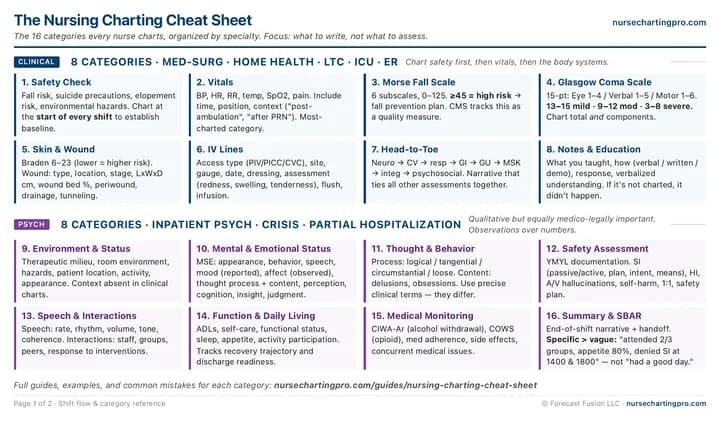
Get the free Nursing Charting Cheat Sheet
- All 16 charting categories, clinical and psych, with what to write for each
- Morse, Braden, Glasgow Coma Scale and SBAR at a glance
- The charting mistakes that cost nurses their licenses
Your patient just said something that scared you. Perhaps they expressed, "I don't want to be here anymore" during a routine check-in, or they directly mentioned thoughts of self-harm. Your heart rate increases, and your mind races through the clinical steps to take - while you also recognize the need to document this situation accurately. This charting category requires precise documentation for both patient safety and your license. The good news is that safety assessment documentation follows a clear, structured framework. Once you understand the required elements, you'll never hesitate in front of the chart again.
Why This Matters
Regulatory bodies: The Joint Commission (NPSG 15.01.01), Centers for Medicare & Medicaid Services (CMS), State Mental Health Codes, ANA Code of Ethics
- National Patient Safety Goals - Suicide Prevention — The Joint Commission (2025)
- The Columbia Suicide Severity Rating Scale (C-SSRS) — Columbia University / Columbia Lighthouse Project (2024)
- Safety Planning Intervention: A Brief Intervention to Mitigate Suicide Risk — Stanley B, Brown GK. Cognitive and Behavioral Practice. 2012;19(2):256-264 (2012)
- SAFE-T: Suicide Assessment Five-Step Evaluation and Triage — Substance Abuse and Mental Health Services Administration (SAMHSA) (2009)
- ASQ Suicide Screening Toolkit — National Institute of Mental Health (NIMH) (2024)
What Safety Assessment Covers
Suicidal Ideation - The Core Category
Documenting suicidal ideation (SI) is the most scrutinized element in any psychiatric chart. When documenting a positive finding or a negative screen, the level of detail expected exceeds that of any other charting category.
Passive Versus Active Suicidal Ideation
The 8 Required Elements of SI Documentation
Using the C-SSRS
Example SI Documentation
Homicidal Ideation
Auditory and Visual Hallucinations
Documenting hallucinations requires more than simply stating, "patient reports AVH." The clinical significance of a hallucination relies heavily on the details you provide.
Type and Content
Command Hallucinations
Patient Response to Hallucinations
1:1 Observation and Safety Plan Documentation
When a patient's risk level warrants continuous observation or a structured safety intervention, documentation requirements increase significantly.
1:1 Observation Documentation
Safety Plans
Common Mistakes
"Denies SI" as the Only Screening Documentation
"Denies SI" does not document the specific question asked, the patient's response, or the assessment conducted. A surveyor or attorney cannot determine from "denies SI" whether you actually screened the patient or simply carried forward a previous entry. The strong example clearly shows the screening question, the patient's response, the standardized tool result, and the current safety status.
Positive SI without all 8 required elements
The weak example documents the presence of SI and one intervention but omits type (passive vs. active), plan, intent, means, timeline, protective factors, and the standardized screening tool. If this patient later attempts suicide, the incomplete documentation suggests an incomplete assessment.
1:1 Observation Documentation Gaps
A single note covering four hours of 1:1 observation does not provide defensible documentation. If an event occurred at 1530, there is no contemporaneous record of the patient's status at that time. Each Q15min interval requires its own entry to demonstrate continuous monitoring.
Using "no-harm contract" language
No-harm contracts lack evidence of effectiveness in reducing suicide risk. Major psychiatric organizations and the Joint Commission recommend against their use. The safety planning intervention (Stanley & Brown, 2012) serves as the evidence-based alternative. Using outdated terminology in charting indicates outdated practice.
Not Documenting Command Hallucinations Specifically
Simply stating "reports auditory hallucinations" does not inform the treatment team whether the voices are benign background noise or commands to self-harm. Command hallucinations with self-harm or violent content require immediate escalation and specific documentation of the command content, the patient's ability to resist, and the interventions taken.
Case Example
Scenario
You are the evening shift nurse on an adult psychiatric unit. Ms. Dominguez was admitted yesterday after presenting to the ED with suicidal ideation. She is on day 2 of her admission. During your shift safety assessment, she endorses passive SI but denies active ideation. She denies HI and AVH. A safety plan is in place from admission. Observation level is Q15min per provider order. Here is the full safety assessment documentation for your shift.
Chart Entry
Safety Assessment - 1600

Suicidal Ideation: Safety screening performed using C-SSRS. Patient endorses suicidal ideation - passive. States: "I still don't want to be here. I keep thinking my kids would be better off without me." Denies active suicidal ideation. Asked directly: "Are you thinking about killing yourself?" Patient responds: "No, not like that. I just don't want to exist." C-SSRS: passive ideation only (wish to be dead); denies active ideation, plan, intent, or means. No change from admission screening severity.

Plan: Denies plan. Asked: "Have you thought about how you might hurt yourself?" Patient states: "No, I haven't thought about that."
Intent: Denies intent to act. States: "I wouldn't do anything. I just feel this way."
Means: Patient does not have access to means on unit. Belongings searched at admission. Sharps restriction in place. Room safety check completed this shift - no contraband or safety hazards identified.
Timeline: Passive ideation has been present for approximately 3 weeks per patient. No increase in frequency or intensity since admission.
Protective factors: Two children (ages 8 and 5). Patient states: "They're the only reason I'm still here." Also identifies her mother as a support.

Homicidal Ideation: Denies HI. Asked directly: "Are you having thoughts of hurting anyone else?" Patient states: "No, nothing like that."

Hallucinations: Denies auditory, visual, or other hallucinations. No evidence of responding to internal stimuli during interview.

Safety Measures: Observation level Q15min per MD order. Room safety check completed - no contraband, cords secured, sharps accounted for. Unit precautions in place (locked unit, belongings restricted).

Safety Plan: Safety plan reviewed with patient (originally developed at admission with social worker). Patient able to identify warning signs (withdrawal from peers, crying spells, difficulty sleeping), coping strategies (calling her mother, deep breathing, asking to talk to staff), and emergency contacts (mother, crisis line number on card in room). Patient states plan is "helpful" and that she would notify staff if ideation worsens.

Interventions: MD notified of continued passive SI, stable from admission. Current orders maintained. Patient encouraged to participate in group therapy tomorrow. Will reassess next shift and PRN.
Key points from above chart entry
- All 8 SI elements addressed:
- Presence, type (passive), plan (denied), intent (denied), means (restricted), timeline (3 weeks, stable), protective factors (children, mother), and interventions (MD notified, orders maintained, encouragement) are all explicitly documented.
- Direct quotes throughout:
- The patient's exact words are documented for SI screening, plan denial, intent denial, and protective factors. This creates a more defensible record than paraphrasing alone.
- C-SSRS score documented:
- The standardized screening tool is referenced with the specific questions endorsed and denied, not just a summary score. This allows the next shift to compare directly.
- HI and AVH screened and documented:
- Even though both are negative, each domain is addressed with the screening question and the patient's response. The absence of findings is documented, not just assumed.
- Safety plan specifics, not just "safety plan in place":
- The documentation includes the warning signs, coping strategies, and contacts the patient identified - demonstrating that the plan was actually reviewed and that the patient can engage with it meaningfully.
Pro Tips
- Document SI with all 8 elements every time it's positive: Document all 8 elements in your assessment, even if the ideation remains unchanged from the previous shift. A complete entry each shift creates a longitudinal record that clearly shows the treatment team and any future reviewer the patient's status during your shift. Avoid shortcuts like "SI unchanged," as they require the reader to locate and compare the original entry. If that entry is also incomplete, the gap compounds.
- Command hallucinations are the most urgent hallucination finding: When a patient reports hearing voices, always ask what the voices say and whether they instruct the patient to do anything. Hearing benign background voices represents a different clinical situation than hearing a voice that commands self-harm. Command hallucinations with violent or self-harm content should trigger immediate provider notification and may necessitate a change in observation level.
- Every 1:1 Interval Gets Its Own Entry: If you are assigned to 1:1 observation, document at every Q15min interval even if the patient is sleeping. Each entry should reflect what you observed at that specific moment: location, activity, behavior, affect. A single summary note covering multiple hours is not defensible and does not demonstrate continuous monitoring.
- Replace "no-harm contract" with "safety plan" in your vocabulary: If your unit still uses no-harm contract language, introduce the evidence-based alternative as the nurse. The Stanley & Brown safety plan emphasizes collaboration, specificity, and patient involvement. In contrast, no-harm contracts are clinician-driven, generic, and lack demonstrated efficacy. Using evidence-based language in your charting reflects evidence-based practice.
- When in doubt, escalate and document that you escalated: If a patient says something that makes you concerned about safety - even if it's ambiguous - document the statement verbatim, notify the provider, and document the notification. "Patient states: 'I don't know how much more of this I can take.' Statement could be interpreted as passive SI. MD notified for evaluation." You are never wrong to escalate a safety concern. You are always wrong to hear one and not document it.
Frequently Asked Questions
- What are the 8 required elements of suicidal ideation documentation?
- The 8 required elements of suicidal ideation (SI) documentation are: (1) presence of SI; (2) type: passive versus active; (3) plan: does the patient have a specific method in mind; (4) intent: does the patient intend to act; (5) means: does the patient have access to the means described; (6) timeline: is the ideation current, recent, or historical, and has the patient identified a timeframe; (7) protective factors: what reasons does the patient identify for living; and (8) interventions initiated: what actions did you take in response to the finding. Address all 8 in every documentation entry where SI is positive, even if the ideation is unchanged from a previous assessment.
- What is the difference between passive and active suicidal ideation?
- Passive suicidal ideation occurs when a patient wishes they were dead or expresses a desire not to be alive, without thoughts of killing themselves or any plan or intention to act. Examples include "I wish I wouldn't wake up" or "everyone would be better off without me." In contrast, active suicidal ideation involves thoughts about killing oneself and may include a plan, intent, means, or timeline. Active suicidal ideation (SI) can range from fleeting thoughts about suicide to a fully formed plan with intent and means. The Columbia Suicide Severity Rating Scale (C-SSRS) distinguishes these: Question 1 captures passive ideation (wish to be dead), while Questions 2-5 capture progressively more severe active ideation. Both require documentation, but active SI with a plan and intent demands the most urgent clinical response.
- Should I still use no-harm contracts?
- No, you should not use no-harm contracts. No-harm contracts (also called contracts for safety) lack evidence support and are no longer recommended by major psychiatric organizations or the Joint Commission. They lack demonstrated efficacy in reducing suicide risk and may create a false sense of security for clinicians; a signed contract can lead staff to believe a patient is safe when they are not. The evidence-based alternative is the Stanley & Brown Safety Planning Intervention, a collaborative, patient-driven document that identifies warning signs, coping strategies, social supports, professional contacts, and means restriction steps. If your facility still uses no-harm contracts, discuss the safety planning alternative with your clinical leadership and document using safety plan language in the meantime.
Get the free Nursing Charting Cheat Sheet
- All 16 charting categories, clinical and psych, with what to write for each
- Morse, Braden, Glasgow Coma Scale and SBAR at a glance
- The charting mistakes that cost nurses their licenses
Chart faster with Nurse Charting Pro
Tap through your assessments during the shift and get a draft of your note to review at clock-out. Your notes are cleared from your phone at the end of your shift.
Related Guides
- C-SSRS documentationThe deeper screener-mechanics guide for the Columbia Suicide Severity Rating Scale referenced throughout this page. Covers all 5 ideation questions, all 5 behavior categories, and the version-selection decisions.
- PHQ-9 documentationA positive PHQ-9 item 9 is the most common upstream trigger for the C-SSRS administration described in this guide.
- Psychiatric Nursing Charting hubSafety assessment serves as a core category in psychiatric charting; explore how it integrates into the full framework.
- Charting cheat sheetAccess all charting categories on one quick-reference page.
- SBAR communication frameworkSI/HI findings play a critical role in any psychiatric SBAR handoff.
- Mental status exam documentationSafety assessment findings often correlate with changes in mental status; document both.
- Thought process documentationThought content (SI, HI, delusions, hallucinations) intersects with the safety assessment category.
- SI/HI/AVH documentationHow to chart a denial, a positive SI or HI finding, hallucinations, and NSSI, with examples.