By Miranda Niemas, Nursing Student (BSN candidate)
This guide is currently pending review by a licensed registered nurse.
Last updated: October 13, 2026
SBAR for Psychiatric Nursing: A Complete Example
Get the free Nursing Charting Cheat Sheet
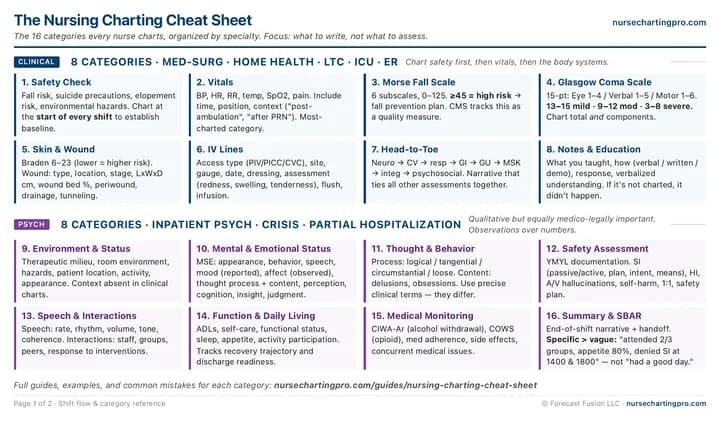
- All 16 charting categories, clinical and psych, with what to write for each
- Morse, Braden, Glasgow Coma Scale and SBAR at a glance
- The charting mistakes that cost nurses their licenses
You learned SBAR in med-surg, and now you are giving handoff on a psychiatric patient for the first time. The framework remains the same - Situation, Background, Assessment, Recommendation - but the content feels different. Instead of tracking vital signs, you describe a patient's thought content. Rather than counting post-op days, you monitor involuntary hold timelines. Instead of reporting on surgical drains and wound measurements, you indicate whether the patient denied suicidal ideation during this shift and what their observation level should be. Psych SBAR is not more challenging than clinical SBAR; it is simply different. The structure helps you stay organized in the same way, but the data elements shift from physiological to behavioral, legal, and observational. Once you identify which data points fit into each component, you will deliver psych handoffs with the same confidence you developed on the med-surg floor.
Why This Matters
Regulatory bodies: The Joint Commission (Behavioral Health Care Standards), Centers for Medicare & Medicaid Services (CMS), State Mental Health Codes
- Behavioral Health Care Accreditation Standards — The Joint Commission (2025)
- SBAR Tool: Situation-Background-Assessment-Recommendation — Institute for Healthcare Improvement (IHI) (2024)
How Psych SBAR Differs from Clinical SBAR
Legal Status: An Often Overlooked Element for Nurses
Safety Status: The Most Important Assessment Element
Psych SBAR Structure Versus Clinical SBAR Structure
Common Mistakes
Including Vitals but Excluding Mental Status
Vital signs rarely represent the most critical assessment data in a psychiatric handoff. Instead, prioritize mental status exam findings, safety screening results, and behavioral observations. Report vitals when relevant, such as during medication monitoring or in cases of medical comorbidity, but lead with the psychiatric assessment.
Omitting Legal Status Entirely
Legal status determines what the oncoming nurse can and cannot do if the patient requests discharge, refuses treatment, or needs to be informed of upcoming legal proceedings. Omitting it forces the next nurse to look it up independently, wastes time, and creates risk if the hold expires during their shift.
Vague Assessment without Mental Status Exam Findings
"Shows improvement" is a subjective impression, not a clinical assessment. The strong example provides specific mental status findings that support the clinical judgment of improvement, making the assessment reproducible and defensible. The oncoming nurse can compare their own findings directly.
Missing the Safety Component in Assessment
Behavioral observations (sleep, appetite, group participation) provide valuable assessment data, but they do not replace an explicit safety statement. A patient can be calm, eating well, and attending groups while still endorsing passive suicidal ideation. Safety screening results must appear directly in every psychiatric SBAR, even when the screen is negative.
Case Example
Scenario
You are the evening shift nurse on an adult inpatient psychiatric unit. Ms. Walker was admitted 3 days ago after presenting to the ED with suicidal ideation and a plan. She is a voluntary admission. You will give SBAR handoff to the night shift nurse at 2300. Here is the complete psych SBAR.
Chart Entry
SITUATION:
Ms. Walker, 27 years old. Diagnosis: major depressive disorder, recurrent, severe. Admitted 3 days ago from the ED with suicidal ideation and a plan (overdose). Voluntary admission. Primary focus this shift: continued depressive symptoms with passive SI, medication adjustment in progress.

BACKGROUND:
Psychiatric history: two prior admissions for MDD with SI (2023 and 2024), one prior attempt (overdose, 2023). No history of psychosis or mania. Substance history: social alcohol use, denies current use. Medications: sertraline increased from 100mg to 150mg two days ago, trazodone 50mg QHS for sleep, lorazepam 0.5mg Q6H PRN for anxiety. PRN usage this shift: lorazepam 0.5mg given at 1800 for self-reported anxiety - patient reported decreased anxiety 45 minutes after administration. Allergies: none. Medical: no significant medical history. Social: lives alone, works as a teacher, parents are primary support. Insurance: [active], discharge planning initiated by social work - outpatient therapist appointment being scheduled for within 7 days of discharge.

ASSESSMENT:
Mental status: Appearance - dressed in hospital clothing, hair uncombed, no makeup (baseline for this patient during admission). Behavior - cooperative, engaged in conversation but with psychomotor retardation (slow to respond, limited spontaneous speech). Mood: "still sad, but the medication is helping a little." Affect: constricted, tearful intermittently, congruent with stated mood. Thought process: linear and goal-directed, no loose associations. Thought content: endorses passive SI - states "I still don't want to be here sometimes" - denies active ideation, plan, intent, or means. Denies HI. Denies AVH. C-SSRS: passive ideation only (wish to be dead); denies active ideation, plan, intent, or means. Unchanged from yesterday's assessment.

Safety: passive SI present, stable. No self-harm behaviors this shift. A safety plan is in place (developed on admission with social worker). The patient reviewed the safety plan with me this shift and identified warning signs (isolating in room, crying, not eating) and coping strategies (calling mother, asking to talk to staff, deep breathing). The patient states she would notify staff if ideation worsens.

Behavioral observations: slept approximately 4 hours last night (per patient report and nursing observation), napped 1 hour this afternoon. Ate 60% of dinner, declined lunch. Attended one group therapy session (CBT skills group) - participated minimally but remained for the full session. Declined recreational therapy. Spent most of the shift in her room, came to the dayroom briefly for dinner. Medication compliance: took all scheduled medications without difficulty.

RECOMMENDATION:
Observation level: Q15 minutes per MD order - no change recommended. Monitoring: continue to assess SI each shift with C-SSRS. The patient may request PRN lorazepam for anxiety - last dose was 1800, next eligible at 0000. Trazodone 50mg QHS due at 2100 (given this shift). Encourage PO intake at breakfast - the patient has been eating less than 50% of meals on average. Social work follow-up scheduled for tomorrow at 1000 to continue discharge planning. Psychiatrist rounding tomorrow morning - may consider further sertraline increase given ongoing symptoms (current dose day 2 of 150mg). No court dates or legal proceedings - voluntary admission, no discharge requests this shift.
Key points from above chart entry
- Legal status stated in Situation:
- Voluntary admission status is identified in the first component, immediately orienting the oncoming nurse to the legal framework. If the patient requests discharge overnight, the night nurse knows this is a voluntary patient and can respond according to facility policy for voluntary discharge requests.
- Mental status exam in Assessment, not vital signs:
- The Assessment leads with a structured mental status exam (appearance, behavior, mood, affect, thought process, thought content) followed by safety screening results. Vital signs are not mentioned because they are unremarkable - the psychiatric data is what the oncoming nurse needs to act on.
- Safety explicitly addressed with C-SSRS results:
- The safety section reports the specific SI finding in clinical language (passive ideation only - wish to be dead), explicitly denies active ideation with specifics, and confirms the safety plan is in place and the patient can engage with it. The oncoming nurse knows exactly what to screen for and what the baseline looks like.
- Medication compliance and PRN response documented:
- Psychiatric handoffs require medication information beyond the medication list. The SBAR includes PRN usage (what was given, when, and the patient's response), scheduled medication compliance, and a note about the next eligible PRN dose - all critical for overnight management.
Pro Tips
- Always state legal status, even when it seems obvious: Mention legal status even when it appears straightforward. Stating "Voluntary admission, no discharge requests" takes only a few seconds and helps prevent the oncoming nurse from making assumptions. On a unit with a mix of voluntary and involuntary patients, understanding the legal framework for each patient is essential before making any clinical decisions regarding privileges, medications, or discharge.
- Lead Assessment with Mental Status, Safety, and Behavioral Observations: The most common error in psych SBAR involves burying psychiatric data beneath vital signs and medical information. Include vital signs in the handoff only when they are clinically relevant, such as during lithium level monitoring, clozapine-related vitals, or when addressing medical comorbidities. However, the Assessment component should prioritize mental status exam findings, safety screening results, and behavioral observations. These data points are what the oncoming nurse will act on first.
- Cross-reference Your Safety Handoff with Your Charted Safety Assessment: Your verbal SBAR and written chart entry must tell the same story. If you charted passive SI with C-SSRS Question 1 endorsed, that finding should also appear in your SBAR Assessment. Additionally, if you changed the observation level during your shift, include it in your Recommendation. Discrepancies between the chart and the handoff create confusion and undermine clinical communication.
- Include Medication Compliance and PRN Response: Psychiatric patients on multiple psychotropic medications require handoff communication about medication adherence. Confirm whether the patient took all scheduled medications or refused any. If a PRN was given, note the indication and whether the patient reported improvement. The oncoming nurse needs this information to manage overnight medication administration and assess the effectiveness of current medications.
- Report Monitoring Level Changes and Privilege Status in Recommendation: The Recommendation component in psych SBAR should address the patient's current monitoring level (Q15, Q5, 1:1, line of sight) and whether any change was made or is being recommended. Include privilege status (grounds passes, visitor restrictions, off-unit activity clearance) and any pending evaluations or court dates that may affect the oncoming shift. The Recommendation is where you tell the next nurse what to do, not just what you observed.
Frequently Asked Questions
- How is psych SBAR different from clinical SBAR?
- Psych SBAR follows the same 4-component structure (Situation, Background, Assessment, Recommendation) as clinical SBAR, but the content within each component differs. The most significant differences include: (1) the Assessment component emphasizes mental status exam findings and safety screening results instead of vital signs and physical findings, (2) legal status (voluntary, involuntary hold type, hold timeline, court dates) is a required element absent in clinical SBAR, (3) monitoring level (every 15 minutes, every 5 minutes, or 1:1) and privilege status replace clinical monitoring parameters (telemetry, neuro checks) in the Recommendation component, and (4) medication compliance and behavioral responses to psychotropic medications receive greater emphasis than in clinical handoffs.
- What goes in the Assessment component for a psychiatric SBAR?
- The Assessment component of a psychiatric SBAR should include: mental status exam findings (appearance, behavior, mood, affect, thought process, thought content, cognition, insight/judgment), safety screening results with specifics (suicidal ideation status including passive vs. active, homicidal ideation status, auditory or visual hallucinations, self-harm behaviors, and standardized tool results such as the highest item endorsed on the Columbia Suicide Severity Rating Scale, or C-SSRS), behavioral observations (sleep quality and duration, appetite and intake, socialization and group participation, activities of daily living), medication compliance and response to any as-needed (PRN) medications given during the shift, and the nurse's clinical judgment about the patient's overall trajectory (improving, stable, or declining, with the specific observations that support that judgment).
- Should I include legal status in every psych SBAR?
- Yes, include legal status in every psychiatric SBAR handoff, regardless of whether it has changed. For voluntary patients, a brief statement suffices: "Voluntary admission, no discharge requests this shift." For involuntary patients, include the hold type, initiation date and time, expiration date and time, and any upcoming court dates or hearings. Legal status determines what the oncoming nurse can do if the patient requests discharge, refuses treatment, or needs information about legal proceedings. Omitting it forces the next nurse to look up the information independently, creating risk if a hold is expiring or a hearing is imminent during their shift.
Get the free Nursing Charting Cheat Sheet
- All 16 charting categories, clinical and psych, with what to write for each
- Morse, Braden, Glasgow Coma Scale and SBAR at a glance
- The charting mistakes that cost nurses their licenses
Chart faster with Nurse Charting Pro
Tap through your assessments during the shift and get a draft of your note to review at clock-out. Your notes are cleared from your phone at the end of your shift.
Related Guides
- The main SBAR guideStart with the comprehensive SBAR framework, which applies across all specialties, especially if you are new to SBAR.
- Clinical SBAR exampleExamine how SBAR appears in a med-surg context to highlight the differences between psych SBAR.
- Psychiatric charting hubThe SBAR handoff connects all 8 psychiatric charting categories - see the full framework.
- Safety assessment documentationSafety screening is the most critical Assessment element in psych SBAR - this guide covers SI, HI, and AVH documentation in depth.
- Mental status exam documentationMental status exam findings drive the Assessment component of psych SBAR; learn to document them accurately.
- C-SSRS documentationC-SSRS results (version, highest endorsed Q, behavior section status) belong in every psych SBAR with a positive safety screen. The C-SSRS guide covers the instrument mechanics.
- PHQ-9 documentationPHQ-9 score, severity band, and item 9 status belong in the Background field of any psych SBAR for a depression-focused admission.
- GAD-7 documentationGAD-7 score and severity band belong in the Background field for any psych SBAR with an anxiety component; commonly paired with PHQ-9.
- SI/HI/AVH documentationHow to chart SI, HI, and hallucination findings before they go into the handoff.