By Amy Niemas, RN-BC, BSN, MSW, Clinical Content Director · Psychiatric Registered Nurse
Last updated: October 13, 2026
COWS Documentation: A Nursing Guide to Opioid Withdrawal Scoring
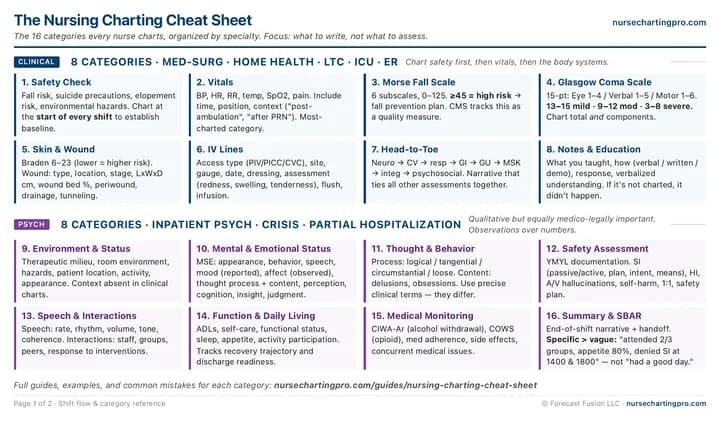
Get the free Nursing Charting Cheat Sheet
- All 16 charting categories, clinical and psych, with what to write for each
- Morse, Braden, Glasgow Coma Scale and SBAR at a glance
- The charting mistakes that cost nurses their licenses
Why This Matters
Regulatory bodies: Centers for Medicare & Medicaid Services (CMS), The Joint Commission, American Society of Addiction Medicine (ASAM), Substance Abuse and Mental Health Services Administration (SAMHSA)
- The Clinical Opiate Withdrawal Scale (COWS) — Wesson DR, Ling W. J Psychoactive Drugs. 2003;35(2):253-259 (2003)
- Opioid Withdrawal — Shah M, Huecker MR. StatPearls Publishing (Updated 2023) (2023)
What COWS Measures
How to score each COWS item
Scoring and Documentation Workflow
The COWS assessment follows a score-intervene-reassess workflow.
What to Document for Each Assessment
A complete COWS chart entry has 6 pieces of information.
Protocol Interpretation Basics
Medication Compliance Tracking
Withdrawing patients are commonly on concurrent psychotropics, so medication compliance documentation shows up alongside COWS scoring in the same shift.
Common Mistakes
Documenting Only the Total Score
Protocols often trigger differently based on which items are elevated, and induction decisions depend on objective signs like pupil dilation and pulse, not the total alone. A score of 14 driven by autonomic signs (pulse, pupils, gooseflesh) reads differently than one driven by self-reported symptoms.
Skipping assessments when the patient seems stable
Protocol gaps appear as missed assessments during surveys and legal reviews. "No news" does not qualify as documentation. Even a low score requires documentation at the ordered interval.
Not Documenting the Medication Response
The COWS protocol follows a loop: assess, medicate, and reassess. Without the post-medication reassessment, you cannot demonstrate that the intervention was effective, document that precipitated withdrawal did not occur, or justify the next interval.
Vague descriptor language instead of scores
"Appears restless" is not a COWS score. Each item has standardized descriptors; use the descriptor and the number. Including the patient's own words in quotes strengthens the documentation.
Using the Wrong Scale for Withdrawal Assessment
COWS was developed and validated specifically for opioid withdrawal. Off-label use for other withdrawal types can lead to misleading scores and inappropriate medication triggers.
Pro Tips
- Remember the 11 COWS items: Pulse, Sweating, Restlessness, Pupil size, Aches, Runny nose/tearing, GI upset, Tremor, Yawning, Anxiety/irritability, Gooseflesh. Reviewing this list helps you avoid missing items during a busy shift.
- Document item-level scores every time (i.e. the score for each individual item): Spending an extra minute to document item-level scores pays off when the provider asks, "What specifically was elevated?" A total of 14 holds limited clinical significance without knowing whether the score is driven by objective autonomic signs or subjective symptoms.
- Escalate right away if scores are rising quickly: When a COWS rises from 8 to 15 in one hour, this indicates rapid withdrawal progression. Use your clinical judgment and call the provider as soon as you see this. Also document it, such as: "COWS rose from 8 to 15 in one hour, provider notified, awaiting orders."
- CIWA and COWS are separate scales - don't mix them: Some patients have both alcohol and opioid use disorder and may need both assessments. Document each scale separately, using its full name (CIWA-Ar, COWS), and never combine the scores.
Step by Step
- Assess each item using standardized descriptors: Evaluate all 11 COWS items with the standardized descriptors on the scoring sheet. Ask the patient about each symptom and observe for objective signs.
- Calculate the total score: Sum all item scores. Compare the total to your facility's protocol thresholds to determine the required intervention.
- Administer medication per protocol: If the score triggers a medication order or induction, administer the medication and document the time, dose, and route of administration.
- Document the complete assessment: Document the time, all item-level scores, total, protocol action taken, and time of the next scheduled assessment.
- Reassess after intervention: If medication was given, reassess within 30-60 minutes per protocol. Document the post-medication score and the patient's response.
Frequently Asked Questions
- What does COWS stand for?
- COWS stands for Clinical Opiate Withdrawal Scale. It is an 11-item scale that assesses the severity of opioid withdrawal. Wesson and Ling published it in 2003.
- What is the difference between CIWA and COWS?
- CIWA-Ar (Clinical Institute Withdrawal Assessment for Alcohol, revised) assesses alcohol withdrawal, while COWS assesses opioid withdrawal. CIWA-Ar has 10 items with a total of 0-67; COWS has 11 items with a total of 0-48. They measure different withdrawal syndromes and should never be used interchangeably.
- What COWS score supports starting buprenorphine?
- Most protocols use a COWS score of 13 or higher to support buprenorphine induction. An inaccurate score leads to the wrong action: a score that is too high can prompt dosing too early and cause precipitated withdrawal, and a score that is too low can delay induction past the right window. Always follow your facility's specific protocol.
- How often should COWS be scored?
- How often you score COWS depends on the score and your facility's protocol. Common intervals: every 1 hour if the score is elevated, every 2 hours if stable mid-range, every 4 hours if stable, and every 8 hours if stable and low scoring. After giving an as-needed (PRN) medication or an induction dose, reassess within 30-60 minutes.
Get the free Nursing Charting Cheat Sheet
- All 16 charting categories, clinical and psych, with what to write for each
- Morse, Braden, Glasgow Coma Scale and SBAR at a glance
- The charting mistakes that cost nurses their licenses
Chart faster with Nurse Charting Pro
Tap through your assessments during the shift and get a draft of your note to review at clock-out. Your notes are cleared from your phone at the end of your shift.
Related Guides
- CIWA-Ar DocumentationThe alcohol-withdrawal counterpart. Same score-intervene-reassess loop, different scale, different protocol triggers.
- Glasgow Coma Scale ChartingNeurological monitoring plays a core role in withdrawal assessment. GCS trends paired with COWS can catch decompensation early.
- SBAR Nursing HandoffCOWS trends play a key role in any SBAR for a withdrawing patient.
- Nursing Charting Cheat SheetAll charting categories in one scannable reference.
- RASS documentation for ICU sedationThe RASS, used primarily in the ICU setting, is the closest documentation method to the COWS. Both follow the same score-intervene-reassess loop; charting habits transfer directly.
- Psychiatric Nursing Charting overviewWithdrawal monitoring is common on both psychiatric and medical units. COWS bridges clinical and psychiatric documentation.