By Miranda Niemas, Nursing Student (BSN candidate)
This guide is currently pending review by a licensed registered nurse.
Last updated: October 13, 2026
How to Score and Document a Glasgow Coma Scale Assessment (Nursing Guide)
Glasgow Coma Scale calculator
If a component cannot be tested, do not total it here. Chart it as not testable instead, such as VT for an intubated patient or E1C for eyes swollen shut, as described below.
Choose one option in each section to see the total.
The score supports, but does not replace, your clinical judgment and facility policy. Nothing you enter here is saved or sent anywhere. Glasgow Coma Scale © University of Glasgow. Teasdale G, Jennett B. Lancet 1974.
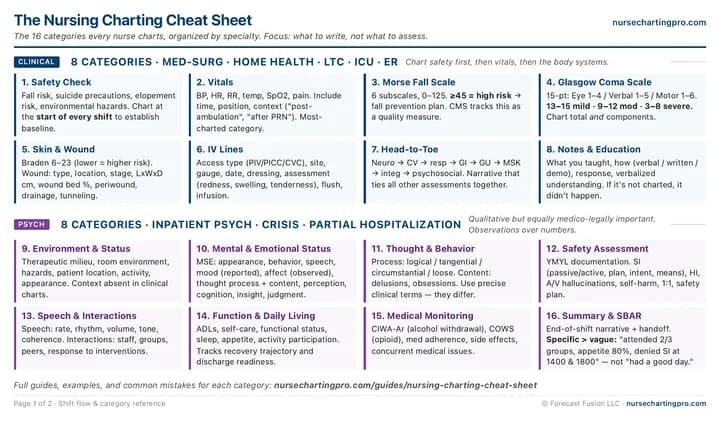
Get the free Nursing Charting Cheat Sheet
- All 16 charting categories, clinical and psych, with what to write for each
- Morse, Braden, Glasgow Coma Scale and SBAR at a glance
- The charting mistakes that cost nurses their licenses
The GCS appears straightforward until you need to document a patient whose score just dropped from 14 to 11, and no one taught you how to chart that change. I felt lost the first time this occurred during my clinical rotation - I knew the number but struggled with what to write, which presented a different challenge. Here's the framework that finally clarified the process.
Why This Matters
Regulatory bodies: The Joint Commission, Centers for Medicare & Medicaid Services (CMS), State Boards of Nursing
- Assessment of coma and impaired consciousness: A practical scale — Teasdale G, Jennett B. Lancet. 1974;2(7872):81-84 (1974)
- Glasgow Coma Scale — Jain S, Iverson LM. StatPearls Publishing (Updated 2023) (2023)
- Standards for Hospital Neurological Assessment — The Joint Commission (2025)
- Guidelines for the Management of Severe Traumatic Brain Injury (4th ed.) — Brain Trauma Foundation (2016)
- The reliability of the Glasgow Coma Scale: a systematic review — Reith FCM et al. Intensive Care Med. 2016;42(1):3-15 (2016)
What the Glasgow Coma Scale Measures
How to Score Each Component
Score each component independently. Add them for the total. Always document all three components, not just the total.
E - Eye Opening (1-4)
V - Verbal Response (1-5)
M - Motor Response (1-6)
How to Apply a Pressure Stimulus (Safely)
Severity Interpretation
What to Document for a Complete GCS Entry
A complete GCS chart entry has 6 pieces of information, not just a number.
When and how often to reassess
GCS in Pediatric Patients
Common Mistakes
Charting Only the Total, Not the Components
Two different GCS 11 patients can have very different clinical pictures. E4 V1 M6 might be a stroke with expressive aphasia. E2 V4 M5 might be intoxication. The components tell the clinical story; the total alone does not.
Not Documenting the Stimulus Used
Reviewers need to know whether the stimulus was central, which is more reliable for eye opening, or peripheral, which indicates a motor response only. Documenting the specific method provides clinical utility and defensibility.
No Trend Reference When the Score Changes
A declining GCS represents the most critical finding to flag. Without the trend in the entry, the next reader must reconstruct it from prior notes, which can be time-consuming.
Charting 0 for a Component
The minimum score for any GCS component is 1, not 0. The total range is 3-15. An "E0" entry signals a scoring error and undermines the credibility of the whole assessment.
Missing Reassessment at the Required Interval
Documenting at regular intervals signals adherence to standard care. Gaps in the GCS timeline may appear as missed assessments to surveyors and legal reviewers.
Describing the Patient Instead of Scoring the Components
"Drowsy" does not represent a GCS score. Narrative descriptions can supplement the assessment, but the GCS must remain numeric with a breakdown of components. The narrative provides context, while the number ensures clinical precision.
Case Example
Scenario
You're the day shift nurse. Admission GCS in PACU was 15. Your 0800 assessment shows a GCS of 15 - the patient is oriented, follows commands, and exhibits no deficits. At 1100, the patient becomes harder to arouse. You reassess and document carefully; this post-op neurological change demands immediate attention.
Chart Entry
0800 Neurological Assessment: GCS 15 (E4 V5 M6). The patient is oriented to person, place, time, and situation. Pupils are 3mm, equal, and reactive. Strength is 5/5 in all four extremities. No headache reported. No nausea. Craniotomy dressing intact, with no drainage. No changes from baseline.

1100 Neurological Reassessment: GCS 13 (E3 V4 M6), decreased from 15 at 0800. Eyes open to sound (not spontaneous). The patient is oriented to self and place but confused about time ("it's morning, right?"). Follows commands by squeezing hands bilaterally on request. Pupils are now 4mm right, 3mm left, both reactive. No new motor deficit. Headache rated 6/10 (new). MD notified at 1102. Orders received: stat head CT, vital signs Q15min, continuous pulse ox.

1115 Update: Stat head CT ordered, and the patient is en route to imaging. GCS remains unchanged at 13 (E3 V4 M6). IV access is patent, and continuous monitoring is in place.
Key points from above chart entry
- 0800 baseline:
- Establishes a clean baseline with all components, pupils, and motor strength for comparison.
- Trend reference:
- The 1100 entry explicitly states "decreased from 15 at 0800" so the decline is visible without hunting through prior notes.
- Pupil asymmetry:
- 4mm right vs. 3mm left is a new finding and is documented precisely - pupil asymmetry post-craniotomy is a red flag.
- MD notification:
- Documented at 1102 with a specific minute. Timely notification of neurological change is a standard-of-care expectation.
- Follow-up entry:
- The 1115 update closes the loop on the intervention - CT ordered, patient status stable, monitoring in place.
Pro Tips
- Memorize E-V-M and the max scores: 4-5-6: That's the entire scoring framework. Eye 1-4, Verbal 1-5, Motor 1-6. Total 3-15. Once you know the max for each component, the individual descriptors are straightforward.
- Intubated Patients Receive "T" for Verbal, Not a Score: Document "GCS 6T (E2 VT M4)." The "T" indicates that the verbal component cannot be assessed due to intubation. Avoid guessing what the patient might say; simply note the presence of the tube.
- Motor is the most prognostically significant component: During a rapid assessment, focus documentation on motor response, as it carries the most predictive weight for patient outcomes. Always document all three responses when possible.
- Always document the trend, not just the snapshot: Develop the habit of writing "decreased from X at [time]" or "stable from X at [time]" during every reassessment. Trends trigger clinical decisions; a single number in isolation provides the next reader with little information.
- When the Score Drops, Chart the Response in Real Time: Documenting "MD notified at 1102" in the same entry as the GCS decrease creates a defensible pattern. In contrast, noting "MD notified earlier" an hour later does not. Chart the drop, the notification, and the orders as they occur.
Step by Step
- Assess Eye opening (E): Assess if the patient's eyes open spontaneously (4), to sound (3), to pressure (2), or not at all (1). Observe first before applying any stimulus.
- Assess Verbal response (V): Assess the patient's best verbal response: oriented (5), confused (4), words (3), sounds (2), or none (1). For intubated patients, document VT.
- Assess Motor response (M): Assess the patient's best motor response: obeys commands (6), localizing (5), normal flexion (4), abnormal flexion (3), extension (2), or none (1). The motor response is the most prognostically significant component.
- Calculate total and determine severity: Calculate the total by adding E, V, and M (3-15). Classify the severity as follows: severe ≤8, moderate 9-12, mild 13-15. Compare the results to the previous assessment to identify trends.
- Document with components, trend, and time: Document the complete entry: time, component scores, total, severity, stimulus used (if applicable), and trend from the prior assessment. For example: "1100 GCS 13 (E3 V4 M6), decreased from 15 at 0800."
Frequently Asked Questions
- What is the Glasgow Coma Scale used for in nursing?
- Nurses use the Glasgow Coma Scale to assess a patient's level of consciousness. They use it to set a baseline neurological assessment, track changes in consciousness over time, report changes to the provider in an SBAR (Situation, Background, Assessment, Recommendation) handoff, and meet documentation requirements for neurological monitoring.
- What is the minimum GCS score?
- The minimum GCS score is 3 (E1 + V1 + M1), not 0. Each component has a minimum of 1. There is no score of 0 for any GCS component.
- How do you score GCS in an intubated patient?
- For intubated patients, score the Verbal component as "T" (for tube) rather than a number. Document as "GCS 6T (E2 VT M4)." The T indicates that you cannot assess the verbal response.
- How often should GCS be documented?
- How often GCS should be documented depends on your facility's policy and the clinical context. Common defaults: every 1 hour for the first 4 hours post-op, every 2 hours for the next 4, then every 4 hours. Any change in neurological status warrants immediate reassessment and documentation.
Get the free Nursing Charting Cheat Sheet
- All 16 charting categories, clinical and psych, with what to write for each
- Morse, Braden, Glasgow Coma Scale and SBAR at a glance
- The charting mistakes that cost nurses their licenses
Chart faster with Nurse Charting Pro
Tap through your assessments during the shift and get a draft of your note to review at clock-out. Your notes are cleared from your phone at the end of your shift.
Related Guides
- SBAR Nursing HandoffGCS is a key Assessment element in any SBAR for a neurological patient.
- CIWA-Ar DocumentationMonitor alcohol withdrawal through neuro assessments, including GCS trends.
- COWS DocumentationMonitor opioid withdrawal alongside neurological status to catch decompensation early.
- Nursing Charting Cheat SheetFind all charting categories in one scannable reference.
- the clinical charting overviewThe GCS falls under the clinical charting umbrella; observe how neuro assessment integrates into the complete clinical documentation framework.
- how to score and document RASS sedation assessmentsThe other major bedside scoring scale used on critically ill patients. RASS measures sedation depth and agitation; GCS measures level of consciousness. Both share the trapezius-squeeze stimulus and the trend-over-time documentation pattern.