By Miranda Niemas, Nursing Student (BSN candidate)
This guide is currently pending review by a licensed registered nurse.
Last updated: October 13, 2026
SBAR Nursing Handoff: The Complete Guide (With Examples)
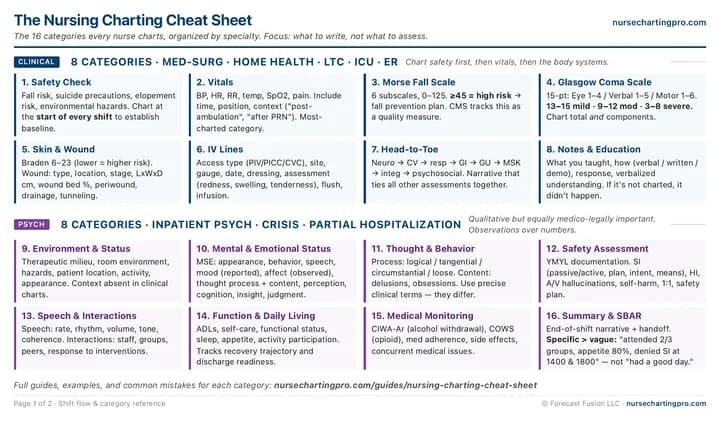
Get the free Nursing Charting Cheat Sheet
- All 16 charting categories, clinical and psych, with what to write for each
- Morse, Braden, Glasgow Coma Scale and SBAR at a glance
- The charting mistakes that cost nurses their licenses
Your first SBAR feels like a final exam you didn't study for. I know - I bombed mine the first three times in sim lab. However, the framework becomes automatic after a few repetitions, and this page provides the weak-vs-strong examples that finally helped me identify my mistakes.
Why This Matters
Regulatory bodies: The Joint Commission, Centers for Medicare & Medicaid Services (CMS), Institute for Healthcare Improvement (IHI)
- National Patient Safety Goals - Hand-off Communication — The Joint Commission (2025)
- SBAR Tool: Situation-Background-Assessment-Recommendation — Institute for Healthcare Improvement (IHI)
- SBAR: a shared mental model for improving communication between clinicians — Jt Comm J Qual Patient Saf. 2006;32(3):167-175 (2006)
- Impact of the communication and patient hand-off tool SBAR on patient safety: a systematic review — BMJ Open. 2018;8(8):e022202 (2018)
What is SBAR (and why nurses use it)
How to Structure Each Component
What goes in each letter, and what doesn't.
S - Situation
B - Background
A - Assessment
R - Recommendation
The complete SBAR example
SBAR for Different Specialties
The framework is the same. The data you plug in changes by specialty.
Psychiatric SBAR
Clinical/Med-Surg SBAR
Other Specialty Variations
Related handoff frameworks
SBAR is the most-taught framework in US nursing education, but it is not the only handoff structure you will encounter. Here are the four variants most nurses run into, and how each one relates to SBAR.
ISBAR
I-PASS
Bedside shift report
Change of shift report
How to Practice SBAR
SBAR is a nursing skill that improves significantly with practice. Here's how to gain experience without working on a real unit yet.
SBAR Templates and Tools
Common Mistakes
Burying the lede in Background
The receiver needs to know the current concern first so they can focus on the relevant background. Providing three minutes of history before the actual problem wastes time and buries the urgency.
No Assessment - Reporting Data Without Judgment
Assessment reflects your clinical judgment. The receiver can read the data in the chart; they need your interpretation of its meaning and the reason for your concern.
Vague or Absent Recommendation
Without a clear recommendation, the receiver must guess your intentions. This ambiguity is precisely what SBAR aims to eliminate. For more information on documentation errors that could jeopardize your license, refer to the charting mistakes guide.
Background that runs 8 minutes
SBAR is a 2-3 minute framework. An 8-minute Background becomes a history-and-physical recitation. Cut ruthlessly - ask yourself, "Does the listener need this to act on the Situation?"
Using SBAR for Documentation Instead of Communication
SBAR is a communication tool. Narrative nursing notes are a documentation tool. They serve different purposes and have different structures. Conflating them weakens both.
Case Example
Scenario
You're the day shift nurse. At 0900 on day 2 of admission, Mr. Chen's wife calls you to the room - he's now short of breath and his O2 sat dropped from 96% to 88% on room air in the last hour. His 0700 vitals were stable (BP 128/76, HR 88, resps 18, sat 96%). Current vitals at 0855: BP 142/84, HR 102, resps 24, sat 88% on RA. He's diaphoretic and using accessory muscles. You need to call the attending.
Chart Entry
S - Situation: "This is Sarah, Mr. Chen's nurse on 4-North. I'm calling about Mr. Chen in Room 412. He's a 68 year old admitted yesterday for CHF exacerbation, and right now he's acutely short of breath with an O2 sat that dropped from 96% to 88% on room air over the last hour."

B - Background: "He came in yesterday with bilateral crackles, 3+ pitting edema, and BNP of 850. He was diuresed overnight with Lasix 40 IV - output was about 1.5 liters. This morning's vitals at 0700 were BP 128/76, HR 88, resps 18, sat 96% on room air. He ate 100% of breakfast at 0730 with no complaints. Since then, his sat has trended down. Current vitals at 0855 are BP 142/84, HR 102, resps 24, sat 88% on room air. He's diaphoretic and using accessory muscles."

A - Assessment: "I believe he's experiencing an acute heart failure exacerbation - possibly fluid-overload rebound after last night's diuresis, or possibly something new. I'm concerned he needs supplemental oxygen now and likely more aggressive treatment."

R - Recommendation: "I'd like to start him on 2 liters O2 via nasal cannula right now, get a chest X-ray, and recheck vitals and O2 sat in 15 minutes. We should also consider another dose of Lasix if he can tolerate it. Can you come see him, or do you want me to escalate further?"
Key points from above chart entry
- Situation:
- Leads with the current problem (acute SOB + dropping sat), not the admission diagnosis.
- Background:
- Provides just enough history to make the situation make sense, with specific numbers and a timeline.
- Assessment:
- States the nurse's actual clinical judgment - "I think he's having an exacerbation...I'm concerned he needs supplemental oxygen now."
- Recommendation:
- Concrete asks: O2, CXR, recheck vitals, consider Lasix, come see him. Not just "wanted to let you know."
Pro Tips
- Write it before you say it, until you're fluent: In my first 20 SBARs, I scripted each one, writing everything on a scrap of paper and reading from it. This approach is acceptable; no one expects you to freestyle a perfect SBAR as a student. After about 20, you will begin to improvise naturally.
- Assessment separates "reading off data" from "giving a report": Practice Assessment specifically. After stating the facts, force yourself to say, "I think..." or "I'm concerned that..." If you cannot finish that sentence, consider what the data means before picking up the phone.
- Don't skip Recommendation because you feel like you're overstepping: The physician can and will disagree with your recommendation - that's their job. Your job is to share your clinical judgment. Saying "I'd like an EKG ordered stat" is not overstepping. Saying nothing and letting the physician guess what you want IS a communication failure.
- If your handoff takes more than 3 minutes, Background is too long: Cut, don't edit. Ask yourself: "Does the listener need this specific piece of information to act on the Situation?" If the answer is no, leave it out. They can ask for more context if they need it.
- SBAR Works for Emails and Messages Too: If you have to write to a provider instead of call, SBAR is still the right structure. Put each section on its own line. The format translates perfectly to written communication.
Step by Step
- Identify the Situation: Introduce yourself, identify the patient, and describe the current situation. Start with the most urgent concern.
- Provide relevant Background: Provide only the history needed to understand the current situation: pertinent diagnoses, current treatment, vital signs trends, and relevant labs.
- State your Assessment: State your clinical judgment regarding the data. Frame your interpretation using phrases like "I think..." or "I'm concerned that...".
- Make a Recommendation: State what needs to happen next: specific orders, monitoring changes, or escalation. Make a concrete request.
Frequently Asked Questions
- What does SBAR stand for in nursing?
- SBAR stands for Situation, Background, Assessment, Recommendation. This structured communication framework facilitates nurse-to-nurse handoffs, physician calls, and patient escalations. Originally developed by the US Navy, it was adapted for healthcare by Kaiser Permanente.
- What is the hardest part of SBAR?
- Assessment is the hardest part of SBAR. Many students and new nurses report data without stating their clinical judgment. In Assessment, you say what you think the data means ("I'm concerned the patient is decompensating") rather than only stating the numbers. Template phrases like "I think..." and "I'm concerned that..." help.
- How long should an SBAR handoff take?
- Aim to keep an SBAR handoff under 3 minutes per patient. If your handoff runs longer, your Background section may have too much detail. Include only the history the receiver needs to act on the current situation.
- Is SBAR the same as a nursing note?
- No, SBAR is not the same as a nursing note. SBAR is a verbal or written communication tool used for handoffs and calls. Nursing notes are documentation in the patient's medical record. They serve different purposes: SBAR communicates urgency and clinical judgment to the next nurse or provider; nursing notes create the permanent legal record of care.
- What is the difference between SBAR and ISBAR?
- ISBAR adds an Identification step to the front of SBAR: you state your name, the patient name plus a second identifier such as date of birth or medical record number, and confirm who you are speaking with before moving into Situation, Background, Assessment, Recommendation. ISBAR is common in Australian, UK, and Irish hospitals and in some US teaching hospitals. The clinical content is identical to SBAR; the change is a formal two-identifier introduction at the top.
- Is bedside shift report the same as SBAR?
- No, bedside shift report is not the same as SBAR. Bedside shift report describes the location and format of the nurse-to-nurse handoff (at the bedside with the patient present), not the framework used to structure the clinical content. Most facilities deliver the SBAR content inside a bedside shift report workflow. You use SBAR (or ISBAR, or I-PASS) to organize what you say, and you do it at the bedside so the patient can see the IV lines, skin, and safety setup while the report happens.
Get the free Nursing Charting Cheat Sheet
- All 16 charting categories, clinical and psych, with what to write for each
- Morse, Braden, Glasgow Coma Scale and SBAR at a glance
- The charting mistakes that cost nurses their licenses
Chart faster with Nurse Charting Pro
Tap through your assessments during the shift and get a draft of your note to review at clock-out. Your notes are cleared from your phone at the end of your shift.
Related Guides
- Glasgow Coma Scale ChartingGCS is one of the most commonly reported Assessment elements in SBAR for neurological patients.
- Skin & Wound Charting (Braden)Wound trends and Braden scores commonly include in SBAR for med-surg and LTC handoffs.
- CIWA-Ar DocumentationAlcohol withdrawal scores and intervention timing drive the SBAR for any patient experiencing alcohol withdrawal.
- COWS DocumentationOpioid withdrawal scores and induction timing drive the SBAR for any patient on MAT induction.
- Nursing Charting Cheat SheetAll charting categories in one scannable reference.
- Clinical Nursing Charting hubThe complete clinical charting overview connects every clinical category, from vitals to wound care, through SBAR.
- Psychiatric Nursing Charting guidePsych charting overview: SBAR serves as the standard handoff framework on psychiatric units as well.
- Objective vs subjective data in nursingKeeping what the patient reported apart from what you observed.