By Miranda Niemas, Nursing Student (BSN candidate)
Clinically reviewed by Amy Niemas, RN-BC, BSN, MSW
Last updated: October 13, 2026
How to Score and Document a GAD-7 (Nursing Guide)
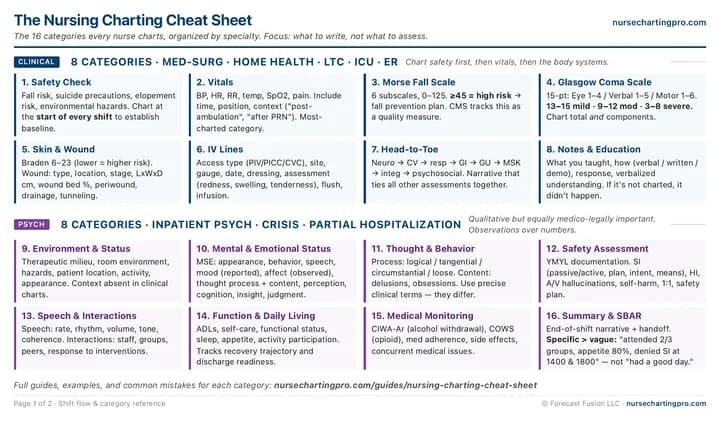
Get the free Nursing Charting Cheat Sheet
- All 16 charting categories, clinical and psych, with what to write for each
- Morse, Braden, Glasgow Coma Scale and SBAR at a glance
- The charting mistakes that cost nurses their licenses
Your med-surg admission is a fictional 27 year old whose chest pain resolved in the ED. The GAD-7 administered on every admission returns a score of 16, with all seven items positive. Cardiology is still ruling out acute coronary syndrome (ACS), but the screening protocol indicates she meets the severe band on a validated anxiety scale. I encountered a similar scenario on my last clinical rotation. The framework that clarified this for me has three pieces: the 2-week recall window (the patient is rating the past 2 weeks, not right now), the four severity bands (0-4 minimal, 5-9 mild, 10-14 moderate, 15-21 severe), and treating the score as a screen rather than a diagnosis.
Why This Matters
Regulatory bodies: U.S. Preventive Services Task Force (USPSTF), American Academy of Family Physicians (AAFP), American Psychiatric Association (APA)
- A brief measure for assessing generalized anxiety disorder: the GAD-7 — Spitzer RL, Kroenke K, Williams JBW, Löwe B. Arch Intern Med. 2006;166(10):1092-1097 (2006)
- Anxiety disorders in primary care: prevalence, impairment, comorbidity, and detection — Kroenke K, Spitzer RL, Williams JBW, Monahan PO, Löwe B. Ann Intern Med. 2007;146(5):317-325 (2007)
- Generalized Anxiety Disorder and Panic Disorder in Adults — Locke AB, Kirst N, Shultz CG. Am Fam Physician. 2015;91(9):617-624 (2015)
- An ultra-brief screening scale for anxiety and depression: the PHQ-4 — Kroenke K, Spitzer RL, Williams JBW, Löwe B. Psychosomatics. 2009;50(6):613-621 (2009)
- Screening for Anxiety Disorders in Adults: US Preventive Services Task Force Recommendation Statement — US Preventive Services Task Force. JAMA. 2023;329(24):2163-2170. doi:10.1001/jama.2023.9301 (2023)
- 988 Suicide and Crisis Lifeline (federally designated) — SAMHSA / Vibrant Emotional Health, 988 Suicide and Crisis Lifeline (active 2024, anxiety with comorbid suicidal ideation referral resource) (2024)
What the GAD-7 Measures and Where It Is Used
The 7 Items, Walked Top Down
The GAD-7 assesses the symptom domains of generalized anxiety disorder. Each item is rated 0 (not at all), 1 (several days), 2 (more than half the days), or 3 (nearly every day), based on the past 2 weeks.
Item 1 - Feeling Nervous, Anxious, or On Edge
Item 2 - Not Being Able to Stop or Control Worrying
Item 3 - Worrying Too Much About Different Things
Item 4 - Trouble Relaxing
Item 5 - Being So Restless That It Is Hard to Sit Still
Item 6 - Becoming Easily Annoyed or Irritable
Item 7 - Feeling Afraid as if Something Awful Might Happen
Functional Impairment Item (Sometimes Called Item 8)
Scoring and Severity Bands
GAD-7 Beyond GAD: Social Anxiety, Panic, and PTSD
GAD-2, GAD-7, PHQ-9: How the Screens Layer in Primary Care
GAD-7 Documentation in NurseChartingPro
Common Mistakes
Charting Only the Total Without the Component Scores
GAD-7 without the 7 component scores hides the differential. Item-pattern shifts (high item 7 alone, or high items 4-5-6 together) point toward different conditions in the GAD spectrum. The next reader needs the component breakdown to interpret the screen.
Treating GAD-7 as a Diagnosis
GAD-7 serves as a screening tool, not a definitive diagnosis. A score in the moderate or severe range suggests possible GAD (or social anxiety disorder, panic disorder, or PTSD per Kroenke 2007) but does not confirm the diagnosis without a clinical interview. Documenting "patient has GAD" based solely on a GAD-7 score constitutes an overreach in documentation.
Missing the Functional Impairment Item
Documenting the functional impairment question is essential for completeness, even though it does not contribute to the score. Two patients with the same total can experience very different functional impacts; the impairment response distinguishes their situations in the chart.
Scoring a Partial GAD-7 as if It Were Complete
GAD-7 cannot be scored if any item is skipped. A partial GAD-7 should be documented as such, not summed and labeled with a severity band. The decline itself is sometimes a clinical signal worth following up on.
Not Pairing With PHQ-9 in Patients With Mood Symptoms
Depression and anxiety frequently co-occur, prompting Kroenke and colleagues to develop the PHQ-4 to identify both with one brief instrument. When mood symptoms accompany anxiety symptoms, GAD-7 alone fails to address the depression aspect; pairing it with PHQ-9 captures both.
Using Adult GAD-7 on a Pediatric Patient
The GAD-7 is validated for individuals aged 18 and older. Pediatric anxiety screening requires different instruments, such as SCARED, MASC, and the Spence Children's Anxiety Scale, because adolescent anxiety symptoms differ from adult presentations. Administering the adult GAD-7 to a minor results in a score that may not align with the validated thresholds for that population.
Case Example
Scenario
As the day shift med-surg nurse, you care for Mrs. Garcia, a fictional 27 year old admitted overnight for chest pain that resolved in the ED. The unit's admission protocol includes a GAD-7 for every patient and a PHQ-9 if any mood symptoms are endorsed. You complete the GAD-7 with the patient at 0930, and the score returns 16, with all 7 items scoring 2 or 3. The patient is alert, oriented, hemodynamically stable, and denies current chest pain. Cardiology follows for serial troponins and a planned outpatient stress test. The on-call hospitalist is in rounds.
Chart Entry
0930 GAD-7 Screening:

GAD-7 total: 16 (severe severity band).

Component scores (each 0-3, recall 2 weeks):
- Item 1 (nervous, anxious, on edge): 3 (nearly every day)
- Item 2 (cannot stop or control worrying): 3 (nearly every day)
- Item 3 (worrying too much about different things): 2 (more than half the days)
- Item 4 (trouble relaxing): 3 (nearly every day)
- Item 5 (restless, hard to sit still): 2 (more than half the days)
- Item 6 (easily annoyed or irritable): 2 (more than half the days)
- Item 7 (feeling afraid as if something awful might happen): 1 (several days)

Functional impairment: "Very difficult" to do work, take care of things at home, or get along with other people.

Mood symptoms reported alongside anxiety:
Patient endorsed low mood, decreased interest in usual activities, and trouble falling asleep over the past 2 weeks. PHQ-9 administered, total 11 (moderate), item 9 negative ("not at all"), functional impairment "somewhat difficult." Both screens documented as separate entries.

Action taken:
- Provider (hospitalist) notified at 0945 with GAD-7 score, severity band, item-pattern (items 1, 2, 4 all at 3 nearly every day; item 7 only "several days"), and the parallel PHQ-9 result.
- Behavioral-health consult ordered; expected within 24 hours.
- Cardiology team made aware that severe anxiety symptoms predate the chest pain admission per patient report (recall 2 weeks); workup continues.
- Patient education: reviewed coping skills and stress-relief techniques (paced breathing, grounding) at the bedside. At discharge, outpatient mental-health resources will be reviewed, including primary-care follow-up for sustained symptom management.
- Reassess GAD-7 score is not indicated on this admission unless symptoms shift; PHQ-9 item 9 reassessment at every shift handoff per institutional policy on positive depression screens.
Key points from above chart entry
- Total + 7 component scores broken out:
- The total alone hides the item-level pattern. Items 1, 2, and 4 all at 3 (nearly every day) with item 7 only at 1 (several days) is consistent with GAD rather than panic disorder. Listing all 7 components makes the differential visible to the next reader.
- Paired with PHQ-9:
- Mood symptoms were endorsed alongside anxiety, so PHQ-9 was administered the same hour. Charting both screens with both totals captures the comorbidity that GAD-7 alone would miss.
- Functional impairment captured:
- The "very difficult" functional impairment alongside the severe-band total communicates more clinical impact than the score alone. Required even though it does not contribute to the total.
- 2-week recall window referenced:
- The chart entry notes that the symptoms predate the admission per the 2-week recall window. This protects against scoring situational anxiety from the chest-pain workup as severe GAD.
- Reassessment frequency specified:
- GAD-7 is not routinely reassessed in inpatient short stays unless symptoms shift; PHQ-9 item 9 reassessment is the more clinically pressing repeat assessment and is documented separately.
Pro Tips
- Read the Items Verbatim: GAD-7 items use plain language for a reason: the validated thresholds rely on patients interpreting the items as written. Paraphrasing item 4 as "do you feel anxious" instead of reading "trouble relaxing" often leads to different responses. Read the seven items word-for-word. The same applies to the response options: "several days" differs from "a few times" or "occasionally," and the score depends on patients mapping their experiences to the validated phrasing.
- The 2-Week Recall Is What Makes the Score Valid in Inpatient Populations: Hospitalized patients are usually anxious about something acute (the workup, the procedure, the diagnosis). The 2-week window is what separates trait anxiety from state anxiety on this admission. Read the recall instructions aloud: "Over the past 2 weeks, how often have you been bothered by the following problems?" Patients answering for "right now" or "the past day" produce a score that does not map to the validated thresholds and may overestimate baseline anxiety severity.
- Pair With PHQ-9 When Mood Symptoms Are Endorsed: Depression and anxiety frequently co-occur, prompting Kroenke and colleagues to develop the PHQ-4 in 2009. This 4-item screen effectively identifies both conditions. If the patient reports low mood, anhedonia, sleep changes, or appetite changes during GAD-7 administration or follow-up, add the PHQ-9 for the next assessment. Documenting both screens in the same encounter captures the comorbidity that either screen alone might miss.
- Watch the Item-Pattern, Not Just the Total: The GAD-7 also identifies social anxiety disorder, panic disorder, and PTSD, according to Kroenke 2007. A high score on item 7 (feeling afraid as if something awful might happen) alongside sub-threshold scores on items 1 through 6 may indicate panic disorder rather than GAD. Similarly, a high score on item 6 (irritability) with arousal symptoms in a patient with a known trauma history may suggest PTSD. These patterns serve as clues for the clinical interview, not strict diagnostic rules. Document any notable patterns to ensure the consult clinician recognizes what you observed.
- Differentiate Score from Diagnosis in Every Chart Entry: Chart "GAD-7 score 14, moderate band, score consistent with possible generalized anxiety disorder; clinical interview pending." Do not chart "patient has anxiety disorder." The score does not establish the diagnosis; the clinical interview that follows does. Keeping that distinction in your chart entry protects the next provider from having to walk back an overreach.
Step by Step
- Frame the 2-week recall window: Read the 2-week recall instructions aloud: "Over the past 2 weeks, how often have you been bothered by the following problems?" The 2-week window separates trait anxiety from state anxiety on this admission and is what makes the score map to the validated thresholds.
- Score each item 0 to 3: Score items 1 through 7 with the patient by reading them verbatim. Assign a score of 0 (not at all), 1 (several days), 2 (more than half the days), or 3 (nearly every day). Document the patient's response when uncertain; let the score reflect their input, not your interpretation.
- Sum the score and identify the severity band: Add the 7 item scores to get a total from 0 to 21. Map the total: 0-4 minimal, 5-9 mild, 10-14 moderate, 15-21 severe. A score of 10 or higher is the most clinically meaningful threshold and is what most programs use to trigger further evaluation.
- Document the functional impairment response: Ask the functional impairment question and document the response: not difficult at all, somewhat difficult, very difficult, or extremely difficult. Although the response does not contribute to the total, it is necessary for complete documentation.
- Pair with PHQ-9 if mood symptoms are also endorsed: If the patient endorses low mood, anhedonia, sleep changes, or appetite changes during the GAD-7 or in the bedside follow-up, administer the PHQ-9 during the same encounter. Document both totals and component scores. The comorbid pattern indicates the clinically actionable finding. Read the related guide
- Communicate to the provider when score is 10 or higher: Total at or above 10 should prompt provider notification with the score, severity band, item-pattern (especially when items 4-5-6 cluster or item 7 stands alone), functional impairment, and any paired PHQ-9 result. Include the score in your SBAR (Situation, Background, Assessment, Recommendation) report at the next handoff and reassess as often as the patient's clinical course requires.
Frequently Asked Questions
- Is GAD-7 only for generalized anxiety disorder?
- No, the GAD-7 also screens for social anxiety disorder, panic disorder, and post-traumatic stress disorder (PTSD), not only generalized anxiety disorder (GAD). Although it was developed and validated for GAD, Kroenke and colleagues showed in 2007 that it also works as a primary-care screen for those three conditions, with a sensitivity of 66% to 74% at a score of 10 or higher. A positive GAD-7 in a patient who does not meet GAD criteria during the provider's clinical interview is not a false positive; it points to the possibility of one of the other three conditions.
- How does GAD-7 differ from GAD-2?
- The GAD-2 is the first two items of the GAD-7 (anxious arousal and uncontrolled worry) and serves as an ultra-brief entry screen. A GAD-2 score of 3 or higher prompts escalation to the full GAD-7 in primary care. While sensitivity is comparable between the two, the GAD-7 has substantially higher specificity. This difference is why clinicians escalate to the full GAD-7 after a positive GAD-2 instead of treating the GAD-2 as the final answer.
- What GAD-7 score should prompt clinical concern?
- A GAD-7 score of 10 or higher should prompt clinical concern; it is the most clinically meaningful threshold. At this level, the GAD-7 achieves 89% sensitivity and 82% specificity for generalized anxiety disorder (GAD) compared to structured psychiatric interviews in the validation cohort (Spitzer 2006). Most anxiety-screening programs use 10 to trigger further evaluation.
- Can a nurse administer GAD-7 independently?
- Yes, a nurse can administer the GAD-7 independently. It is a self-report instrument and is routinely administered by nursing staff in admission, primary-care, and emergency department settings. The score and the documentation belong to the nurse who administered it; the diagnostic interpretation belongs to a clinician licensed to make an anxiety-disorder diagnosis. Administering and scoring GAD-7 is within nursing scope; diagnosing GAD or any other anxiety disorder from the score is not.
- Should GAD-7 always pair with PHQ-9?
- Pair the GAD-7 with the PHQ-9 in any patient who has mood symptoms alongside anxiety symptoms. Depression and anxiety co-occur often enough that Kroenke and colleagues developed the PHQ-4 in 2009 specifically to catch both with one ultra-brief instrument (PHQ-2 + GAD-2). When low mood, anhedonia, sleep changes, or appetite changes are endorsed alongside anxiety, PHQ-9 should follow GAD-7 in the same encounter.
- How often should GAD-7 be repeated?
- In primary care, the GAD-7 is commonly repeated every 4 to 6 weeks to monitor response to treatment. In inpatient settings, repeat administration is uncommon during a short stay unless symptoms shift; the score reflects the 2-week recall window and a repeat the next day rarely produces clinically actionable change. Document the rationale when the score is repeated so the next reader understands why.
Get the free Nursing Charting Cheat Sheet
- All 16 charting categories, clinical and psych, with what to write for each
- Morse, Braden, Glasgow Coma Scale and SBAR at a glance
- The charting mistakes that cost nurses their licenses
Chart faster with Nurse Charting Pro
Tap through your assessments during the shift and get a draft of your note to review at clock-out. Your notes are cleared from your phone at the end of your shift.
Related Guides
- PHQ-9 documentationThe paired depression screen. PHQ-9 and GAD-7 are typically paired in primary care because depression and anxiety are highly comorbid. Read the PHQ-9 guide when low mood, anhedonia, or sleep changes are endorsed alongside anxiety.
- mental and emotional status chartingMental and Emotional Status category. GAD-7 is in NCP once the structured field ships. Read this guide for the framework that holds anxiety, depression, and mood observations together.
- thought and behavior chartingThis category captures observable behavior, including the motor and cognitive correlates of anxiety such as restlessness, irritability, and catastrophic thinking. GAD-7 component-score patterns often align with the unit team's observations in this area.
- SBAR for psychiatric nursingInclude the GAD-7 in the Background of any psych SBAR along with the PHQ-9. The four elements to carry into the handoff are score, severity band, item pattern, and functional impairment.
- psychiatric nursing charting overviewPsychiatric charting overview. GAD-7 is one of several validated instruments the psych framework uses.