I struggled to distinguish tangential from circumstantial thinking for weeks during my psych rotation. A patient would talk for five minutes straight, and I would sit there wondering whether they had answered my question. I kept second-guessing my notes. Then came the first time a patient described hearing voices. I wrote, "patient reports auditory hallucinations," but my preceptor asked, "What do the voices say? Are they commanding? How does the patient respond?" I had not asked any of those follow-up questions. This page is the breakdown I wish I had taped to my clipboard that first week: what each thought finding means, how to differentiate them, and what a thorough entry looks like.
Video coming soon — subscribe to be notified when new episodes drop.
Why This Matters
Regulatory bodies: Joint Commission Behavioral Health Standards, State Mental Health Codes
Documenting thought process and content carries diagnostic and legal weight that surpasses most other charting categories. A patient's thought disorganization often serves as clinical evidence supporting or challenging a psychotic disorder diagnosis. The specificity of your documentation can determine whether an involuntary hold is upheld in a commitment hearing, whether a treatment team adjusts antipsychotics, or whether a forensic evaluator can reconstruct the patient's mental state months after discharge. Joint Commission behavioral health standards require psychiatric assessments to document the patient's thought process and content as part of the mental status evaluation. State mental health codes frequently reference thought disorder findings as criteria for involuntary treatment decisions. Vague entries like "thought process disorganized" without supporting examples leave the clinical and legal record incomplete. Specific entries that describe the pattern of disorganization, quote the patient's words, and document behavioral correlates create a record that withstands scrutiny. The 1979 Andreasen taxonomy of thought, language, and communication disorders remains the foundational classification system for formal thought disorder; the terminology you use in the chart traces back to that work. Accurate documentation also matters for tracking treatment response: if a patient's loose associations resolve over two weeks of antipsychotic therapy, the chart should reflect that progression through increasingly organized entries.
Thought process describes how the patient's thinking is organized and flows - not the content of their thoughts, but the connections between their ideas. The NurseChartingPro app offers eight thought process options: Clear, Linear, Organized, Disorganized, Tangential, Delusional, Grandiose, and Paranoid. Below, I outline each pattern with clinical examples and documentation tips.
Linear and Goal-Directed
The patient's ideas connect logically from one to the next. They answer your questions, stay on topic, and reach the point. This represents the baseline - most patients present with linear, goal-directed thought most of the time. In the app, "Clear," "Linear," and "Organized" describe variations of this baseline.
What you hear: You ask, "How did you sleep last night?" and the patient responds, "Not great, I woke up around 3 AM and couldn't get back to sleep. I kept thinking about my court date."
Documentation example: "Thought process linear and goal-directed. Patient answers questions directly and elaborates appropriately when prompted. No tangential or circumstantial thinking observed."
Tangential
The patient goes off on a detour and never returns to the original question. You ask about sleep, and they start discussing their roommate, then shift to the food in the cafeteria, leaving you without an answer about sleep. The key distinction is that they leave the topic and do not come back. This finding is often confused with circumstantial thinking, as noted in the entry below.
What you hear: You ask, "How did you sleep?" and the patient says, "Well, my roommate was snoring again, and you know the food here - I asked for extra pudding yesterday, and they said no. My sister used to make this pudding recipe that was really good; she lives in Ohio now..."
Documentation example: "Thought process tangential. Patient frequently diverges from the topic of conversation and does not return to the original question without redirection. Required repeated prompting to address sleep, medication adherence, and safety screening questions."
Circumstantial
The patient takes long, winding detours but eventually returns to the point. They provide excessive details and go on tangents, but if you wait long enough (or gently redirect), the answer to your question does appear. The destination is reached; it just takes a scenic route to get there.
What you hear: You ask, "How did you sleep?" and the patient responds, "Well, my roommate was snoring, and the lights in the hallway are really bright, and I was thinking about what the doctor said yesterday about changing my medication. I was worried about side effects because last time I had that nausea - but anyway, I slept maybe four hours total."
Documentation example: "Thought process circumstantial. Patient provides excessive detail and takes frequent detours but ultimately answers questions when allowed to continue. Interview required additional time due to over-inclusive responses."
Loose Associations
Ideas shift between unrelated or distantly related topics without logical connections. The patient is not merely going off on tangents; the links between their ideas are missing or incomprehensible to the listener. This is a hallmark finding in psychotic disorders and is more severe than tangentiality.
What you hear: You ask, "How did you sleep?" and the patient responds, "The sleep was blue. My mother sent telegraphs. Sixteen is the number they use for the water. I need new shoes."
Documentation example: "Thought process characterized by loose associations. Patient's statements shift between unrelated topics without identifiable logical connections. Unable to maintain a coherent conversational thread. Example: when asked about sleep, patient responded with references to colors, family communication, numbers, and clothing in sequence without apparent connection."
Flight of Ideas
Rapidly shifting between topics that may share loose or superficial connections (often rhyming, punning, or associative links). The rate is fast - the patient jumps quickly from one idea to the next. This pattern is most often associated with manic or hypomanic episodes. The difference from loose associations is that in flight of ideas, you can sometimes trace the thread (even if it is thin); in loose associations, there is no discernible thread.
What you hear: You ask, "How are you feeling?" and the patient responds rapidly: "Feeling great, feeling the beat, I could be on the street, Wall Street, that's where the money is, honey, funny you should ask - "
Documentation example: "Thought process notable for flight of ideas. Patient speaks rapidly and shifts between topics connected by superficial associations, including rhyming and phonetic similarity. Difficult to interrupt. Content loosely linked, but transitions are driven by word sounds rather than logical connections."
Disorganized (Word Salad)
At its most severe, thought disorganization produces speech that is incomprehensible - sometimes called "word salad." Words are strung together without grammatical structure or meaning. This represents a severe disruption of thought process and is most commonly seen in acute psychosis.
What you hear: "The table is running through the telephone. Green is the going. My fingers have the answer but the ceiling."
Documentation example: "Thought process severely disorganized. Patient's speech lacks coherent grammatical structure or identifiable meaning. Unable to engage in goal-directed conversation. Example of verbatim output documented: [quote]. Speech appears to represent word salad with no discernible communicative intent during this assessment period."
Thought Blocking
The patient stops mid-sentence and cannot resume their train of thought. A sudden, noticeable break occurs - the patient may look confused or frustrated, then start on a completely different topic or simply go silent. This differs from pausing to gather thoughts (which is normal); in thought blocking, the idea is lost, and the patient often cannot explain what they were about to say.
What you hear: "I was telling you about my - " [5-second pause, patient looks confused] " - I don't know. What were we talking about?"
Documentation example: "Thought blocking observed on three occasions during the interview. Patient stopped mid-sentence, appeared confused, and was unable to resume or recall the topic of conversation. Required redirection to continue the interview."
Thought Content (the "What")
Thought content documents what the patient thinks about - the substance of their thoughts, as opposed to how they organize those thoughts. This section covers the major categories of abnormal thought content that require specific documentation on a psychiatric unit.
Delusions
A delusion represents a fixed, false belief inconsistent with the patient's cultural or religious background, maintained despite contradictory evidence. When documenting delusions, identify the type and quote the patient directly. The major types include:
Persecutory - belief that one is being targeted, followed, poisoned, or conspired against. "The nurses are putting something in my food to keep me sedated."
Grandiose - belief in inflated self-importance, special powers, or identity. "I have been chosen by God to lead the new government."
Somatic - belief about the body that is medically unfounded. "My organs are rotting from the inside. I can feel them dissolving."
Religious - belief with religious content that exceeds the patient's cultural norms. "I am the second coming and I must deliver a message to the world."
Referential - belief that neutral events or objects carry special personal significance. "The news anchor was talking directly to me last night. The story was a coded message."
Documentation example: "Patient endorses persecutory delusions. States: 'The staff is working with my ex-wife to keep me locked up. They are listening to my phone calls and reporting back to her.' Belief is fixed - patient was not redirectable when presented with alternative explanations. No insight into the delusional nature of belief."
Obsessions
Obsessions consist of intrusive, unwanted, repetitive thoughts that cause significant distress. They differ from delusions in that the patient typically recognizes the thoughts as irrational or excessive, though this insight can vary. Document the content of the obsessive thoughts and the patient's level of distress.
Documentation example: "Patient reports intrusive, repetitive thoughts about contamination. States: 'I know it doesn't make sense but I can't stop thinking the doorknobs are going to make me sick.' Reports washing hands approximately 30 times per day. Describes the thoughts as distressing and unwanted."
Suicidal Ideation (SI)
Document SI screening every shift on a psychiatric unit. Note whether the patient endorses or denies SI, and if endorsed, specify: passive vs. active, presence or absence of plan, intent, means, and access to means. Quote the patient. This section of your thought content documentation should align with your safety assessment; a discrepancy between the two indicates a survey finding.
Documentation example: "Patient endorses passive SI. States: 'I just don't want to wake up tomorrow.' Denies active suicidal ideation, plan, intent, or access to means. Safety assessment updated and precaution level reviewed."
For a full breakdown of SI documentation, risk stratification, and safety planning, see the safety assessment charting guide. For the structured suicide risk screen most often used at the bedside (the C-SSRS), with verbatim ideation and behavior questions, see the C-SSRS documentation guide. When a positive PHQ-9 item 9 is the upstream trigger, the C-SSRS is the standard escalation.
Homicidal Ideation (HI)
HI screening follows the same structure as SI: endorsement or denial, specificity of target, plan, intent, and means. If HI is endorsed, document whether the patient identifies a specific person and whether there is a plan. Duty-to-warn obligations (Tarasoff) may apply depending on your state.
Documentation example: "Patient denies homicidal ideation. No expressed intent to harm others. When asked directly, states: 'I'm not going to hurt anyone. I just want to go home.'"
For detailed HI documentation guidance, see the safety assessment charting guide.
Auditory and Visual Hallucinations (AVH)
When a patient reports hallucinations, stating "patient reports auditory hallucinations" is insufficient. Document four aspects: the type (auditory, visual, tactile, olfactory, gustatory), the content (what the voices say, what the patient sees), the command quality (do the voices instruct the patient to act, and if so, how?), and the patient's response (does the patient follow the commands, argue with the voices, or try to ignore them?).
Command hallucinations - voices that instruct the patient to act - represent a safety-critical finding. The content of the command matters: "The voice tells me to go outside" differs from "The voice tells me to hurt myself." Document the specific command and the patient's stated response.
Documentation example: "Patient endorses auditory hallucinations. Reports hearing one male voice, described as 'my uncle's voice,' occurring intermittently throughout the day. Content: voice makes critical statements ('You're worthless, no one wants you here') and has issued commands to 'stop eating.' Patient states he has followed this command on two occasions this week, skipping meals. Patient reports attempting to ignore the voice by 'putting my headphones in.' No visual, tactile, olfactory, or gustatory hallucinations reported. Hallucination content reported to treatment team for safety review."
Observed behaviors
Behavioral documentation captures what you observe the patient doing, including their motor activity, social engagement, interactions with staff, adherence to unit structure, and self-care. The NurseChartingPro app offers seven behavior options: Cooperative, Pleasant, Appropriate, Restless, Agitated, Irritable, and Withdrawn. Here's how to observe and document using objective, observable language.
Motor activity: Is the patient calm and seated? Are they pacing the hallway or rocking in their chair? Psychomotor retardation (slowed movements, delayed responses) and psychomotor agitation (restlessness, pacing, inability to sit still) represent clinically significant findings. Document what you see, not your interpretation of their actions.
Social engagement: Is the patient interacting with peers, isolating in their room, or participating in group activities? Are they approaching staff spontaneously or only responding when approached? Withdrawal and isolation commonly present in depression and psychosis, while excessive sociability and boundary violations may occur in mania.
Response to staff: Cooperative, guarded, hostile, dismissive, or overly familiar. Document specific interactions rather than using labels. "Patient declined morning vitals, stating 'Leave me alone'" provides more useful information than "Patient was uncooperative."
Adherence to unit structure: Is the patient attending groups, following the daily schedule, and complying with unit rules? Document specific instances of engagement or refusal. "Patient attended two of three scheduled groups today. Declined art therapy, stating 'I don't feel like it.' Attended medication education and process group without incident."
Self-care: Hygiene, grooming, eating, and sleeping patterns. Document your observations: "Patient showered independently this morning and changed into clean clothes" or "Patient has not showered in three days per nursing observation. Wearing the same hospital gown since admission. Eating less than 25% of meals." These observations are concrete and trackable over time.
The through-line for all behavioral documentation is to describe the behavior, not the person. "Patient paced the hallway for 40 minutes between 1400-1440, appeared unable to sit still, and declined two staff offers to return to their room" constitutes observation. In contrast, "Patient is agitated and restless" serves as a label. The observation version provides the treatment team with actionable information and a basis for comparison tomorrow.
Observation vs. Interpretation
The distinction between observation and interpretation is especially critical in psychiatric charting. Interpretive labels can bias the entire treatment team and follow a patient through their medical record for years. Observational language creates a defensible, transferable record.
Weak (interpretation): "Patient is paranoid and delusional."
Strong (observation): "Patient states: 'The nurses are poisoning my food.' Refused lunch and dinner trays. Examined medication closely before accepting, asking 'What is this really?' Belief is fixed - patient was not redirectable when staff explained the medication and its purpose."
The observation version documents the exact statements and behaviors that led to your clinical impression. Another nurse, a physician, or an attorney reading the chart can see the evidence and draw their own conclusions.
Weak (interpretation): "Patient is manipulative and attention-seeking."
Strong (observation): "Patient activated call light 12 times between 0800-1200. Requests included: extra blankets (x3), room temperature adjustment (x2), request to speak with physician (x4), request for PRN medication (x2), and request to use phone outside scheduled hours (x1). When informed that physician would round at 1400, patient raised voice and stated 'Nobody listens to me in this place.'"
Weak (interpretation): "Patient is responding to internal stimuli."
Strong (observation): "Patient observed standing in the corner of the dayroom, looking at the upper right corner of the room, and moving lips as if speaking. When approached, patient stated 'I'm talking to him' and pointed to the empty corner. Patient reports hearing a male voice giving instructions. Content of hallucinations assessed - see thought content documentation."
Every time you find yourself reaching for an adjective that assigns motive or character - manipulative, attention-seeking, noncompliant, resistant, dramatic - stop and ask: what did I actually see and hear? Write that instead. The behavior speaks for itself.
Common Mistakes
Quoting the Patient When Describing Paranoia
❌Weak: Thought content: Patient exhibits paranoia.
✅Strong: Thought content: Patient endorses persecutory beliefs. States: "The staff is recording my conversations and sending them to the government." Belief is fixed and patient was not redirectable when presented with alternative explanations.
Using the term "paranoid" requires supporting evidence. Without quoting the patient, the reader cannot evaluate the severity, specificity, or content of the paranoid ideation. Including the patient's statements transforms a label into a documented finding.
Confusing Tangential with Circumstantial
❌Weak: The thought process was tangential; the patient provided lengthy answers but eventually responded to questions.
✅Strong: The thought process was circumstantial. The patient offered excessive detail and frequently digressed (discussing family history, meal preferences, and roommate complaints) but ultimately answered each question when allowed to continue without interruption.
If the patient eventually reaches the point, the thought process is circumstantial, not tangential. Tangential thinking means the individual leaves the topic and never returns. This distinction matters diagnostically - tangential thinking is more clinically significant and often associated with psychotic processes. Misclassifying this in the chart can mislead the treatment team.
Missing SI/HI/AVH Screening Documentation
❌Weak: Thought content: Patient preoccupied with family stressors. No delusions noted.
✅Strong: Thought content: Patient preoccupied with family stressors. Denies suicidal ideation, homicidal ideation, and hallucinations (auditory, visual) on direct questioning. No delusions elicited.
Omitting SI, HI, and hallucination screening from thought content documentation creates a gap that surveyors and attorneys will notice. Even when the patient denies these issues, the denial must be explicitly documented to demonstrate that the screening was performed. Stating "No delusions noted" without addressing SI/HI/AVH is incomplete.
Using Stigmatizing or Interpretive Language
❌Weak: Patient is manipulative and attention-seeking. Appears to be faking hallucinations for secondary gain.
✅Strong: The patient activated the call light 8 times this shift with requests to speak with the physician. They report auditory hallucinations, but their presentation is inconsistent; the patient does not appear distracted or respond to stimuli when unaware of observation. Documented inconsistencies are available for treatment team review.
Labels such as "manipulative," "attention-seeking," and "faking" interpret behaviors and bias the treatment team, following the patient through their medical record. Document observable behaviors and inconsistencies, allowing the clinical team to draw conclusions. If you suspect symptom exaggeration, describe the specific observations that raised your concern.
Documenting Hallucinations Without Content or Response
❌Weak: Patient reports auditory hallucinations.
✅Strong: Patient endorses auditory hallucinations - reports hearing two female voices that make derogatory comments ("You're disgusting," "Nobody wants you here"). Voices occur primarily at night. Denies command hallucinations. Patient states she copes by "turning the TV up loud." No visual, tactile, or olfactory hallucinations reported.
The type, content, command quality, and patient response are clinically essential. A hallucination that says "You're worthless" differs significantly from one that says "Pick up the knife." Documenting only the presence of hallucinations without these details leaves the safety assessment incomplete and the treatment team uninformed about command risk.
Case Example
Mr. WilliamsAge 35 — Psychotic episode, rule out schizophrenia
fictional patient
Scenario
Mr. Williams is a 35 year old male admitted involuntarily after police brought him to the ED from a bus station where he was "yelling at people who weren't there," according to the officer's report. Day 1 of admission. He is undergoing assessment for a new-onset psychotic episode. You are conducting your initial shift assessment, which includes evaluating thought process, thought content, and behavioral observations.
Chart Entry
Thought Process: Tangential. Patient begins answering questions but diverges to unrelated topics and does not return to the original question without redirection. Example: when asked about sleep, patient stated "Sleep is when they do it - the wiring, you know, the wires in the walls are connected to the main system" and continued discussing a surveillance system without returning to the sleep question. Loose associations also noted - connections between ideas are difficult to follow. No flight of ideas, thought blocking, or perseveration observed.

Thought Content:
Delusions: Patient endorses persecutory delusions. States: "They have been following me for three months. They put cameras in my apartment and they are tracking me through the bus system. The driver was one of them." Belief is fixed - patient became visibly agitated when asked who "they" are and stated "You know who they are. You are probably one of them." Not redirectable. No grandiose, somatic, or referential delusions elicited.

SI: Patient denies suicidal ideation on direct questioning. States: "I don't want to die. I want them to leave me alone." Denies plan, intent, or access to means.

HI: Patient endorses general statements about self-defense - "If they come for me I will protect myself" - but denies intent to harm any specific individual. No identified target. Denies plan or access to weapons. Staff aware; documented for treatment team review.

AVH: Patient endorses auditory hallucinations. Reports hearing two male voices that comment on his behavior ("He's sitting down now," "He's not going to do it") and intermittently issue commands. Patient reports the voices told him to "get off the bus and run" yesterday, which he followed. Denies the voices have commanded self-harm or harm to others. Patient states he "usually does what they say because they get louder if I don't." No visual, tactile, olfactory, or gustatory hallucinations reported.

Observed Behaviors: Patient is restless - standing and sitting repeatedly during the 25-minute interview, pacing to the door twice. Agitated when discussing surveillance beliefs, raising voice and gesturing broadly. Eye contact intense and sustained, described by patient as "I have to watch you." Withdrew from peer interaction in the dayroom prior to interview - sat in the far corner with his back to the wall. Declined lunch tray, stating "I'm not eating that." Accepted water from sealed bottle only. Hygiene fair - wearing clothes from admission, has not showered. Cooperative with interview overall despite intermittent agitation; did not require de-escalation.
Key points from above chart entry
Thought process:
Identifies the specific pattern (tangential with loose associations) and provides a verbatim example showing how the patient diverged from the sleep question. This lets the reader assess severity rather than taking the documenter's word for it.
Delusions:
Quotes the patient directly, identifies the delusion type (persecutory), notes it is fixed and not redirectable, and documents the patient's response when the belief was explored. Rules out other delusion types explicitly.
AVH documentation:
Covers all four required elements: type (auditory, two male voices), content (commentary and commands), command quality (told to "get off the bus and run" - not self-harm), and patient response (usually follows commands because voices escalate). This is the level of detail that informs safety planning.
HI documentation:
Documents the general self-defense statement with a direct quote rather than labeling it as "homicidal ideation." Notes the absence of a specific target, plan, and means. Appropriately flags for treatment team review without over-interpreting.
Observed behaviors:
Describes specific, observable actions (pacing, declining food, sitting with back to wall) rather than labels. The food refusal detail paired with the persecutory delusion content gives the treatment team clinical context - is the patient refusing food because of paranoia about poisoning?
Pro Tips
💡
Quote the patient when documenting delusions: Documenting a delusion as "patient is delusional" provides little information. In contrast, documenting it as "patient states: 'The CIA implanted a chip in my tooth during my last dental visit'" conveys the content, specificity, and conviction of the statement. Always capture the patient's exact words in quotes. If the patient expresses something that seems delusional but remains uncertain, document their statement and note "belief not yet fully assessed" instead of labeling it prematurely.
💡
Tangential vs. Circumstantial - One Simple Test: Did the patient eventually answer your question? If yes, they provided a circumstantial response (taking the scenic route but ultimately arriving at the answer). If no, their response was tangential (they left and never returned). When unsure, document the number of redirections: "Patient required three redirections to answer the question about sleep." This documentation remains useful even if you are uncertain which label applies. Over time, the pattern will become clear.
💡
Always assess command quality for hallucinations: When a patient endorses auditory hallucinations, asking "What do the voices say?" is step one. Step two is "Do the voices ever tell you to do things?" and if yes, "What do they tell you to do?" and "Do you follow those instructions?" Command hallucinations that direct self-harm or harm to others are a safety-critical finding that changes the patient's risk stratification. Document the specific command content and the patient's stated response to the commands.
💡
Screen SI/HI/AVH Every Shift and Document Each Instance: Even when the patient denies everything yesterday and today, document the denial. Writing "Denies SI, HI, and hallucinations on direct questioning" takes five seconds and provides evidence that the screening occurred. An empty thought content section, or one that only mentions delusions, raises the question: was SI/HI/AVH screening performed this shift? The documentation must contain the answer, not just your memory.
💡
Use Neutral Observation Language for Behaviors: Replace character-assigning labels with specific behaviors you observe. For example, "Uncooperative" becomes "declined to participate in morning group, stating 'I don't want to talk today.'" Similarly, "Aggressive" changes to "struck the wall with an open hand and raised voice, stating 'Get away from me.' De-escalation initiated." The behavior serves as evidence, while the label reflects your conclusion - another nurse might interpret it differently. Document the evidence and allow it to convey the message.
Frequently Asked Questions
What is the difference between tangential and circumstantial thinking?
The difference between tangential and circumstantial thinking is whether the patient gets back to your question. Tangential thinking leaves the topic and never returns to the original question. Circumstantial thinking takes a long, winding path with excessive detail but eventually answers the question. The simplest test is whether the patient ultimately addressed what you asked. If yes, it is circumstantial; if no, it is tangential. Clinicians generally consider tangential thinking more significant and more commonly associate it with psychotic processes, while circumstantial thinking may appear in anxiety, mania, personality disorders, and psychosis.
How do you document delusions in a nursing chart?
Document delusions by identifying the type (persecutory, grandiose, somatic, religious, or referential), quoting the patient's exact words, noting whether the belief is fixed (not redirectable when presented with contradictory evidence), and assessing the patient's insight into the delusional nature of the belief. For example: "Patient endorses persecutory delusions. States: 'My neighbors are putting poison in my water supply.' Belief is fixed. Patient became agitated when asked to consider alternative explanations. No insight into delusional nature of belief." Always use the patient's own words rather than paraphrasing, as the specific content informs diagnosis and treatment planning.
What goes in thought content vs. thought process documentation?
Thought process describes how the patient thinks, focusing on the organization and logical flow of their ideas. Is their thinking linear, tangential, circumstantial, loosely associated, or blocked? Thought content reveals what the patient is thinking about, encompassing the substance of their thoughts. This includes delusions, obsessions, suicidal ideation, homicidal ideation, hallucinations, and preoccupations. A simple analogy: thought process represents the road (straight, winding, broken), while thought content signifies the destination (where the thoughts are going and what they contain). Both aspects are documented in every psychiatric assessment.
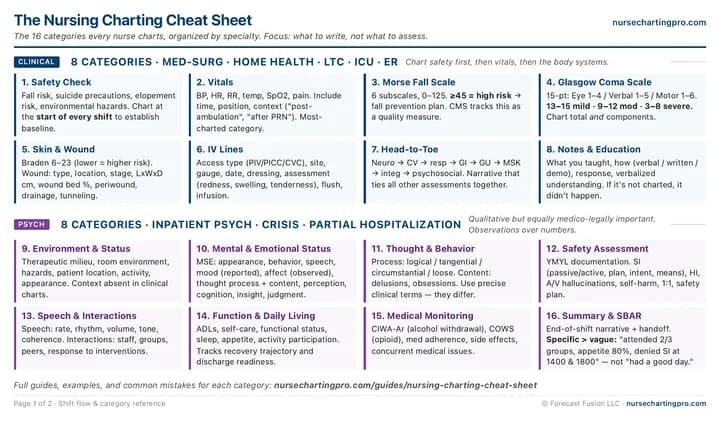
Get the free Nursing Charting Cheat Sheet
All 16 charting categories, clinical and psych, with what to write for each
Morse, Braden, Glasgow Coma Scale and SBAR at a glance
The charting mistakes that cost nurses their licenses
Tap through your assessments during the shift and get a draft of your note to review at clock-out. Your notes are cleared from your phone at the end of your shift.