By Miranda Niemas, Nursing Student (BSN candidate)
This guide is currently pending review by a licensed registered nurse.
Last updated: October 13, 2026
How to Document a Head-to-Toe Assessment (With a Full Example)
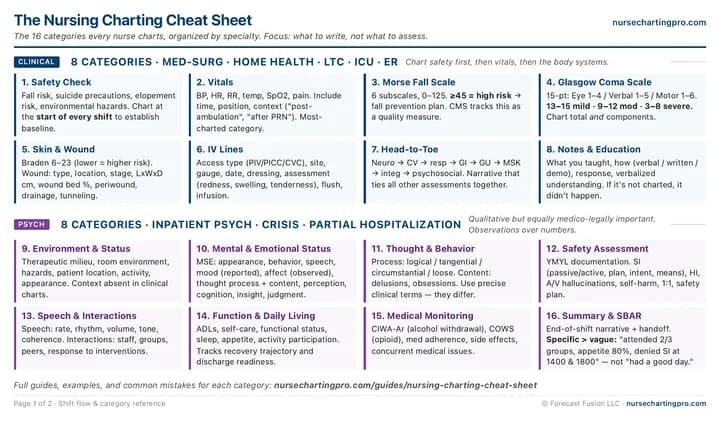
Get the free Nursing Charting Cheat Sheet
- All 16 charting categories, clinical and psych, with what to write for each
- Morse, Braden, Glasgow Coma Scale and SBAR at a glance
- The charting mistakes that cost nurses their licenses
You just completed your first head-to-toe assessment on a real patient. Lungs are clear, the heart is regular, and the abdomen is soft. You checked all 10 systems while your preceptor observed, and the assessment itself went smoothly. Now, back at the computer, you stare at an empty documentation field, unsure of what to write. Should you document every finding or simply note "normal"? How much detail is excessive? During my first med-surg rotation, I spent 25 minutes documenting a single head-to-toe assessment because I was unfamiliar with the WDL framework. By the end of the rotation, I reduced that time to 6 minutes. Here is the system that helped me achieve that.
Why This Matters
Regulatory bodies: Centers for Medicare & Medicaid Services (CMS), The Joint Commission, State Nurse Practice Acts
- CMS Conditions of Participation - Medical Record Services — Code of Federal Regulations, Title 42, Part 482, Section 482.24 (2024)
- The Joint Commission Hospital Accreditation Standards — The Joint Commission (2025)
- Physical Examination and Health Assessment (9th ed.) — Jarvis C. Physical Examination and Health Assessment. Elsevier. (2024)
- Nursing: Scope and Standards of Practice (4th ed.) — American Nurses Association (ANA) (2021)
What Counts as a Head-to-Toe Assessment
The WDL Framework
WDL stands for Within Defined Limits. It is the single most important concept for efficient head-to-toe documentation.
How to Document Each Body System
For each system I will define WDL and list common exceptions, with an example showing what the documentation looks like.
Neurological
HEENT
Respiratory
Cardiac
Peripheral Vascular
Integumentary
Musculoskeletal
Gastrointestinal
Genitourinary
Psychosocial
Documenting Findings vs. Interpretations
How to be efficient
Common Mistakes
Writing out every normal finding instead of using WDL
Using WDL conveys the same information in one term when all findings are normal. Documenting every normal finding across 10 body systems can extend a 5-minute task into a 20-minute one. Reserve detailed descriptions for exceptions.
Using WDL When the Patient Has Known Abnormal Findings
WDL means within defined limits; however, a patient with known atrial fibrillation and a murmur does not have a "normal" cardiac system. Document the known abnormalities along with their current status. Use WDL only when the system genuinely has no abnormal findings to report.
Vague exception language
"Some crackles" does not tell the next nurse where, what type, or how significant. "Seems a little off" is not a clinical observation. Specify the type of adventitious sound, the location, the vital signs, and any interventions.
Not Cross-Referencing Related Documentation
A pressure injury mentioned in the head-to-toe assessment should reference the complete wound assessment and Braden score documented elsewhere. Cross-referencing prevents duplication and directs the reader to the full data.
Skipping the Psychosocial Assessment
The psychosocial assessment is a critical component of the overall evaluation, not an optional add-on. Omitting it indicates a failure to assess mood, coping, safety, or support - elements that require documentation. Regulatory surveys specifically seek evidence of psychosocial assessment.
Case Example
Scenario
You are the day shift nurse on a medical-surgical unit. Mr. Chen was admitted 2 days ago for CHF exacerbation with fluid overload. He has a history of atrial fibrillation, type 2 diabetes, and a chronic venous stasis ulcer on his left lower leg. I am performing my 0700 shift head-to-toe assessment.
Chart Entry
0700 Head-to-Toe Assessment - 10 Body Systems

Neurological: WDL. A&Ox4, PERRL 3mm, speech clear, moves all extremities purposefully, sensation intact.

HEENT: WDL. Head normocephalic, sclera white, conjunctiva pink, hearing intact bilateral, oral mucosa pink and moist, swallowing intact with cardiac diet.

Respiratory: Fine crackles bilateral lower lobes, clear upper fields. RR 20, unlabored at rest. SpO2 94% on 2L NC (baseline SpO2 was 89% on RA at admission). Productive cough with small amount clear sputum. Incentive spirometry in use, achieving 1250 mL (goal 1500 mL).

Cardiac: S1/S2 with grade II/VI systolic murmur at apex, unchanged from admission. Irregular irregular rhythm - telemetry showing A-fib with controlled ventricular rate 68-82. Denies chest pain, palpitations, or dizziness. On metoprolol 50mg BID, apixaban 5mg BID, furosemide 40mg IV BID per MAR. I/O last 24h: intake 1400 mL, output 2800 mL (net negative 1400 mL).

Peripheral vascular: Radial pulses 2+ bilateral. Dorsalis pedis 1+ bilateral (baseline). Posterior tibial 1+ bilateral (baseline). Cap refill 3 sec bilateral lower extremities. 2+ pitting edema bilateral lower extremities to mid-calf - improved from 3+ on admission. Feet warm bilaterally, no calf tenderness.

Integumentary: Skin warm, dry. Color appropriate. Turgor elastic. Intact except: chronic venous stasis ulcer left medial lower leg, 3.2 x 2.1 x 0.2 cm - see wound assessment for full details. No new skin breakdown. Pressure areas assessed - sacrum, heels, occiput intact.

Musculoskeletal: WDL. Full ROM all extremities. Strength 5/5 bilateral upper, 4/5 bilateral lower (baseline per patient). Ambulates with rolling walker to bathroom, steady gait. No joint swelling or deformity.

Gastrointestinal: WDL. Abdomen soft, non-tender, non-distended. BS active x4 quadrants. Tolerating 2g sodium cardiac diet, ate 75% breakfast. Last BM this morning, formed, brown. Denies nausea.

Genitourinary: WDL. Voiding independently without difficulty. Urine clear yellow, adequate volume. No catheter. Continent. No flank tenderness. Fluid restriction 1500 mL/day in place.

Psychosocial: Mood appropriate but mildly anxious - states "I worry about ending up back here again." Affect congruent. Cooperative with care and fluid restriction. Coping: engaged in CHF education, asking appropriate questions. Support system: wife present daily, adult son available by phone. PHQ-2: denies depressed mood and anhedonia. Safety: denies SI/HI, no safety concerns. Cardiac rehab referral discussed - patient receptive.
Key points from above chart entry
- WDL used for 7 of 10 systems:
- Neurological, HEENT, musculoskeletal, gastrointestinal, and genitourinary are all WDL with brief supporting detail. This keeps the chart scannable while confirming those systems were assessed.
- Three exception systems documented in full:
- Respiratory, cardiac, and integumentary have detailed exception documentation because they are directly related to the admitting diagnosis (CHF) or have active findings (venous stasis ulcer).
- Peripheral vascular shows trending:
- Edema documented as 2+ with comparison to admission (3+), demonstrating that diuresis is working. Trending is what turns a snapshot into useful clinical data.
- Cardiac includes I/O and medication context:
- For a CHF patient, intake/output and diuretic response are core cardiac findings. Documenting net negative 1400 mL shows the treatment plan is effective.
- Psychosocial is not an afterthought:
- The patient's anxiety about readmission is documented with a direct quote, coping assessment, and an intervention (cardiac rehab referral). This documentation supports discharge planning.
Pro Tips
- Memorize the 10-System Order and Use It Consistently: Neurological, HEENT, respiratory, cardiac, peripheral vascular, integumentary, musculoskeletal, gastrointestinal, genitourinary, psychosocial. Use this same order for every patient and every shift. Consistency eliminates the "did I forget something?" feeling and reduces documentation time, allowing you to focus on content rather than structure.
- Develop Your Own WDL Reference Sheet: Write out the meaning of WDL for each system on an index card or in a phone note. Refer to it during your first few weeks until the definitions become automatic. Understanding exactly what WDL includes for each system allows you to mark it confidently, without second-guessing whether you assessed everything.
- Document exceptions with trends, not just snapshots: A finding in isolation holds less value than one with context. "2+ pitting edema bilateral lower extremities" serves as a snapshot. In contrast, "2+ pitting edema bilateral lower extremities, improved from 3+ on admission" conveys a clinical story. When documenting an exception, always include a comparison to the prior assessment or admission baseline if available.
- Do Not Duplicate Findings Across Systems: Edema belongs in peripheral vascular, not cardiac AND peripheral vascular. A wound belongs in integumentary with a cross-reference to the full wound assessment, not described in full detail under integumentary AND repeated under musculoskeletal because it is on a limb. Pick the most appropriate system and cross-reference from the others.
- Assess Psychosocial Factors Last Every Time: Assessing psychosocial factors is more challenging than conducting a quick physical check; it requires conversation and observation throughout your interaction. By placing this assessment last in your documentation order, you can observe the patient's mood, affect, coping, and communication style during the entire encounter. Your psychosocial documentation will reflect the full interaction, leading to greater accuracy than if based solely on the first 30 seconds.
Step by Step
- Assess neurological status: Assess level of consciousness, orientation (person, place, time, situation), pupil response, sensation, speech, and motor function. Document findings as WDL (within defined limits) if all are within expected limits, or note specific exceptions using Glasgow Coma Scale (GCS) scoring if indicated.
- Work through HEENT, respiratory, and cardiac: Assess the head, eyes, ears, nose, and throat. Auscultate breath sounds bilaterally, noting the respiratory rate, pattern, and oxygen saturation (SpO2). Auscultate heart sounds, assess rhythm regularity, and evaluate for chest pain. Document each system as WDL (within defined limits) or switch to exception documentation with specific findings.
- Evaluate peripheral vascular and integumentary: Assess pulses (radial, dorsalis pedis, posterior tibial), capillary refill, edema, and extremity color and temperature. Conduct a full skin survey, focusing on pressure injury risk areas, surgical sites, and any wounds or lesions. Cross-reference wound assessments with Braden scoring if applicable.
- Complete musculoskeletal, gastrointestinal, and genitourinary: Assess range of motion, strength, gait, and mobility aids. Auscultate bowel sounds in 4 quadrants, palpate the abdomen, and document diet tolerance and bowel pattern. Evaluate urine output, character, catheter status, and continence. Document each as WDL (within defined limits) or with specific exceptions.
- Document psychosocial assessment: Document mood, affect, anxiety level, coping strategies, support system, and safety screening (suicidal and homicidal ideation). Position psychosocial assessment last in your documentation sequence to ensure your observations reflect the full patient encounter rather than just the initial interaction.
Frequently Asked Questions
- What does WDL mean in nursing documentation?
- WDL stands for Within Defined Limits. It means you assessed every item in your facility's written definition for that body system and every item matched. The definition is your facility's, not the patient's own baseline, so a known chronic finding outside it, such as atrial fibrillation or a below-knee amputation, is charted "WDL except" with the finding, noting that it is the patient's baseline.
- How often should a head-to-toe assessment be done?
- Perform a full head-to-toe assessment on admission and at the start of each shift. Most facilities also require one whenever a significant change occurs in the patient's condition. Between full assessments, conduct focused assessments targeting specific systems as needed. For example, reassess respiratory status after a breathing treatment or cardiac status after a new arrhythmia. Your facility's policy determines the exact frequency, but shift-based assessments are the most common standard in acute care.
- What is the difference between a full assessment and a focused assessment?
- A full head-to-toe assessment systematically evaluates all body systems, typically covering 10 systems in clinical nursing. In contrast, a focused assessment examines only the system(s) relevant to a specific complaint, change in condition, or post-intervention reassessment. Full assessments establish the baseline and occur on admission and each shift. Nurses conduct focused assessments in between to monitor specific findings. Both types are documented, but a focused assessment does not replace the shift head-to-toe.
- What order should I document body systems in?
- Document body systems in this standard order: neurological, HEENT (head, eyes, ears, nose, and throat), respiratory, cardiac, peripheral vascular, integumentary, musculoskeletal, gastrointestinal, genitourinary, and psychosocial. This head-to-toe sequence aligns with most nursing textbooks and clinical assessment tools. Consistently using this order prevents you from skipping a system and makes your documentation predictable for the nurses who read it after you.
Get the free Nursing Charting Cheat Sheet
- All 16 charting categories, clinical and psych, with what to write for each
- Morse, Braden, Glasgow Coma Scale and SBAR at a glance
- The charting mistakes that cost nurses their licenses
Chart faster with Nurse Charting Pro
Tap through your assessments during the shift and get a draft of your note to review at clock-out. Your notes are cleared from your phone at the end of your shift.
Related Guides
- Clinical Nursing Charting hubThe head-to-toe assessment ranks among the seven clinical charting categories. Explore its role within the complete clinical charting framework.
- Complete nursing charting cheat sheetAll charting categories in one scannable reference, including the 10-system assessment checklist.
- SBAR nursing handoff guideHead-to-toe findings directly inform the Assessment section of SBAR handoff reports.
- Glasgow Coma Scale documentationWhen neurological findings are not WDL, GCS scoring offers a standardized framework to document the level of consciousness.
- Skin and wound assessment chartingWhen the integumentary system is not WDL, the full Braden Scale and wound assessment protocol takes over.
- What WDL means in nursingWhen a WDL click is a complete entry, and when a finding needs "WDL except" instead.