By Miranda Niemas, Nursing Student (BSN candidate)
This guide is currently pending review by a licensed registered nurse.
Last updated: October 13, 2026
Documenting IV Site Assessments and IV Insertion (Nursing Guide)
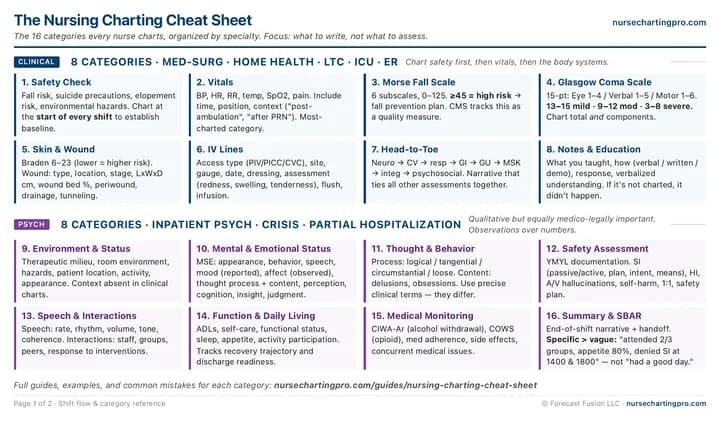
Get the free Nursing Charting Cheat Sheet
- All 16 charting categories, clinical and psych, with what to write for each
- Morse, Braden, Glasgow Coma Scale and SBAR at a glance
- The charting mistakes that cost nurses their licenses
Your first IV insertion went fine - you got it on the second attempt, the flush was smooth, the patient barely flinched. Now you're sitting at the computer and you realize you're not sure what a complete insertion note actually looks like. Do you chart the gauge? The number of attempts? The exact vein? What about the patient who already had an IV when you took over - what does a site assessment note include when you didn't place the line? This page covers every phase of IV documentation so you know exactly what to write whether you're starting a new line, checking an existing one, or pulling one that's gone bad.
Why This Matters
Regulatory bodies: Centers for Disease Control and Prevention (CDC), The Joint Commission, Infusion Nurses Society (INS), Centers for Medicare & Medicaid Services (CMS)
- Guidelines for the Prevention of Intravascular Catheter-Related Infections — Centers for Disease Control and Prevention (CDC) (2024)
- Infusion Therapy Standards of Practice — Infusion Nurses Society (INS) (2024)
- Routine Versus Clinically Indicated Replacement of Peripheral Intravenous Catheters — Rickard CM et al. Lancet. 2012;380(9847):1066-1074 (2012)
Documenting IV Insertion
Documenting Site Assessment
Documenting IV Complications
When an IV site shows signs of a complication, document the findings, the clinical decision, and the actions taken.
Infiltration
Phlebitis
Occlusion
Dislodgement
Documenting IV Removal
Common Mistakes
"IV site WNL" with no specific findings
"WNL" (within normal limits) tells a reviewer nothing about what you actually assessed. Did you look at the site? Did you flush the line? Did you check the dressing? The strong example demonstrates that a specific, systematic assessment was performed.
No site assessment for 12+ hours
INS standards require regular site assessments. A 12-hour gap between entries indicates no documented evidence of anyone examining the IV site for half a day. If the patient develops phlebitis or an infection, the documentation gap will be challenging to defend.
Missing insertion note entirely
If you placed the IV, you need an insertion note. If you inherited the IV from a previous shift and there is no insertion note in the chart, document what you can observe and note the gap: "20G PIV in place right forearm per previous shift. Insertion note not found in chart. Site assessed: VIP 0, dressing dated 04/09 at 1400."
Number of Attempts Not Documented
Patients have the right to know how many times they were stuck. Many facilities track attempt data for competency purposes. Vague phrases like "some difficulty" do not protect you or the patient. Document each attempt with the site, outcome, and reason for failure.
Generic "no complications" without supporting assessment
The phrase "no complications" lacks supporting assessment details. Without specific findings, the evaluation remains unclear. The strong example provides detailed assessment findings that substantiate the conclusion of no complications.
Case Example
Scenario
You are the day shift nurse on a medical floor. Mr. Delgado was admitted yesterday for pneumonia and is receiving IV antibiotics. He has a 20G PIV in his right forearm placed by the night shift. Over the course of your shift, the IV site progresses from healthy to early phlebitis, requiring removal and replacement. Here are the key documentation entries showing the lifecycle of IV management.
Chart Entry
0800 - IV site assessment. 20G PIV, right cephalic vein, mid-forearm, inserted 04/10 at 2200 by night shift RN. VIP score 0 - site appears healthy. No redness, swelling, warmth, tenderness, or drainage. Transparent dressing is clean, dry, and intact, labeled with insertion date and time. Flushed with 3mL NS without resistance. Blood return obtained. Ceftriaxone 1g IVPB infusing over 30 minutes per order. Patient denies discomfort at site.

1500 - IV site assessment. 20G PIV, right cephalic vein, mid-forearm. VIP score 1. Patient reports mild tenderness on palpation 1cm proximal to the insertion site. No visible redness, swelling, or drainage. Dressing intact. Flushed without resistance. Blood return is sluggish but obtained. MD notified of VIP 1 finding - order to continue monitoring and reassess in 4 hours. Site marked with pen at the border of tenderness for comparison at the next assessment.

1845 - IV site reassessment. VIP score 2. Tenderness has extended 2cm proximal to the insertion site (beyond the pen marking from 1500). Mild redness is visible along the vein path. No swelling, no drainage, no palpable cord. Per VIP protocol and MD order, the decision is made to remove and relocate. IV ceftriaxone dose completed at 1830 - line flushed and capped prior to removal. Catheter removed intact - tip intact, measured 1.25 inches. Site: mild redness at the former insertion point. Pressure applied for 2 minutes, hemostasis achieved. Warm compress applied to the area of phlebitis per policy. Catheter dwell time: approximately 21 hours. Will monitor the former site for resolution.

1900 - New IV insertion. 20G x 1.25 inch catheter inserted into the left cephalic vein, mid-forearm. First attempt successful. Blood return obtained. Flushed with 3mL NS - no resistance, no pain, no swelling. Transparent dressing applied and labeled with date, time, and initials. Securement device in place. Patient tolerated the procedure without difficulty. Next ceftriaxone dose scheduled for 2200 - line patent and ready.
Key points from above chart entry
- 0800 - Baseline documented thoroughly:
- The first assessment of the shift establishes the baseline: VIP 0, specific findings documented, and catheter function confirmed. This serves as the comparison point for all subsequent assessments.
- 1500 - Early change caught and marked:
- VIP 1 is subtle - just tenderness without visible changes. The nurse documented the finding, notified the MD, and marked the border with pen for objective comparison later. This demonstrates proactive site monitoring.
- 1845 - Progression documented with clinical reasoning:
- The nurse documents that findings progressed beyond the previous pen marking, justifies the removal decision with VIP score and MD order, and includes catheter integrity check, dwell time, and site care after removal.
- 1900 - New insertion note is complete:
- All 7 insertion elements are present: date/time, gauge, specific vein, attempt count, blood return/flush, dressing/securement, and patient response. The entry links to the clinical context (next antibiotic dose) so the oncoming shift understands why a new line was placed.
Pro Tips
- Date and Time for Every Dressing and Label: When you place or change a dressing, document the date, time, and your initials directly on the dressing or label. This practice enables any nurse to quickly assess dwell time and dressing age without searching the chart. CDC guidelines recommend changing transparent dressings every 5-7 days and gauze dressings every 2 days unless they are soiled, loosened, or damp.
- Document the Specific Vein, Not Just the Region: "Right cephalic vein, mid-forearm" provides specificity and utility. In contrast, "Right forearm" lacks precision, as it could refer to several veins within a large anatomical area. Specifying the vein is crucial for tracking site history, planning future access, and clearly communicating to the next nurse exactly where to look. If you used ultrasound guidance, document that as well.
- Document Every Attempt, Including Failed Ones: Document each attempt on a separate line, noting the site, outcome, and reason for failure. For example, "Attempt 1: right basilic, antecubital - flash obtained but unable to advance catheter, removed" gives the next nurse useful information about this patient's vascular access. This documentation also protects you if the patient later complains about multiple sticks.
- Use the VIP Scale for Every Site Assessment: The Visual Infusion Phlebitis (VIP) scale provides a standardized score (0-5) that any nurse can interpret. Even when the site appears healthy, document "VIP 0" to establish a trackable baseline. As the VIP score increases, the trajectory becomes visible in the chart, supporting clinical decision-making regarding when to remove and relocate the IV site.
- Document the Site After Removal, Not Just the Removal: After pulling an IV, examine the site and describe your observations: "site without redness, swelling, or drainage; hemostasis achieved" or "1cm area of redness at former insertion point, no drainage." This final assessment closes the documentation loop and establishes a baseline for monitoring the old site during subsequent shifts.
Frequently Asked Questions
- What should an IV insertion note include?
- A complete IV insertion note includes seven elements: (1) date and time of insertion, (2) catheter gauge and length, (3) specific insertion site, including the vein name and anatomical location, (4) number of attempts, detailing failed attempts with sites and reasons, (5) blood return and flush confirmation, including saline volume and patency status, (6) dressing type and securement, along with labeling information, and (7) patient response to the procedure. If ultrasound guidance was used, document that as well.
- How often should IV sites be assessed?
- The Infusion Nurses Society (INS) recommends that nurses assess IV sites regularly, whenever an infusion starts, during the infusion, and upon completion. Most facilities require at least a once-per-shift assessment, while many have transitioned to assessments every 4 hours or every 6 hours for actively infusing lines. Always assess the site before administering any medication through the line. Use the VIP scale to standardize your assessment and document the score with each check.
- When should a peripheral IV be replaced?
- Current evidence and updated CDC guidance support replacing peripheral IVs based on clinical indications rather than at routine fixed intervals. The landmark Rickard et al. (2012) Lancet study demonstrated that clinically indicated replacement is not inferior to routine 72-hour replacement. Your site assessment serves as the decision-making tool: replace the IV when you observe signs of phlebitis (VIP score 2 or higher), infiltration, occlusion, dislodgement, or when the catheter is no longer needed. Some facilities still have time-based replacement policies; follow your institution's protocol, but understand that the evidence supports assessment-based replacement.
Get the free Nursing Charting Cheat Sheet
- All 16 charting categories, clinical and psych, with what to write for each
- Morse, Braden, Glasgow Coma Scale and SBAR at a glance
- The charting mistakes that cost nurses their licenses
Chart faster with Nurse Charting Pro
Tap through your assessments during the shift and get a draft of your note to review at clock-out. Your notes are cleared from your phone at the end of your shift.
Related Guides
- Clinical charting hubDocumenting IV lines represents one of the core clinical charting categories.
- Nursing charting cheat sheetAccess all charting categories on one quick-reference page.
- SBAR handoff guideAssessing IV access status is crucial for any clinical SBAR handoff.
- Head-to-toe assessmentAssessing the IV site forms part of the comprehensive head-to-toe evaluation.
- Skin and wound documentationIV complications such as infiltration and phlebitis overlap with skin assessment documentation.
- What WDL means in nursingWhy "IV site WNL" says little on its own, and what WDL means instead.