By Miranda Niemas, Nursing Student (BSN candidate)
This guide is currently pending review by a licensed registered nurse.
Last updated: October 13, 2026
How to Score and Document the Morse Fall Scale (Nursing Guide)
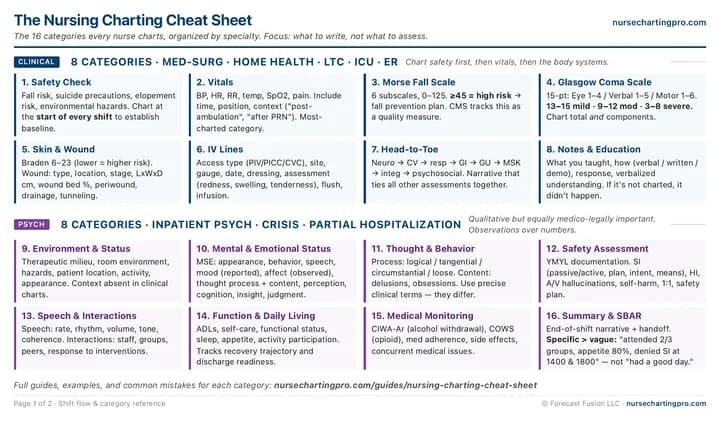
Get the free Nursing Charting Cheat Sheet
- All 16 charting categories, clinical and psych, with what to write for each
- Morse, Braden, Glasgow Coma Scale and SBAR at a glance
- The charting mistakes that cost nurses their licenses
Morse Fall Scale scoring looks simple until you're trying to decide whether gait is "weak" or "impaired," or you watch a patient grab the bedside table to stand and realize that counts as a 30-point ambulatory aid. I stumbled on my first three Morses because nobody told me the scoring has clinical judgment baked into almost every item. Here's the breakdown that finally made each subscale feel clear instead of fuzzy.
The Morse Fall Scale Item Nurses Always Miss (Chart With Me)
A walkthrough of all six Morse Fall Scale subscales and where nurses lose points, including the "furniture" trap on ambulatory aid and weak vs. impaired gait, then a full fall risk assessment scored and charted live.
Why This Matters
Regulatory bodies: Centers for Medicare & Medicaid Services (CMS) - Hospital-Acquired Conditions (HACs), The Joint Commission - National Patient Safety Goal 9 (Reduce falls), State health departments (survey-ready fall prevention programs), Medicare non-reimbursement for preventable inpatient falls with injury
- Development of a fall risk assessment tool (Morse Fall Scale) — Morse JM, Morse RM, Tylko SJ. Canadian Journal on Aging. 1989;8(4):366-377 (1989)
- Prevalence of falls among hospitalized adults — Sharif SI, Al-Harbi AB, Al-Shihabi AM, et al. J Pharm Bioallied Sci. 2018;10(4):185-197 (2018)
- AHRQ Preventing Falls in Hospitals: A Toolkit for Improving Quality of Care — Agency for Healthcare Research and Quality (AHRQ) (2023)
- Hospital-Acquired Conditions (HAC) Reduction Program — Centers for Medicare & Medicaid Services (CMS) (2024)
What the Morse Fall Scale Measures
How to score each subscale
Score all six items at every assessment. The total determines the risk level, while the subscale breakdown drives your intervention plan.
History of falling (0 or 25)
Secondary diagnosis (0 or 15)
Ambulatory aid (0, 15, or 30)
IV therapy / heparin lock (0 or 20)
Gait (0, 10, or 20)
Mental status (0 or 15)
Total Score and Risk Levels
Fall Precautions by Risk Level
Each risk level corresponds to an intervention bundle. Document the specific interventions you implemented, rather than simply stating "fall precautions in place."
Low Risk (0-24): Standard Precautions
Moderate Risk (25-44): Standard Fall Precautions
High risk (45+): High-risk fall precautions
What to Document
A complete Morse Fall Scale entry includes five components. The total score alone does not provide sufficient documentation.
When to Reassess
Common Mistakes
Charting Only the Total Without Subscale Breakdown
Without the subscale breakdown, no one can verify how you arrived at the total. If a surveyor or attorney asks which items drove the score, stating "55 high risk" does not provide sufficient information. The breakdown is essential for targeted interventions; for example, a score of 55 driven by gait impairment requires different precautions than one driven by mental status and fall history.
Scoring from Admission Data Instead of Current Assessment
The Morse Fall Scale must reflect the patient's current status rather than a static snapshot from admission. A patient who walked independently at admission may now have an impaired gait after surgery. Document what you observe right now, not what was recorded three days ago.
Missing "Furniture" as an Ambulatory Aid
The Morse Fall Scale frequently overlooks the use of furniture as an ambulatory aid. Patients often grab the bed rail, IV pole, overbed table, or wall for support, which qualifies as using furniture as an ambulatory aid and scores 30 - the highest value for this item. Observing the patient during movement is essential; they typically do not self-report furniture use because they do not recognize it as an aid.
"Fall precautions in place" without specifics
"Fall precautions in place" is the most common fall documentation gap cited in surveys and litigation. It fails to specify which precautions were implemented, whether they match the risk level, or if they address the specific risk factors identified in the subscale scores. Document every intervention.
Not Updating the Score After a Fall
A fall changes at least the history-of-falling subscale (adds 25 points) and may change gait, mental status, or ambulatory aid scores. Keeping the old total after a fall is both clinically inaccurate and a survey risk. Rescore immediately and document the specific subscale changes.
Case Example
Scenario
Mrs. Thompson, a 78 year old, was admitted for community-acquired pneumonia. She reports two falls at home in the past month, both occurring while getting up at night to use the bathroom. She uses a rolling walker at home and brought it with her. IV antibiotics (ceftriaxone Q24h) are currently running. Her medical history includes hypertension, type 2 diabetes, and osteoarthritis. During your assessment, you observe her rising slowly from the bed with the walker, taking short shuffling steps. Her gait appears steady but clearly weak. She is oriented to person, place, and time, and consistently uses the call light before getting up.
Chart Entry
0800 Morse Fall Scale Assessment:

History of falling (past 3 months): Yes - 2 falls at home in past month (patient and family report) = 25
Secondary diagnosis (≥2 diagnoses): Yes - pneumonia, HTN, DM2, osteoarthritis = 15
Ambulatory aid: Cane/crutches/walker - patient uses rolling walker = 15
IV therapy: Yes - IV ceftriaxone running via peripheral line, left forearm = 20
Gait: Weak - short shuffling steps with walker, rises slowly, steady but cautious = 10
Mental status: Oriented to own ability - patient uses call light before ambulating, recognizes need for walker, does not attempt to walk unassisted = 0

Total: 85 - HIGH RISK
(Prior score: none, this is admission assessment)

High-risk fall precautions initiated:
• Yellow fall risk wristband applied
• Fall risk sign placed on door
• Bed in lowest position, wheels locked
• Bed alarm activated
• Call light within reach, patient educated on use (patient demonstrates understanding)
• Non-skid footwear provided
• Walker positioned within reach at bedside
• Toileting offered Q2h (patient's fall history is bathroom-related)
• Room assignment near nursing station confirmed with charge nurse
• PT consult placed for safe mobility assessment
• Medication review: IV antibiotics, home antihypertensives - orthostatic precautions reinforced

Next reassessment: change of shift per unit policy.
Key points from above chart entry
- Subscale breakdown:
- Every subscale is listed with its point value and the clinical observation that supports the score. A reviewer can verify the total without guessing.
- Gait scoring rationale:
- "Short shuffling steps, rises slowly, steady but cautious" explains why gait is scored as weak (10) rather than impaired (20). The clinical reasoning is visible.
- Mental status distinction:
- The patient is scored 0 for mental status because she uses the call light and recognizes her need for the walker - not because she is oriented x4. Orientation and mental status on the MFS are different things.
- Specific precautions:
- Every intervention is listed individually rather than "fall precautions in place." The toileting schedule specifically references the patient's bathroom-related fall history - showing the precautions are tailored to the risk profile.
- Reassessment timing:
- The entry states when the next reassessment is due, closing the loop and signaling to the next nurse that ongoing monitoring is expected.
Pro Tips
- Score at the End of Your Assessment, Not the Beginning: Observe the patient's gait, ambulatory aid use, and mental status before scoring accurately. Conduct your head-to-toe assessment first, watch the patient get up and walk to the bathroom, and note whether they grab furniture. Then, score the MFS based on real observations instead of guesses.
- Watch for Furniture Use - The Most Underscored Item: Encourage the patient to walk to the bathroom or across the room. If they grab the overbed table, bed rail, IV pole, or wall at any point, that indicates furniture-walking and scores 30 - not 0 or 15. Patients often do not self-report this behavior because they do not recognize it as using an aid. You must observe it happening.
- Mental status on the MFS is not the same as orientation: A patient who is oriented x4 but attempts to get up without calling for help scores 15, indicating an overestimation of ability. In contrast, a confused patient who consistently waits for assistance scores 0, reflecting an accurate understanding of their own ability. Score behavior, not cognitive status. This item ranks as the second most commonly mis-scored after ambulatory aid.
- Document Specific Precautions That Match the Risk Factors: If the patient's high score is driven by fall history and gait impairment, your precautions should address mobility: walker at bedside, PT consult, toileting schedule. If the score is driven by mental status and IV therapy, focus on bed alarm, sitter consideration, and tubing management. Generic precaution lists are better than nothing, but tailored lists show clinical reasoning.
- Rescore Immediately After Any Fall - Do Not Wait for Next Shift: A fall adds at least 25 points (history of falling) and may change gait, ambulatory aid, and mental status scores. The post-fall MFS often scores dramatically higher than the pre-fall score, necessitating changes to the intervention bundle. Document the rescored MFS in your post-fall assessment rather than as a separate entry hours later.
Step by Step
- Assess history of falling: Inquire whether the patient has fallen in the past three months, including falls at home, in other facilities, and during the current admission. Verify with family members or prior chart notes if cognitive impairment exists. Score 0 (no) or 25 (yes).
- Assess secondary diagnosis: Review the patient's active medical diagnoses. If the patient has two or more documented diagnoses, score 15. If only one diagnosis, score 0. Count active diagnoses only, not resolved conditions.
- Assess ambulatory aid: Observe the patient while ambulating. Score 0 for no aid, bed rest, or nurse assistance. Score 15 for crutches, a cane, or a walker. Score 30 if the patient grabs furniture (bed rail, overbed table, IV pole, wall) for support. Watching the patient move ensures accurate scoring of this item.
- Assess IV therapy: Assess the patient's intravenous (IV) access, including running infusions and saline or heparin locks. Score 20 if any IV access is present: a peripheral line, a peripherally inserted central catheter (PICC), or a central line. Score 0 if no IV access.
- Assess gait: Watch the patient walk. Score 0 for normal gait, bed rest, or wheelchair-bound. Score 10 for weak gait (stooped, shuffling, cautious but controlled). Score 20 for impaired gait (difficulty rising, grabbing objects, lurching, or swaying). When in doubt between weak and impaired, score higher.
- Assess mental status: Observe if the patient recognizes their physical limitations. Score 0 when the patient is oriented to their abilities, such as using the call light, waiting for help, or knowing they need the walker. Score 15 when the patient overestimates their abilities or forgets their limitations, for example, attempting to get up without calling for assistance or refusing to use the walker despite an unsteady gait. This assessment focuses on behavioral observation rather than orientation.
Frequently Asked Questions
- What is the Morse Fall Scale?
- The Morse Fall Scale (MFS) is a validated bedside tool that assesses a patient's fall risk using six items: history of falling, secondary diagnosis, ambulatory aid, intravenous (IV) therapy, gait, and mental status. Each item receives a score, and the total (0-125) determines whether the patient is at low, moderate, or high risk for falls. Janice Morse developed this scale in 1989, and it remains a widely used fall risk assessment tool in North American hospitals.
- What Morse Fall Scale score is considered high risk?
- A total score of 45 or higher indicates high risk on the standard Morse Fall Scale thresholds (Low: 0-24, Moderate: 25-44, High: 45+). Some facilities may adjust cutoffs based on their own fall rate data. Always refer to your facility's adopted thresholds. High-risk patients require an enhanced intervention bundle that includes a bed alarm, fall risk identification, and potentially a 1:1 sitter.
- How often should the Morse Fall Scale be reassessed?
- Reassess the Morse Fall Scale at admission, every shift change, immediately after any fall event, following a significant change in patient status (such as a new medication, change in mobility, or post-procedure), upon transfer to a new unit, and during discharge planning. While facility policies may vary, reassessing at shift change represents the most common minimum standard.
- What is the difference between "weak" and "impaired" gait on the Morse Fall Scale?
- Weak gait (10 points) indicates that the patient walks with a stooped posture, shuffling steps, or requires light support but can ambulate in a controlled manner. Impaired gait (20 points) signifies that the patient struggles to rise, cannot walk without grasping objects, or exhibits a short, choppy, lurching, or swaying pattern. In practical terms, a weak gait appears cautious yet controlled, while an impaired gait suggests the patient may not manage without assistance. When uncertain, score higher.
Get the free Nursing Charting Cheat Sheet
- All 16 charting categories, clinical and psych, with what to write for each
- Morse, Braden, Glasgow Coma Scale and SBAR at a glance
- The charting mistakes that cost nurses their licenses
Chart faster with Nurse Charting Pro
Tap through your assessments during the shift and get a draft of your note to review at clock-out. Your notes are cleared from your phone at the end of your shift.
Related Guides
- Clinical Nursing Charting hubThe Morse Fall Scale ranks among seven clinical charting categories. Explore how fall risk assessment integrates into the complete clinical documentation framework.
- Charting cheat sheetAll charting categories in one scannable reference, including the Morse Fall Scale quick-score summary.
- SBAR nursing handoffInclude the fall risk level and MFS score in the Assessment section of every SBAR handoff for at-risk patients.
- Safety check and hourly roundingHourly rounding with the 4 Ps serves as a core fall prevention intervention for high-risk patients - learn how to document this process.
- Head-to-toe assessment documentationGait and mobility observations from your head-to-toe directly inform MFS scoring; assess first, then score.