By Miranda Niemas, Nursing Student (BSN candidate)
This guide is currently pending review by a licensed registered nurse.
Last updated: October 13, 2026
Patient Safety Check Documentation: Nursing Hourly Rounding Guide
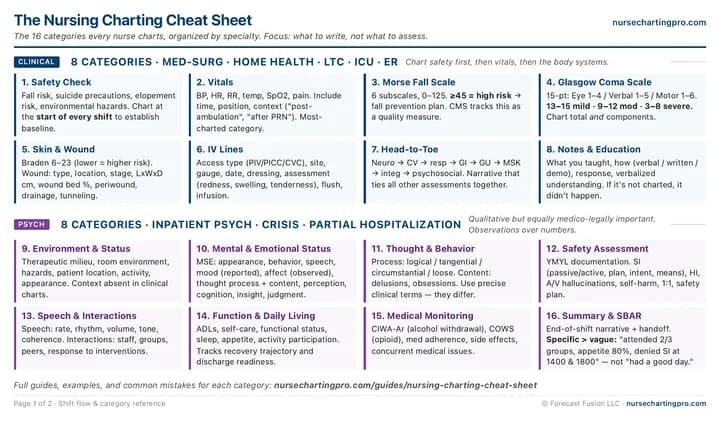
Get the free Nursing Charting Cheat Sheet
- All 16 charting categories, clinical and psych, with what to write for each
- Morse, Braden, Glasgow Coma Scale and SBAR at a glance
- The charting mistakes that cost nurses their licenses
Hourly rounding seems straightforward until you face a 6-patient assignment while needing to round and chart every hour. By 1400, you may find yourself three rounds behind on documentation, and by the end of your shift, you struggle to reconstruct what occurred at 0900 from memory. I witnessed this situation with my preceptor during my first med-surg rotation, and I experienced it myself the following week. The key isn't to chart faster; it's to develop a documentation habit that aligns with rounding in real time. Here's what I learned.
Why This Matters
Regulatory bodies: The Joint Commission (NPSG), Centers for Medicare & Medicaid Services (CMS)
- AHRQ Fall Prevention in Hospitals Toolkit — Agency for Healthcare Research and Quality (AHRQ) (2023)
- Hourly Rounds: What Does the Evidence Indicate? — Halm MA. Am J Crit Care. 2009;18(6):581-584 (2009)
- National Patient Safety Goals - Fall Reduction — The Joint Commission (2025)
What is Hourly Rounding
The 4 P's Framework
Each P represents a question, an observation, and a documentation point. Address all four during every round.
Pain
Potty
Position
Possessions
What to Document for Each Round
Documenting Fall Precautions
How to Keep Up with Rounding Documentation
Common Mistakes
"Safety round done" with no details
"Safety round done" tells a reviewer nothing about what you assessed, what you found, or what you did. It's legally equivalent to not documenting the round at all - it can't demonstrate that you actually addressed the patient's needs.
Batch-charting All Rounds at End of Shift
Batch-charting at end of shift is a red flag for auditors and attorneys. Identical timestamps on 12 entries suggest reconstruction from memory (or fabrication). Even if every round was performed, the documentation doesn't demonstrate real-time assessment. Chart each round as close to real time as possible.
Skipping Environmental Safety Checks
While the 4 P's address the patient's immediate needs, environmental safety requires separate documentation. Confirm and document bed position, side rails, call bell placement, and fall precaution items during every round.
"No change" instead of specifics
Using "no change" fails to demonstrate that you assessed anything. It may suggest you copied the previous entry without entering the room. Each round requires its own observations, even if the findings are similar.
Missing Fall or Near-Fall Documentation in Rounding Record
The incident report is in a separate system. The hourly rounding record is where the clinical team looks for the real-time narrative. If a fall or near-fall doesn't appear in the rounding documentation, it creates a gap in the clinical record that's difficult to explain during a chart review.
Case Example
Scenario
You're the day shift nurse on a medical floor. Mrs. Johnson was admitted yesterday with pneumonia. She's on 2L O2 via nasal cannula, has a productive cough, and is weak and deconditioned. The Morse Fall Scale score is 45 (high risk). She has a history of one fall at home in the past 3 months. Fall precautions are in place: bed alarm, non-skid footwear, gait belt for ambulation, and fall risk signage. Here are four consecutive hourly rounds showing the rhythm of rounding documentation.
Chart Entry
0800 - Safety round. Patient reports pain 4/10 in bilateral lower back, aching, worsened overnight. Acetaminophen 650mg PO administered per PRN order. Assisted to BSC, voided a moderate amount of clear yellow urine. Repositioned to high Fowler's for breakfast, HOB 45°. Call bell clipped to gown, water, tissues, and phone within reach. Bed low/locked, x2 side rails up, bed alarm on, O2 at 2L/NC, suction at bedside and tested, ID band verified. Non-skid socks on. Morse 45 (high risk) - fall precautions in place and reviewed with the patient at the start of the shift. Next round 0900.

0900 - Safety round. Patient reports pain 2/10 in bilateral lower back, improved after acetaminophen. Ate 60% of breakfast. Declined toileting. Remains in high Fowler's, HOB 45°, comfortable. Call bell in reach. Bed low/locked, x2 rails, bed alarm on, ID band intact. Productive cough - tissues and emesis basin within reach, sputum cup at bedside. No new concerns. Next round 1000.

1000 - Safety round. Patient reports pain 1/10, controlled. Assisted to BSC with gait belt, voided a small amount. Noted mild unsteadiness during transfer - patient stated, "I feel a little dizzy when I stand up." Assisted back to bed without incident. VS obtained: BP 108/62 sitting, 94/58 standing (orthostatic drop noted). MD notified of orthostatic findings and new-onset dizziness. Orders received: IVF bolus 500mL NS, hold lisinopril, recheck orthostatics after bolus. Repositioned to R side, HOB 30°. Call bell in reach. Bed low/locked, x2 rails, bed alarm on. Reinforced with the patient: use call bell before standing. Next round 1100.

1100 - Safety round. Patient reports pain 0/10. Declined toileting. IVF bolus infusing, 200mL remaining. Denies dizziness while lying in bed. Repositioned from R side to L side. HOB 30° maintained. Call bell in reach, water refilled. Bed low/locked, x2 rails, bed alarm on, ID band intact. Will recheck orthostatics after bolus completion. Next round 1200.
Key points from above chart entry
- 0800 - Shift-start completeness:
- The first round of the shift includes the Morse score, fall precautions in place, and review with the patient. This establishes the baseline for the entire shift.
- 0900 - Brief but specific:
- A round where nothing changed is still documented with specific findings: pain improved, intake noted, position confirmed, environment verified. Not just "no change."
- 1000 - Clinical escalation captured in real time:
- The round caught new dizziness during a transfer. The nurse documented the finding, obtained vitals, notified the MD, and recorded new orders - all within the rounding entry. This is the rounding documentation doing exactly what it's designed to do.
- 1100 - Follow-through documented:
- The 1100 round references the IVF bolus from the 1000 escalation and includes a plan to recheck orthostatics. The rounds form a continuous clinical narrative, not isolated snapshots.
- Rhythm and variation:
- Each entry has different content because each round found different things. Real rounding documentation should show variation - identical entries suggest copy-paste, not actual assessment.
Pro Tips
- Document While You're Still in the Room: Bring the WOW or use a tablet. Charting in real time takes 30-60 seconds for a rounding entry, while reconstructing from memory an hour later takes 2-3 minutes. Over a 12-hour shift with 6 patients, this difference means staying current versus drowning in catch-up charting.
- Use the 4 P's as Your Verbal Script: Walk into the room and literally say: "Hi Mrs. Johnson, I'm here for your check. How's your pain? Do you need to use the bathroom? Are you comfortable in that position? Do you have everything you need within reach?" The script takes 15 seconds, covers all 4 P's, and gives you the content for your documentation.
- If you fall behind, catch up by actual time - don't fake uniformity: If you missed the 1300 documentation, don't chart it at 1300 after the fact. Chart your 1400 round at 1400 and add a note: "1300 round performed at approximately 1310, all 4 P's addressed, no concerns." Honest gaps are defensible in a chart audit. Fabricated timestamps are not.
- Rounding entries should vary - identical entries are a red flag: When every round states "pain 0/10, declined toileting, comfortable, bed low and locked," auditors may question whether actual assessments occurred. Real patients experience changing pain levels, use the bathroom, shift positions, and make requests. Your documentation must reflect this natural variation.
- Document fall precautions at the start of the shift, not just during rounds: Begin your shift by documenting the Morse score, the risk level, and all precautions in place: bed alarm, signage, footwear, gait belt, and toileting schedule. This establishes the baseline. During subsequent rounds, confirm that precautions remain in place and note any changes.
Frequently Asked Questions
- What are the 4 P's of hourly rounding?
- The 4 P's are Pain, Potty, Position, and Possessions. This framework guides structured hourly rounding: assess the patient's pain level, offer toileting assistance, check and adjust their position, and ensure personal items and the call bell are within reach. Some facilities include a fifth P for Plan of care. Address and document each P during every round.
- How often should safety rounds be documented?
- Most facilities require hourly rounding documentation during day and evening shifts, and every-two-hour documentation on night shift. Your facility's policy determines the exact frequency. Each round should be documented individually with the actual time, findings for each of the 4 P's, actions taken, and environmental safety status. Batch-charting multiple rounds at once is a documentation red flag.
- What's the difference between a safety check and a safety assessment?
- The difference between a safety check and a safety assessment is scope: a safety check (hourly round) is a brief, structured check-in using the 4 P's framework, and a safety assessment is a fuller evaluation. A safety check takes 2-3 minutes and focuses on immediate patient needs and environmental safety. A safety assessment is something like a fall risk assessment (Morse Fall Scale), skin assessment (Braden Scale), or head-to-toe assessment. Safety checks occur every 1-2 hours, while safety assessments take place on admission, each shift, or with a change in status. Although the two are complementary, they serve different purposes.
Get the free Nursing Charting Cheat Sheet
- All 16 charting categories, clinical and psych, with what to write for each
- Morse, Braden, Glasgow Coma Scale and SBAR at a glance
- The charting mistakes that cost nurses their licenses
Chart faster with Nurse Charting Pro
Tap through your assessments during the shift and get a draft of your note to review at clock-out. Your notes are cleared from your phone at the end of your shift.
Related Guides
- Clinical nursing charting hubSafety checks represent a core category in clinical charting; explore how they integrate into the complete framework.
- Charting cheat sheetAll charting categories on a single scannable quick-reference page.
- SBAR handoff guideKey elements of any clinical SBAR handoff include fall risk status and rounding findings.
- Morse fall scale documentationThe Morse Fall Scale drives the fall precaution bundle that you document during each safety round.
- Vital signs charting guideOrthostatic vitals and other findings during rounds often overlap with vital sign documentation.