By Miranda Niemas, Nursing Student (BSN candidate)
This guide is currently pending review by a licensed registered nurse.
Last updated: October 13, 2026
The New Nurse Charting Survival Guide
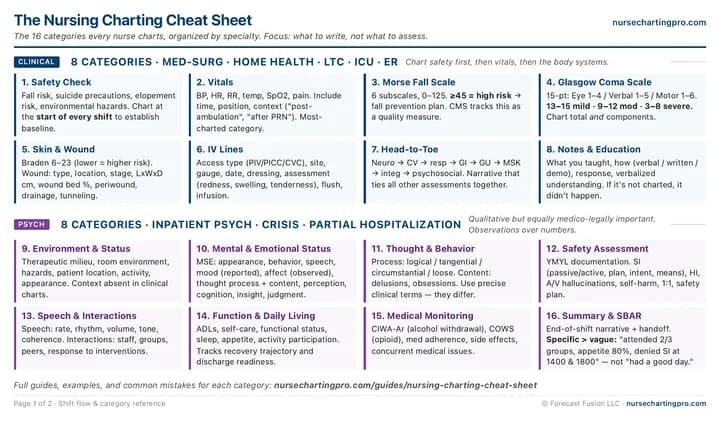
Get the free Nursing Charting Cheat Sheet
- All 16 charting categories, clinical and psych, with what to write for each
- Morse, Braden, Glasgow Coma Scale and SBAR at a glance
- The charting mistakes that cost nurses their licenses
Your first shift is in 48 hours, and you're scrolling through this page because you're unsure what to write when you reach the charting screen. You'll be fine. I wrote this when I faced the same situation - I had my first clinical tomorrow, had watched a simulation of charting in class, and didn't know if "patient ate breakfast" counted as charting or if I needed to write a novel. Neither extreme is correct; the middle offers a framework.
Why This Matters
Regulatory bodies: American Nurses Association (ANA), State Boards of Nursing
- Principles of Nursing Documentation — American Nurses Association (ANA)
- Transition shock: the initial stage of role adaptation for newly graduated Registered Nurses — J Adv Nurs. 2009;65(5):1103-1113 (2009)
Key Takeaways for Your First Shift
The 3 things you must chart on every patient
For your first shift, remember these three essential charting points.
1. Safety status
2. Current condition
3. Interventions performed and patient response
The charting framework that simplifies documentation
Every specialty follows a specific structure. Choose the one that aligns with your unit.
Clinical units (med-surg, home health, LTC, ICU, ED)
Psychiatric units
The cheat sheet for both
Your First Shift Charting Checklist
The 8 things to do during your first charting session.
What NOT to worry about
Things that feel scary but aren't actually going to end your career.
The Real Mistakes That Matter
Understanding the difference between "mistakes that feel bad" and "mistakes that actually affect your career or your patient" is crucial.
Where to go from here
Choose the guide that matches the clinical unit you are starting on.
Common Mistakes
Thinking a Typo Is a Career-Ending Mistake
Typos are not falsification. A simple correction - clearly marked as a correction with the accurate information - is all that's needed. Surveyors see corrections as evidence of quality assurance, not evidence of incompetence.
Waiting until the end of shift to chart everything
End-of-shift batch charting is legal, but it reduces accuracy. Reconstructing twelve hours of clinical data from memory at 1830 is less reliable than charting the same data at the bedside. Real-time charting also prevents the anxiety of wondering, "What time did I give that medication?"
Charting what you think instead of what you observed
The statement "Patient is in pain" represents a conclusion. In contrast, the strong example details specific observations that led to that conclusion. Documenting observations provides a defensible basis for your assessments, while conclusions may be challenged.
Not asking your preceptor because you're embarrassed
Your preceptor expects questions. That's the job. The nurse who asks 30 questions on day one and charts accurately is doing better than the nurse who asks zero questions and charts vaguely.
Comparing Your Charting Speed to Experienced Nurses
The nurse who charts in 8 minutes has years of experience. She isn't better than you; she simply has more practice. Your speed will improve over time. For now, concentrate on documenting what you actually assessed.
Case Example
Scenario
It's 0645. You're in the break room with your scrub pockets full of pens and a folded cheat sheet. Your preceptor just handed you your patient assignment. Here's what the next 12 hours look like from a charting perspective.
Chart Entry
0700 - Report from night shift. You take notes on scrap paper: patient names, room numbers, diagnoses, and anything the night nurse highlights as "watch for this." Your hands shake a little. That's normal.

0730 - Start your first assessment. Choose the most clinically stable patient to build confidence before tackling the complex ones. Your preceptor is nearby.

0800-0930 - Assessments and initial charting. This is your longest charting session of the day. You toggle between the patient's room and the computer. It feels slow. It is slow. That's fine.

1000 - First medication pass. Document what you gave, when, and the patient's response. Check with your preceptor if you're unsure about anything.

1200 - Vitals round + lunch assessments. You're finding your rhythm now. The charting screen looks less foreign than it did at 0800.

1400 - Safety rounds. Conduct quick checks: bed position, call light, patient comfort. Document each one. This category will require the most frequent charting.

1600 - Reassessments. Any patient whose condition changed gets a fresh look and a new chart entry. Document any medications given earlier and their responses.

1800 - End of shift. You write your narrative notes and prepare your SBAR handoff for the night nurse. Your charting took twice as long as your preceptor's. That is completely, totally, boringly normal.

1900 - You clocked out. You charted real patients today. That's a milestone.
Key points from above chart entry
- 0700 Report:
- Taking handwritten notes during report builds the single most helpful habit you can develop on day one.
- 0800-0930 Block:
- This block will shrink as you get faster. On day 1, expect it to take 90+ minutes. By month 3, it should take 30.
- 1800 Narrative:
- If you charted in real-time during the day, this end-of-shift block serves as a summary, not a reconstruction.
- 1900 Done:
- Your first shift is done. Return to this page in 6 months and see how different it reads.
Pro Tips
- Write a Scrap-Paper Cheat Sheet for Your First Shift: Not from this page - a handwritten one. List the 3 things to chart on every patient in big letters: safety, condition, interventions + response. Keep it in your scrub pocket. Writing it by hand helps you remember it.
- Tell Your Preceptor You're Nervous: Your preceptor likely already knows. By expressing your feelings, you encourage them to slow down and provide more explanations without judgment. I shared my nerves with my preceptor on the first day of my clinical rotation, and she recounted her own first day, which was even more challenging than mine.
- Chart in the Order That Matches Your Assessment: If you do vitals first, chart vitals first. If you do head-to-toe first, chart head-to-toe first. The EHR doesn't care about order; your brain cares about flow. Match them and charting feels less disjointed.
- At the end of the shift, give yourself credit for showing up: You wrote real charts on real patients today. Regardless of how smooth it felt, that marks a milestone. The smoothness comes with repetition, and today was your first repetition.
- Come back to this page in 6 months: You will find it reads completely differently when you're on the other side of the learning curve. The things that feel impossible now will feel automatic. That's what 30 shifts of practice accomplish.
Step by Step
- Read the previous shift's handoff note: Before beginning your assessment, review the documentation from the night nurse. Take notes on paper to guide your observations.
- Document the time you start your assessment: Document the time prior to entering the room. This detail is easy to forget and crucial for maintaining an accurate timeline.
- Chart safety status first: Document fall precautions, bed position, call light placement, and any safety measures in place for the patient.
- Document vitals and current condition: Record vital signs with time, position, and context. Note any changes from the previous shift's baseline.
- Chart interventions and patient response: For every medication given or procedure performed, document what you did, when, and how the patient responded.
- Save your work frequently: After completing each section of charting, save your work before moving to the next. Electronic health record (EHR) crashes can occur, and losing your work is demoralizing.
- Review your charting before shift end: Conduct a final review to identify blank fields, missing reassessments, or gaps in your documentation.
- Give your SBAR handoff to the oncoming nurse: Summarize events from the shift, current patient status, and any outstanding items by applying the Situation-Background-Assessment-Recommendation framework.
Frequently Asked Questions
- How long should it take a new nurse to chart a full assessment?
- A new nurse may take 30-45 minutes to chart a full assessment during the first few shifts. By your 20th shift, expect about 30 minutes, and by your 100th shift, about 15 minutes. Experienced nurses can finish in under 10 minutes. Speed comes from repetition, not shortcuts, so do not rush your first assessments to match the pace of experienced nurses.
- What if I make a charting mistake on my first shift?
- If you make a charting mistake on your first shift, correct it by clearly marking the correction with the accurate information. Charting corrections are normal, and they are not falsification. Surveyors view corrections as a sign of quality assurance, not incompetence.
- Is it okay to chart late?
- Yes, late charting is legal and common. Clearly note the time of the event you are documenting and the time you are entering the documentation. For example, "Late entry for 1200: vitals obtained, BP 128/76..." documented at 1600 is perfectly acceptable.
- What is the most important thing to chart on every patient?
- Safety status is the most important thing to chart on every patient. Document the safety assessment for every patient during each shift. Surveyors read this category first, and it often reveals the most visible gaps. After safety, include the current condition and any interventions performed along with the patient's response.
Get the free Nursing Charting Cheat Sheet
- All 16 charting categories, clinical and psych, with what to write for each
- Morse, Braden, Glasgow Coma Scale and SBAR at a glance
- The charting mistakes that cost nurses their licenses
Chart faster with Nurse Charting Pro
Tap through your assessments during the shift and get a draft of your note to review at clock-out. Your notes are cleared from your phone at the end of your shift.
Related Guides
- Nursing Charting Cheat SheetAccess all 16 categories in one scannable reference. Print the PDF for your scrub pocket.
- Clinical Nursing ChartingThe 8 clinical categories for med-surg, home health, LTC, ICU, and ED.
- Psychiatric Nursing ChartingThe 8 psych categories for inpatient and outpatient behavioral health.
- Charting Mistakes That Can Cost Your LicenseSeparates the real risks from the anxiety - read this for calibration.
- SBAR Nursing HandoffA framework for your first handoff report.
- Objective vs subjective data in nursingObjective vs subjective data, with examples of each and how to chart them.
- What WDL means in nursingWhat WDL means, and the situations where a WDL click is not enough.