By Miranda Niemas, Nursing Student (BSN candidate)
This guide is currently pending review by a licensed registered nurse.
Last updated: October 13, 2026
Patient Education and Nursing Notes Documentation: The Complete Guide
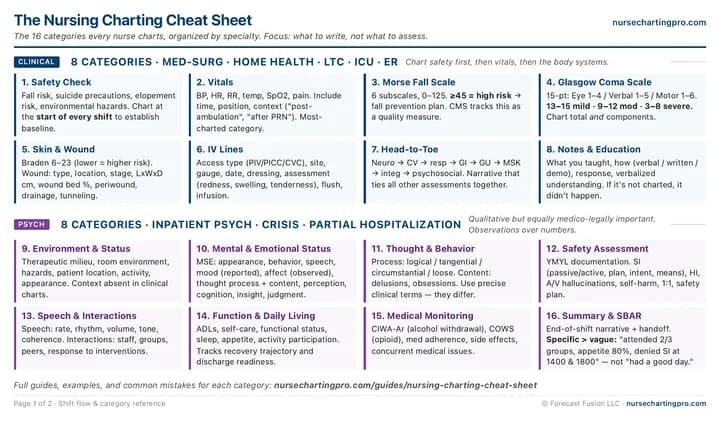
Get the free Nursing Charting Cheat Sheet
- All 16 charting categories, clinical and psych, with what to write for each
- Morse, Braden, Glasgow Coma Scale and SBAR at a glance
- The charting mistakes that cost nurses their licenses
Your patient asked about her new medication, and you explained it. After answering her questions, she nodded, and you moved on to your next task. Now what do you write? "Patient educated on medications" sounds weak - because it is. That note tells the next nurse nothing: which medication? What did you say? Did she actually understand? Could she repeat it back? Were there barriers? A surveyor reading that note finds no evidence that education occurred. During my med-surg rotation, I watched a preceptor spend 20 minutes teaching a patient about insulin self-injection, yet the documentation consisted of just one sentence. The teaching was excellent, but the documentation was invisible.
Why This Matters
Regulatory bodies: The Joint Commission (PC.02.03.01), Centers for Medicare & Medicaid Services (CMS §482.43), State Boards of Nursing
- Joint Commission PC.02.03.01 - Patient Education Standards — The Joint Commission (2025)
- AHRQ Health Literacy Universal Precautions Toolkit - Teach-Back Method — Agency for Healthcare Research and Quality (AHRQ) (2020)
- CMS §482.43 Condition of Participation: Discharge Planning — Code of Federal Regulations, Title 42 (2024)
- Closing the Loop: Physician Communication With Diabetic Patients Who Have Low Health Literacy — Schillinger D, Piette J, Grumbach K, et al. Arch Intern Med. 2003;163(1):83-90 (2003)
Types of Notes Covered on This Page
The 5 Elements of a Patient Education Event
Whenever you teach a patient something, document all 5 elements. Missing even one creates a gap that a surveyor or attorney can question.
Topic Taught
Method Used
Patient Response
Teach-Back Verification
Barriers to Learning
Discharge Teaching Documentation
The Teach-Back Method
Teach-back is the most evidence-supported technique for verifying patient understanding. The Schillinger study demonstrated its effectiveness; now you need to document its use.
The Evidence Behind Teach-Back
How to Use Teach-Back
Documenting Teach-Back
Narrative Nursing Notes (When and How)
Narrative notes serve as the free-text section of your chart, capturing events and clinical reasoning that structured fields cannot accommodate. Unfortunately, they are often misused.
When to Write a Narrative Note
How to Format a Narrative Note
What NOT to Use Narrative Notes For
Common Mistakes
"Patient educated" with no details
"Patient educated on medications" contains zero evidence that education occurred. It does not identify which medication, what was taught, how the patient responded, or whether they understood. A surveyor reading that note has no basis to confirm the education happened.
Skipping teach-back verification
"Patient verbalized understanding" is not teach-back - it is your interpretation of what the patient said, without any evidence. Teach-back requires the patient to restate or demonstrate the information, and you to document what they said or did.
Document Barriers When They Exist
Documenting barriers when they clearly exist indicates thorough assessment. For example, a patient with a hand tremor learning insulin injection faces a physical barrier. By documenting the barrier and the accommodation, you demonstrate an individualized education plan.
Missing a discharge teaching topic
"Discharge teaching completed" without a topic list fails to document essential information. If a patient is readmitted and the receiving team inquires about what they learned regarding warning signs, a note stating "discharge teaching completed" offers no clarity. Each topic must be individually addressed and documented.
Narrative notes for data that belongs in structured fields
The weak example buries vital signs and medication administration in a narrative note where they are not searchable or trendable. The strong example puts structured data in structured fields and uses the narrative note for what it is designed for: the clinical story, provider communication, and the plan.
Case Example
Scenario
Ms. Okeke is being discharged after a 3-day admission for hyperglycemia (BG 487 on admission) that led to her new diagnosis of T2DM. She has no prior diabetes education. Her daughter, Adaeze, is present and will help with care at home. You are conducting the discharge teaching session. Ms. Okeke speaks English fluently but reports she "never finished high school." She wears reading glasses and has no cognitive deficits.
Chart Entry
Discharge Teaching Session - 1030-1145
Patient: Ms. Okeke. Daughter Adaeze present and participating.
Barriers assessed: Patient reports limited formal education ("never finished high school"). Health literacy screening: patient can read medication labels with reading glasses but prefers verbal instruction with pictures. Accommodation: all education provided verbally with pictorial handouts; written materials at a 5th-grade reading level selected from the diabetes education library. No cognitive, language, or hearing barriers identified.

1. Diagnosis - Type 2 Diabetes Mellitus
Topic: What T2DM is, how it affects the body, and that it is manageable with medication, diet, and monitoring.
Method: Verbal explanation with ADA pictorial handout "What Is Type 2 Diabetes?"
Patient response: Patient asked, "So my body still makes insulin but it doesn't work right?" - confirmed correct understanding.
Teach-back: Patient stated, "My pancreas makes insulin but my body can't use it like it should, so sugar builds up in my blood. I have to take medicine and watch what I eat to keep the sugar down." Teach-back accurate.

2. Medications - Metformin 500mg PO BID, Glipizide 5mg PO daily
Topic: Name, dose, frequency, purpose, timing, common side effects, and when to hold each medication.
Method: Verbal with pharmacy medication guides. Pill identification performed with actual discharge medications.
Patient response: Patient identified both pills by appearance. Asked, "What happens if I miss a dose?" - educated on missed dose protocol.
Teach-back: Patient stated, "The big white one is metformin, I take it with breakfast and dinner for my sugar. The little white one is glipizide, I take it every morning before I eat. If my stomach gets upset from the metformin I call the doctor, I don't just stop it." Teach-back accurate. Daughter Adaeze also identified both medications.

3. Blood Glucose Monitoring
Topic: How to use the glucometer, when to test (fasting and 2h post-meal), target ranges, and what to do with high and low readings.
Method: Demonstration of the glucometer by the nurse; return demonstration by the patient.
Patient response: Patient performed the return demonstration with correct technique on the second attempt (first attempt: insufficient blood sample, re-educated on lancing depth). Patient correctly read the result from the display.
Teach-back: Patient stated, "I check my sugar when I wake up before eating and two hours after dinner. If it's under 70 I drink juice and recheck. If it's over 300 I call the doctor." Teach-back accurate. Blood glucose log provided; patient demonstrated correct entry.

4. Diet - 1800-Calorie Diabetic Diet
Topic: Carbohydrate awareness, meal spacing, reading nutrition labels, and foods to limit.
Method: Verbal with pictorial plate method handout; reviewed sample meal plan with the patient.
Patient response: Patient stated, "I'm going to have to change how I cook - we eat a lot of rice." Discussed culturally appropriate modifications (portion control for rice, adding vegetables, reducing sweetened beverages). Patient receptive.
Teach-back: Patient demonstrated the plate method using the handout: "Half the plate is vegetables, a quarter is my protein, and a quarter is my starch like rice or bread. And I don't drink the sweet tea anymore." Teach-back accurate. Dietitian referral placed for outpatient follow-up.

5. When to Call the Doctor
Topic: Symptoms requiring a call to the provider (persistent BG >300, BG <70 not responding to treatment, signs of infection, and illness affecting eating or medication).
Method: Verbal with written "When to Call" card.
Teach-back: Patient stated, "I call if my sugar stays over 300, if it goes low and the juice doesn't fix it, if I get sick and can't eat or keep my medicine down, or if I get a cut that won't heal." Teach-back accurate. Daughter stated she will also keep the card on the refrigerator.

6. Follow-Up Appointments
Topic: Endocrinology appointment in 1 week, PCP in 2 weeks, lab work (HbA1c, metabolic panel) before the PCP visit.
Method: Verbal with printed appointment summary.
Patient response: Patient confirmed she has transportation arranged with her daughter for both appointments.
Teach-back: Patient stated correct dates and locations for both appointments and knew to get lab work done "the day before I see my regular doctor." Teach-back accurate.

7. DKA Warning Signs
Topic: Signs of diabetic ketoacidosis (nausea/vomiting, fruity breath, deep rapid breathing, confusion, abdominal pain) and that this is a 911 emergency.
Method: Verbal with pictorial warning signs handout.
Patient response: Patient appeared concerned; reassured that DKA is preventable with medication adherence and monitoring.
Teach-back: Patient stated, "If I start throwing up and can't stop, or my breathing gets fast and deep, or I get confused, my daughter calls 911. Don't drive to the hospital, call 911." Teach-back accurate. Daughter verbalized the same understanding.

Overall assessment: Patient and daughter engaged throughout the 75-minute teaching session. All 7 topics covered with teach-back verified on each. Patient demonstrated glucometer use via return demonstration. Barriers addressed (health literacy accommodation with pictorial materials). Discharge packet provided, including all handouts reviewed, medication list, appointment summary, When to Call card, and blood glucose log. Patient stated she feels "nervous but ready." Follow-up reinforcement planned at the endocrinology visit in 1 week.
Key points from above chart entry
- Barriers assessed at the start:
- Health literacy barrier identified, documented, and accommodated BEFORE teaching began - not as an afterthought.
- Each topic has all 5 elements:
- Every one of the 7 topics includes the specific content taught, the method, the patient response, teach-back with a direct quote, and barrier awareness.
- Direct patient quotes for teach-back:
- Using the patient's actual words ("My pancreas makes insulin but my body can't use it like it should") is stronger documentation than "patient verbalized understanding."
- Failed first attempt documented:
- The glucometer return demonstration failed on the first try. Documenting the failure, the re-education, and the successful second attempt shows thorough teaching - not a gap.
- Family involvement documented:
- Daughter's presence, participation, and understanding are documented throughout. This proves the caregiver was included in discharge planning as CMS requires.
- Cultural accommodation:
- Dietary teaching addressed the patient's actual eating patterns ("we eat a lot of rice") with culturally appropriate modifications rather than generic instructions.
Pro Tips
- Document During or Immediately After the Teaching Session: You will not remember teach-back quotes and patient responses at the end of a 12-hour shift. Document these details while the conversation is fresh, even if you make brief notes on a paper brain that you later transcribe into the chart within the hour. Waiting until the end of your shift turns specific documentation into vague summaries.
- Use Actual Patient Quotes for Teach-Back: Direct quotes provide the strongest evidence of teach-back. For example, "Patient stated: 'I take the water pill in the morning so I'm not up all night'" is observable and verifiable. In contrast, "Patient verbalized understanding of medication timing" reflects your interpretation. Writing quotes takes only seconds longer but significantly strengthens your documentation during a chart review or deposition.
- Document failed teach-back - it is not a charting failure: A patient who cannot accurately teach back after the first explanation represents a normal finding, not a documentation issue. Document as follows: "Initial teach-back inaccurate - patient stated warfarin is for blood pressure. Re-educated: warfarin is a blood thinner to prevent clots. Repeat teach-back accurate." This demonstrates that you identified and addressed a knowledge gap. Only documenting the successful attempt obscures the gap and results in weaker documentation.
- Use a Discharge Teaching Checklist to Avoid Missing Topics: A 10-topic discharge teaching checklist (diagnosis, medications, follow-up, activity, diet, wound care, warning signs, when to call, equipment, contacts) serves as your safety net against omissions. Work through it systematically. If a topic does not apply, document "N/A" along with a brief reason. An intentional "N/A" differs from a missing topic - one reflects a clinical decision, while the other indicates a gap.
- Keep Education Documentation and Narrative Notes Separate: Education events belong in the education section of your chart. Use narrative notes for clinical events, provider communication, and context. Mixing the two places your education documentation where a surveyor does not expect to find it, while cluttering your narrative notes with teaching details. If a teaching session involved a notable event, such as a patient becoming upset, refusing further education, or family conflict about the care plan, document the teaching in the education section and the event in a narrative note, cross-referencing each other.
Frequently Asked Questions
- What are the 5 elements of patient education documentation?
- Every patient education event requires documentation of 5 key elements: (1) the specific topic taught, (2) the method used to deliver the education (verbal, demonstration, written materials, video), (3) the patient's response (what you observed), (4) teach-back verification (the patient restating or demonstrating the information in their own words), and (5) identified barriers to learning and the accommodations made. Missing any of these elements results in incomplete documentation that may not meet Joint Commission or Centers for Medicare & Medicaid Services (CMS) requirements.
- What is the teach-back method?
- Teach-back is a technique in which you ask the patient to explain what you just taught them in their own words or to demonstrate a skill you just showed them. This method verifies understanding instead of relying on the question, "Do you understand?" (which patients almost always answer yes to). Research by Schillinger et al. (2003) found that patients with diabetes whose physicians used teach-back had significantly better blood sugar control. To document teach-back, record the patient's actual words or describe their return demonstration, noting whether the teach-back was accurate or required re-education.
- What goes in a narrative note vs. education documentation?
- Teaching goes in education documentation, and clinical events that do not fit structured fields go in a narrative note. Education documentation captures what you taught, how you taught it, the patient's response, teach-back results, and any barriers encountered. Narrative notes document clinical events, observations, and reasoning, such as changes in condition, provider communication, patient interactions, incidents, and clinical decision-making. For example, if you taught a patient about wound care, that information belongs in education documentation. However, if the patient became upset during the teaching and refused further education, you would record the teaching in education documentation and the refusal in a narrative note.
Get the free Nursing Charting Cheat Sheet
- All 16 charting categories, clinical and psych, with what to write for each
- Morse, Braden, Glasgow Coma Scale and SBAR at a glance
- The charting mistakes that cost nurses their licenses
Chart faster with Nurse Charting Pro
Tap through your assessments during the shift and get a draft of your note to review at clock-out. Your notes are cleared from your phone at the end of your shift.