Documenting vitals may seem straightforward with just six or seven numbers. However, you might find yourself spending 10 minutes per patient as you second-guess what to include beyond the raw values. Should you document position for every blood pressure? What if the SpO2 is 93% but the patient consistently runs low? When should you call a provider for a heart rate of 102, and when is it merely post-ambulation? During my first med-surg rotation, I recorded bare numbers for my first three patients and added contextual narratives for the next three after my preceptor pulled me aside and said, "These vitals tell me nothing." That conversation transformed my approach to charting. Here's what I learned about making vitals documentation fast, defensible, and genuinely useful for the next nurse.
How to Chart Vital Signs Correctly: Nursing Documentation Tips
Amy and Miranda walk through documenting a full set of vital signs, including the context (position, oxygen source, route, and trend) that turns bare numbers into a defensible entry.
Regulatory bodies: Centers for Medicare & Medicaid Services (CMS), The Joint Commission, State Nurse Practice Acts
Clinicians frequently document vital signs, making them the most referenced data point in malpractice cases. CMS Conditions of Participation require the medical record to contain sufficient information to justify treatment and document results. The Joint Commission expects timely, accurate documentation of patient assessments, including vital signs. State Nurse Practice Acts define assessment - vital sign monitoring included - as a core nursing responsibility that cannot delegate to unlicensed personnel (though the measurement itself can be delegated, the interpretation and documentation of abnormals cannot). Despite being the single strongest predictor of clinical deterioration, respiratory rate is the most commonly neglected vital sign. A 2008 study by Cretikos and colleagues found that an abnormal respiratory rate was the most common finding preceding cardiac arrest and ICU admission; yet, it was the vital sign most likely to be fabricated or estimated rather than actually counted. The AACN Practice Alerts reinforce that accurate vital sign measurement and documentation form the foundation of early warning score systems and rapid response activation. When clinicians chart vitals as bare numbers without context - no position for blood pressure, no oxygen source for SpO2, no trending comparison - the documentation fails to serve its clinical or legal purpose.
The traditional four vital signs are blood pressure, heart rate, respiratory rate, and temperature. These parameters have formed the foundation of clinical assessment for over a century. Modern practice has expanded the set to include pulse oximetry (SpO2) and pain, raising the standard to six. Some facilities also track blood glucose as a routine vital sign for certain patient populations, though this practice is not universal.
The distinction matters because documentation expectations follow the definition. If your facility considers pain a vital sign - and most acute care facilities do since The Joint Commission emphasized pain assessment in its standards - then a set of vitals without a pain score is incomplete. Similarly, SpO2 has become so standard in acute care that charting a set of vitals without it for a patient with continuous pulse oximetry would raise questions during a chart audit.
An important distinction exists between vital signs and assessment findings. Heart rate qualifies as a vital sign, while heart rhythm represents a cardiac assessment finding. Respiratory rate serves as a vital sign, whereas breath sounds are a respiratory assessment finding. Vital signs are measured parameters, while assessment findings are observed or auscultated. Both require documentation, but they belong in different sections of the chart. Vital signs go in the vitals flowsheet, and assessment findings go in the head-to-toe or focused assessment documentation.
Knowing where each data point belongs keeps your charting organized and prevents duplication. You do not need to document the heart rate in both the vitals flowsheet and the cardiac assessment section; chart it once in vitals and reference the rhythm in the assessment.
How to document each vital sign
Each vital sign has a number, but the number alone does not constitute complete documentation. Here is what makes each one defensible.
Blood pressure
Document the systolic and diastolic values, the patient's position (supine, sitting, standing), the arm used (right or left), and the method (manual auscultation, automatic cuff, arterial line). Position matters because blood pressure changes with position - a patient who is normotensive supine may be hypotensive sitting, and that orthostatic change is clinically significant. The arm matters because there can be a 10-20 mmHg difference between arms, and consistency allows accurate trending. The method matters because an arterial line reading and an automatic cuff reading on the same patient at the same time can differ by 5-15 mmHg.
Example of complete BP documentation: "BP 138/82, sitting, left arm, auto cuff." That takes five extra seconds compared to writing "138/82" and transforms the data point from ambiguous to trendable. If the next set is 122/74 and you did not document position, no one knows whether the blood pressure actually dropped or the patient was just lying down this time.
For orthostatic vital signs, document all three positions with the time between position changes: "Supine 128/76 HR 68, sitting (1 min) 118/70 HR 78, standing (3 min) 104/62 HR 92 - patient reports lightheadedness on standing. Provider notified."
Heart rate
Document the rate, the rhythm (regular or irregular), and the strength when palpating rather than reading from a monitor. An automated monitor provides only the rate; it does not indicate whether the pulse is bounding, thready, or weak. When you palpate a radial pulse and the rate matches the monitor, you gain information about pulse quality that the monitor cannot provide.
If the heart rate on the monitor does not match the palpated pulse, document both: "HR 88 on monitor, apical rate 96 - pulse deficit of 8. Irregular rhythm palpated, telemetry showing A-fib with RVR." A pulse deficit is a clinically significant finding that only appears when you compare the two.
For patients on telemetry, you do not need to re-document the full rhythm interpretation in the vitals section; that belongs in the cardiac assessment. However, noting "regular" or "irregular" alongside the rate is appropriate because it adds context to the number without duplicating the assessment.
Respiratory rate
Respiratory rate is the vital sign most likely to be estimated, fabricated, or documented inaccurately. Studies consistently show that nurses and nursing students frequently record a respiratory rate of 18 or 20 without actually counting. This matters because respiratory rate serves as the earliest and most sensitive indicator of clinical deterioration. A patient whose respiratory rate gradually climbs from 16 to 22 to 28 over three sets of vitals is conveying important information, but only if the numbers are accurate.
Count for a full 60 seconds. Yes, this feels slow. Yes, you may be tempted to count for 15 seconds and multiply by four. The problem with the short-count method is that it misses irregular patterns - periodic apnea, Cheyne-Stokes, cluster breathing - and amplifies counting errors. One miscount in 15 seconds becomes a 4-breath error in the documented rate.
Document the rate, the effort (unlabored, mildly labored, labored, severe respiratory distress), and the pattern if it deviates from regular. "RR 22, unlabored, regular" indicates a patient who is breathing slightly fast but comfortably. "RR 22, labored with accessory muscle use" presents a different clinical picture entirely. The number is the same; the context is everything.
SpO2 (pulse oximetry)
An SpO2 value without the oxygen source constitutes incomplete documentation. "SpO2 96%" conveys almost nothing. "SpO2 96% on 4L NC" indicates the patient needs supplemental oxygen to maintain an acceptable saturation. "SpO2 96% on room air" shows the patient is oxygenating independently. The clinical significance differs entirely, even though the number remains the same.
Document the percentage and the oxygen delivery device with its flow rate or FiO2: room air, nasal cannula with liter flow, simple mask with liter flow, Venturi mask with FiO2 percentage, non-rebreather with liter flow, high-flow nasal cannula with flow rate and FiO2. If the patient is on a ventilator, SpO2 is documented alongside the ventilator settings in the respiratory flowsheet.
Also note whether the waveform is adequate if you are using a pulse oximeter. A poor waveform means the reading may not be reliable; cold fingers, nail polish, patient movement, and poor perfusion all affect accuracy. If you obtain a reading of 88% but the waveform is poor and the patient appears comfortable and pink, document that: "SpO2 88% per finger probe, poor waveform noted - repositioned probe to earlobe, SpO2 95% with good waveform on 2L NC."
Temperature
Document the value, the route, and the time when timing is clinically relevant (such as tracking a fever curve or documenting response to antipyretics). Routes matter because they have different accuracy profiles: rectal is considered the gold standard and most closely approximates core temperature; oral is standard for alert, cooperative patients; tympanic and temporal artery are convenient but can be affected by technique and ambient temperature; axillary is the least accurate and typically reads 0.5-1.0 degrees lower than core.
Consistency in route matters for trending. If the 0800 temperature was 37.2 oral and the 1200 temperature is 37.8 tympanic, you cannot determine whether the patient's temperature actually increased or if the route difference accounts for the change. When tracking a fever, use the same route each time.
For fever documentation, include the intervention and the follow-up: "Temp 38.9 C oral at 1400. Acetaminophen 650mg PO administered per order. Recheck temp 38.1 C oral at 1530 - trending down." This closed-loop documentation shows the finding, the intervention, and the reassessment result.
Pain
Pain documentation requires more than a number. The numeric rating scale (0-10) or Wong-Baker FACES scale provides intensity, but defensible pain charting includes location, quality, onset and duration, aggravating and alleviating factors, and whether the pain occurs at rest or with activity.
"Pain 6/10" serves as a data point. "Pain 6/10, right lower quadrant, sharp, constant since 0600, worsens with movement, not relieved by positioning" presents a clinical picture. The first statement indicates the patient hurts. The second informs you, the next nurse, and the provider about what is happening and what has already been tried.
For pain reassessment after intervention, document the reassessment within the timeframe your facility requires (typically 30-60 minutes for PO medications, 15-30 minutes for IV): "Hydromorphone 0.5mg IV administered at 1020 for pain 7/10 right lower quadrant. Reassessed at 1045: pain 4/10 same location, patient states 'much better, I can shift in bed now.' Tolerable per patient." This shows the intervention, the timing, the reassessment, and the patient's own words about effectiveness.
Trending and Abnormal Values
A single set of vital signs provides a snapshot, while multiple sets compared over time reveal a trend. Trending transforms vitals documentation from mere data entry into clinical reasoning.
Each time you chart a new set of vitals, review the previous set. Is the blood pressure increasing, decreasing, or remaining stable? Is the heart rate gradually climbing? Has the respiratory rate increased by 4 breaths per minute since the last check? These changes may not trigger an alarm individually - a heart rate moving from 78 to 86 remains within normal limits - but the direction of change is as significant as the absolute value.
Document trends explicitly when they hold clinical significance. Do not assume the next nurse will examine the flowsheet and make connections. "HR 102 - up from 78 at 0800 and 88 at 1200, trending upward" conveys more information than simply stating "HR 102." The trend line constitutes the assessment, while the single number serves as just a data point.
The abnormal-intervention-reassessment loop forms the core pattern for documenting any vital sign that falls outside expected parameters. Step one: document the abnormal finding with full context. Step two: record your actions (intervention, provider notification, protocol activation). Step three: document the reassessment result, including timing. This three-part loop is what auditors, attorneys, and risk managers seek. An abnormal value without follow-up documentation raises a red flag. In contrast, an abnormal value followed by intervention and reassessment demonstrates clinical reasoning and appropriate nursing judgment.
Early warning scores - NEWS2, MEWS, or your facility's version - aggregate vital signs into a single score that predicts deterioration risk. If your facility employs an early warning score system, document the score alongside the vitals. A NEWS2 of 7 communicates urgency in a way that individual vital sign values might not, especially when no single vital is dramatically abnormal but several are mildly off baseline.
What to Document When Vitals Are Abnormal
When one or more vital signs fall outside expected parameters, document the complete story. Here is a six-step template for abnormal vitals documentation.
Step one: document the abnormal value with full context. Include everything you would for a normal vital plus any additional observations. "BP 84/52, supine, left arm, auto cuff. Patient diaphoretic, reports feeling dizzy."
Step two: document what you compared it to. "Baseline BP 118-126/72-78 over the last 24 hours. This represents a drop of 34 mmHg systolic from the most recent reading of 118/74 at 0800."
Step three: document your immediate interventions. "Placed patient supine with legs elevated. Assessed IV access - 20G right AC patent, flushed with 10 mL NS. Initiated NS 500 mL bolus per hypotension protocol."
Step four: document who you notified and when. "Provider notified via phone at 1032. Read back vitals, patient symptoms, and interventions already initiated. Orders received: NS 1000 mL bolus, CBC and BMP stat, repeat BP in 15 minutes."
Step five: document the reassessment. "1047 reassessment: BP 92/58, supine. Patient reports dizziness improved. NS bolus infusing at 250 mL/hr. Still diaphoretic but less pronounced. Stat labs drawn and sent."
Step six: document the outcome or ongoing plan. "1100 reassessment: BP 108/68, supine. Dizziness resolved. Diaphoresis resolved. Patient sitting up without symptoms. Will continue to monitor BP every 15 minutes x4, then every 30 minutes x2 per provider order."
This six-step framework applies to any abnormal vital sign - hypotension, tachycardia, fever, desaturation, acute pain. The specifics change, but the structure remains the same: finding, comparison, intervention, notification, reassessment, outcome.
Speed vs. Thoroughness
On a busy med-surg floor with six patients, you might take vitals every four hours - potentially 36 sets of vitals in a 12-hour shift. At 10 minutes per set for documentation, you would spend 6 hours just charting vitals. That math does not work. Here's how to be thorough without being slow.
First, build the habit of documenting context only when it adds clinical value. A stable patient with consistent vitals does not need a trending narrative with every set. Use "VS stable, consistent with prior" alongside the numbers in the flowsheet when nothing has changed. Save the detailed narrative for when values change, when they are abnormal, or when you intervene.
Second, use the vitals flowsheet for the numbers and the nursing notes for the narrative. The flowsheet captures data points in a trendable, scannable format, while the nursing note conveys the clinical story when something happens. Avoid writing a narrative in the flowsheet or replicating flowsheet data in the notes.
Third, pre-fill what you can. If your patient's oxygen source has not changed, the position is always sitting for vitals, and the route is always oral for temperature, those contextual details carry forward. Document changes to the context, not the context itself every single time.
Fourth, chart in real time. The biggest time sink in vitals documentation is not the charting itself; it is trying to remember details three hours later. If you take vitals at 0800, chart them at 0805. The numbers are fresh, the context is in your working memory, and you will not have to go back and reconstruct what happened.
Fifth, know your facility's documentation requirements. Some facilities require narrative documentation with every set of vitals, while most require it only with abnormals. Understanding the standard prevents over-documenting stable patients and under-documenting unstable ones.
NurseChartingPro's vitals screen is built around this principle. You enter the numbers, toggle context fields when relevant (position change, new O2 source, pain location), and the structured format ensures completeness without requiring you to write everything from scratch each time.
✅Strong: BP 142/88 sitting, right arm, auto cuff. HR 96 regular. RR 20 unlabored. SpO2 94% on 2L NC. Temp 37.1 C oral. Pain 4/10 left knee, aching, at rest.
Numbers without context lack trendability and defensibility. You cannot compare blood pressures without knowing the position. You cannot evaluate SpO2 without knowing the oxygen source. Spending five extra seconds per vital sign transforms data entry into clinical documentation.
Writing "vitals stable" without actual values
❌Weak: Patient seen. Vitals are stable with no acute changes noted. Monitoring will continue.
✅Strong: VS at 1200: BP 122/74 sitting R arm, HR 76 regular, RR 16 unlabored, SpO2 97% RA, Temp 36.8 C oral, Pain 0/10. Consistent with 0800 set - no significant changes.
"Vitals stable" without values is meaningless from a legal and clinical standpoint. Stable compared to what? If the chart is ever audited or subpoenaed, "vitals stable" with no numbers means there is no documentation that vitals were actually assessed. Always include the values.
Documenting an Abnormal Value with No Follow-Up
❌Weak: BP 82/50. HR 112. Will continue to monitor.
✅Strong: BP 82/50, supine, L arm - down from 116/72 at 0800. HR 112 regular, up from 78. Patient reports lightheadedness. Placed supine with legs elevated. NS bolus initiated per protocol. Provider notified at 1035; orders received for stat labs and repeat BP in 15 min.
Documenting an abnormal vital sign without intervention, notification, or reassessment poses a liability. It indicates that you identified a problem but took no action. Every abnormal finding requires documentation of the intervention-reassessment loop - what you did, who you informed, and the subsequent outcomes.
Estimating Respiratory Rate Instead of Counting
❌Weak: RR 18. (Documented without actual counting.)
✅Strong: RR 24, counted for 60 seconds, mildly labored at rest with occasional use of accessory muscles. Up from RR 16 at 0800.
Respiratory rate often becomes the most commonly fabricated vital sign. If you frequently document rates like 16, 18, or 20, consider whether you are actually counting. Estimating the respiratory rate can overlook the gradual increase that precedes clinical deterioration - the very situation where accurate vitals are crucial.
Copying Vitals from a Previous Shift
❌Weak: 0800 vitals match 2000 vitals from the night shift. (Copied forward without reassessment.)
✅Strong: 0800 vitals: BP 130/78 sitting R arm, HR 82 regular, RR 18 unlabored, SpO2 96% on 2L NC, Temp 37.0 C oral, Pain 2/10 R hip at rest. Compared to the 0400 set, BP increased by 8 systolic; otherwise, the values remain consistent.
Copying forward vitals constitutes falsification of medical records. Even if the patient is stable and the values are similar, each set must undergo independent assessment and documentation. Identical vitals across shifts trigger immediate audit flags and may lead to disciplinary action.
Case Example
Mr. PatelAge 58 — Post-op day 1 laparoscopic cholecystectomy
fictional patient
Scenario
You are the day shift nurse on a surgical unit. Mr. Patel had a laparoscopic cholecystectomy yesterday and is expected to discharge today if his vitals remain stable and he tolerates a regular diet. He has a history of hypertension managed with lisinopril 20mg daily and type 2 diabetes managed with metformin. You will take vitals at 0800, 1200, and reassess at 1315 after an intervention.
Chart Entry
0800 Vitals
BP 128/78, sitting, right arm, auto cuff. HR 74 regular. RR 16 unlabored, counted 60 sec. SpO2 97% on room air. Temp 37.0 C oral. Pain 3/10, right upper quadrant, aching, at rest - patient states "it's sore but manageable." Consistent with 0400 set from night shift - no significant changes. Patient alert, conversational, tolerated clear liquids overnight. Advancing to regular diet per orders.

1200 Vitals
BP 118/70, sitting, right arm, auto cuff - down from 128/78 at 0800. HR 98 regular - up from 74 at 0800. RR 22 mildly labored, counted 60 sec - up from 16 at 0800. SpO2 94% on room air - down from 97% at 0800. Temp 38.4 C oral - up from 37.0 at 0800. Pain 6/10 right upper quadrant, sharp, worsening with deep breathing and movement.

Trend summary: all six vital signs have moved in an unfavorable direction since 0800. Heart rate and respiratory rate increases with new low-grade fever and increased pain suggest possible early post-operative complication.

Interventions: Encouraged incentive spirometry - patient achieving 750 mL (was 1250 mL at 0800). Assisted with repositioning and splinting for deep breathing. Administered ketorolac 15mg IV per PRN order for pain. Provider notified at 1215 via phone - reported full vital sign trend, pain escalation, and decreased incentive spirometry volumes. Orders received: CBC and CMP stat, blood cultures x2 if temp exceeds 38.5 C, chest X-ray portable, continue incentive spirometry every hour, reassess vitals in 1 hour.

1315 Reassessment Vitals
BP 124/76, sitting, right arm, auto cuff - improved from 118/70 at 1200. HR 86 regular - improved from 98 at 1200. RR 18 unlabored, counted 60 sec - improved from 22 at 1200. SpO2 96% on room air - improved from 94% at 1200. Temp 38.1 C oral - slightly down from 38.4 at 1200. Pain 3/10 right upper quadrant, aching - improved from 6/10 at 1200. Patient reports pain relief after ketorolac, performing incentive spirometry independently, achieving 1000 mL.

Trend: all parameters improving toward 0800 baseline. Stat labs drawn and sent. Chest X-ray completed. Continuing to monitor per provider orders - next vital signs due at 1415.
Key points from above chart entry
0800 baseline establishes the comparison point:
The stable 0800 set includes full context (position, arm, method, O2 source, route, pain detail) and a comparison to the prior shift. This baseline is what makes the 1200 changes visible and meaningful.
1200 set documents every change from baseline:
Each vital sign at 1200 is explicitly compared to the 0800 value. The trend summary synthesizes the individual changes into a clinical picture rather than leaving the reader to connect the dots.
Intervention section follows the abnormal-intervention-reassessment pattern:
The documentation follows the sequence: finding, intervention, provider notification, orders received. Every step is timestamped and specific - no vague "provider aware" or "will continue to monitor."
1315 reassessment closes the loop:
The reassessment documents improvement toward baseline after intervention, confirms the labs and imaging were completed, and states the ongoing monitoring plan. The loop is closed - finding, intervention, reassessment, outcome.
Pro Tips
💡
Count Respiratory Rate for a Full 60 Seconds: The 15-second shortcut can introduce up to a 4-breath error and may miss irregular patterns entirely. Count for the full minute, particularly for patients who are post-operative, on opioids, or showing any signs of respiratory compromise. If you worry the patient will alter their breathing because they know you are watching, count while pretending to take their pulse - keep your fingers on the wrist and observe the chest.
💡
Always Document Blood Pressure Position: A blood pressure reading without position lacks trendability. If you charted 132/84 sitting at 0800 and 118/72 at 1200, is that a real drop, or did the patient happen to be supine? Make position a non-negotiable part of every BP documentation. Adding two extra words eliminates ambiguity for every nurse who reads the chart after you.
💡
Document pain by location and quality, not just a number: A pain score of 6 alone is barely useful. A pain level of 6/10 in the right lower quadrant, described as sharp, constant, and worsening with movement, provides the next nurse and the provider with a clear clinical picture. The number remains subjective and varies among patients. Location and quality drive the differential diagnosis and guide treatment decisions.
💡
Trend the Data, Don't Just Snapshot It: When you chart a new set of vitals for a patient with changing values, include a one-line comparison to the previous set. For example, "HR 94, up from 76 at 0800" adds four extra words and transforms a data point into a trend. The trend represents the assessment, while the single number serves as merely a measurement. Trending captures the gradual deterioration that individual values may miss.
💡
Never copy vitals forward from a previous entry: When two consecutive sets of vitals match exactly, an auditor may question whether an independent assessment occurred. Even stable patients exhibit small variations between readings. Document what you measured. If the values are genuinely similar, your documentation will reflect that naturally; you do not need to copy them to demonstrate stability.
Step by Step
Assess and record each vital sign with full context: Assess blood pressure (including position, arm, and method), heart rate (noting rhythm), respiratory rate (counted for 60 seconds, including effort and pattern), oxygen saturation (SpO2, noting the oxygen source), temperature (noting route), and pain (including location, quality, and scale). Enter each value into the vitals flowsheet along with its contextual details.
Compare to previous values and identify trends: Look at the prior set of vital signs and note any changes in direction or magnitude. A heart rate that has climbed from 72 to 84 to 96 over three sets is a trend that matters even though each individual value might be within normal limits. Document the comparison explicitly when values are changing.
Flag abnormal findings with clinical context: When a vital sign falls outside expected parameters, document it using the full abnormal-intervention-reassessment framework. Include the abnormal value, compare it to the baseline, note any associated symptoms reported by the patient, and record your clinical observations. Avoid simply documenting an abnormal value and moving on.
Intervene and document your actions: Start appropriate nursing interventions based on the abnormal finding: repositioning, oxygen therapy, fluid bolus per protocol, medication administration. Document each intervention with the time and the specific action; include the rationale. Notify the provider and document the notification time, the information communicated, and the orders received.
Reassess and close the loop: Reassess the vital sign within the prescribed timeframe after your intervention. Document the reassessment result, compare it to both the abnormal value and the original baseline, and note the patient's response. Clearly state the ongoing monitoring plan. You close the loop only after documenting what happened following the intervention.
Frequently Asked Questions
How often should vital signs be documented?
How often you document vital signs depends on the patient's acuity and your facility's policy. In acute care, stable med-surg patients typically require documentation every 4 hours, while step-down or intermediate care patients need it every 1-2 hours. In ICU settings, continuous monitoring occurs with documentation every 1-2 hours. Post-operative patients usually need more frequent monitoring: every 15 minutes for the first hour, every 30 minutes for the next 2 hours, and then every 4 hours if stable. Whenever a patient's condition changes or you administer a medication that affects vital signs (such as antihypertensives, opioids, or antipyretics), reassess and document within the timeframe specified by your facility.
What should you do when vital signs are abnormal?
When vital signs are abnormal, follow the abnormal-intervention-reassessment loop. First, document the abnormal value with full context and compare it to the previous set. Next, start appropriate nursing interventions, such as positioning, oxygen, and protocols. Then, notify the provider with the specific values, the trend, and the actions you have already taken. Afterward, document the orders received. Finally, reassess and document the result within the prescribed timeframe. Your documentation should tell the complete story: what you found, what you did, who you informed, what was ordered, and what happened next.
Why is respiratory rate considered the most important vital sign for detecting deterioration?
Respiratory rate changes earliest among vital signs when a patient deteriorates, often increasing hours before other vital signs become abnormal. Research by Cretikos and colleagues found that an abnormal respiratory rate was the most common finding preceding cardiac arrest and unplanned ICU admission. Heart rate and blood pressure are held near normal by the body's compensation until late in deterioration, but respiratory rate rises early as the body tries to compensate for acidosis, hypoxia, pain, or systemic infection. This early response is why early warning score systems heavily weight respiratory rate and why accurate counting (not estimating) matters.
Should I document vital signs differently for different patient populations?
Yes, document vital signs with the context each patient population needs. Compare pediatric values to age-appropriate normal ranges, and include weight-based context when necessary. For obstetric patients, record maternal and fetal vital signs, focusing on pregnancy-specific parameters. Post-surgical patients require more frequent documentation, emphasizing anesthesia recovery parameters. Cardiac patients may need telemetry correlation with each set of vital signs. Some facilities also track blood glucose as a routine vital sign for patients with diabetes; follow your facility's policy. Tailor your documentation to the clinically relevant aspects for each patient while keeping the standard format: value, context, trend, and response to abnormals.
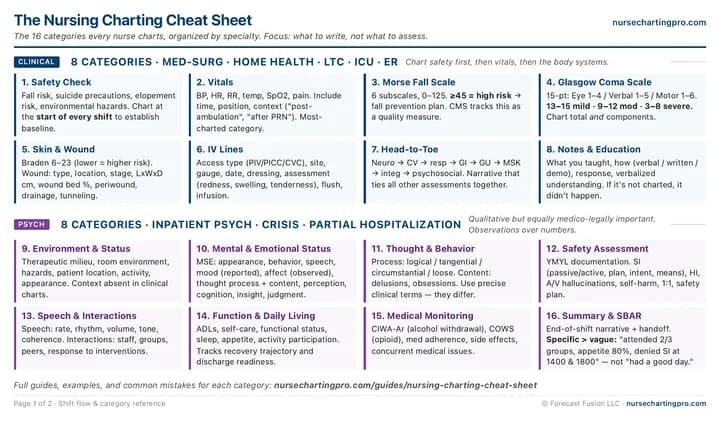
Get the free Nursing Charting Cheat Sheet
All 16 charting categories, clinical and psych, with what to write for each
Morse, Braden, Glasgow Coma Scale and SBAR at a glance
The charting mistakes that cost nurses their licenses
Tap through your assessments during the shift and get a draft of your note to review at clock-out. Your notes are cleared from your phone at the end of your shift.