Your instructor asked you to document your patient's speech and you realized you had no idea what to write beyond "normal." The patient talked to you for fifteen minutes during the interview and you could tell something was off about how he was speaking - slow, quiet, almost like it took effort to get the words out - but you did not have the vocabulary to describe it. And then your preceptor asked about his peer interactions and you had not been tracking those at all. This page gives you the five-dimension speech framework I wish someone had handed me on day one of my psych rotation, plus how to document interactions with staff, peers, and groups so your entries actually tell the clinical story.
Video coming soon — subscribe to be notified when new episodes drop.
Why This Matters
Regulatory bodies: Joint Commission Behavioral Health Standards, Centers for Medicare & Medicaid Services (CMS)
Speech assessment constitutes one of the ten standard components of the Mental Status Exam, with changes in speech patterns serving as some of the earliest observable indicators of psychiatric decompensation or medication response. Pressured speech may signal a manic episode before the patient reports mood changes. Poverty of speech can indicate worsening depression, emerging psychosis, or medication side effects. Slurred speech in a patient on psychotropics might suggest toxicity or a neurological event. The StatPearls reference on mental status examination identifies speech as a core assessment domain that clinicians should document at every encounter. Joint Commission behavioral health standards require psychiatric assessments to include speech evaluation as part of the comprehensive mental status examination. Documenting patient interactions - how the patient relates to staff, peers, and the treatment program - provides the behavioral evidence that supports or contradicts the verbal assessment findings. A patient who reports feeling "fine" but refuses groups, avoids peers, and responds to staff with one-word answers presents a clinical picture that the speech and interaction documentation captures, which the verbal self-report does not.
Speech documentation encompasses five distinct dimensions. Assessing all five each time you chart provides a complete picture and reveals changes over time. The NurseChartingPro app offers 10 speech options (normal rate/tone, pressured, hyperverbal, tangential, clear, slurred, soft/whispered, loud, linear, limited) that correspond to these five dimensions.
Rate
Rate refers to how fast the patient speaks. A normal rate is conversational; the patient speaks at a pace that is easy to follow and does not feel rushed or labored. Slow speech may indicate depression, sedation from medications, cognitive impairment, or neurological issues. Rapid speech may suggest anxiety, stimulant use, or the early stages of mania. Pressured speech is a specific clinical finding: the patient speaks rapidly, is difficult or impossible to interrupt, and seems driven to keep talking. Pressured speech is one of the DSM-5 criteria for a manic episode and should always be flagged.
Documentation examples: "Speech rate normal, conversational." "Speech slow - noticeable latency of 3-4 seconds before responding to questions. Responses brief." "Speech rapid and pressured - patient difficult to interrupt, continued speaking over interviewer on multiple occasions."
Volume
Volume indicates how loud or quiet the patient speaks. Normal volume is audible at conversational distance without straining. Soft or whispered speech may suggest depression, anxiety, fear, or a patient who does not want to be overheard. Loud speech may indicate agitation, mania, hearing impairment, or cultural norms. Variable volume - shifting between quiet and loud within the same conversation - may suggest emotional lability or psychotic processes.
Documentation examples: "Volume normal, easily audible." "Volume soft - patient speaking in near-whisper, had to lean in to hear responses." "Volume loud and increasing over the course of the interview. Patient appeared unaware of volume level."
Articulation
Articulation refers to the clarity of the patient's speech production. Clear articulation means the words are distinct and understandable. Slurred speech may indicate medication effects (benzodiazepines, antipsychotics), substance intoxication, or a neurological event and should always be compared to the patient's baseline. Mumbled speech may suggest low motivation, depression, or dental/oral issues. If the patient's articulation changes acutely from their baseline, it warrants immediate assessment.
Documentation examples: "Articulation clear, words distinct and easily understood." "Speech slurred - words running together, difficulty pronouncing multi-syllable words. This is new since the Seroquel dose increase yesterday." "Speech mumbled, patient speaking with mouth partially closed. Difficult to understand approximately 30% of responses."
Spontaneity
Spontaneity describes whether the patient initiates conversation or only responds when directly addressed. Spontaneous speech means the patient offers information, asks questions, and engages in dialogue without needing prompts. Responsive-only speech means the patient answers questions when asked but does not initiate. Poverty of speech (also called alogia) means the patient produces very little speech even when directly questioned - responses are minimal, often one or two words, with long pauses.
This dimension is often overlooked in documentation because it requires noticing an absence rather than a presence. A patient who answers every question you ask but never volunteers a single comment, never asks a question, and never initiates a topic demonstrates reduced spontaneity - a finding worth documenting, especially when compared to their baseline.
Documentation examples: "Speech spontaneous - patient initiated conversation about his medication concerns and asked several questions about discharge timeline." "Speech responsive only - patient answered all questions but did not initiate any topics. Required direct prompting to elaborate." "Poverty of speech noted - responses limited to one or two words despite open-ended questioning. Long pauses between question and response."
Prosody
Prosody refers to the melody and inflection of speech - the rise and fall of pitch, the emphasis on certain words, and the emotional coloring of the voice. Normal prosody exhibits natural variation: the voice rises with questions, emphasizes important words, and reflects the emotional content of what is being said. Monotone speech - flat, unvarying pitch with no emotional inflection - represents a significant finding that may indicate depression, negative symptoms of schizophrenia, or medication effects. Exaggerated or dramatic prosody - theatrical emphasis, sing-song quality, rapid pitch changes - may suggest mania or histrionic features.
Prosody is subtle and harder to document than rate or volume, but it is clinically important because it contributes to the affect picture. A patient who reports their mood as "fine" in a flat, monotone voice with no inflection presents incongruent affect - the prosody finding supports that clinical observation.
Documentation examples: "Prosody normal - appropriate inflection and emotional variation throughout conversation." "Monotone - voice flat with no pitch variation or emotional inflection even when discussing distressing topics." "Prosody exaggerated - dramatic emphasis, rapid pitch changes, theatrical quality to speech."
Speech Findings That Matter Clinically
Certain speech findings carry specific diagnostic and treatment significance that the treatment team must know about.
Pressured speech occurs when the patient speaks rapidly, voluminously, and with difficulty in interruption. The patient seems driven to keep talking, often speaking over you, jumping between topics, and resisting redirection. This symptom is one of the DSM-5 criteria for manic episodes and often serves as the first observable sign of mania, sometimes appearing before the patient reports any mood change. If pressured speech is new or worsening, document it clearly and notify the treatment team.
Poverty of speech (alogia) represents the opposite extreme: the patient produces very little speech, gives one-word answers, and exhibits long response latency. This may indicate a negative symptom of schizophrenia, a sign of severe depression, or a medication side effect. When documenting poverty of speech, note the response latency and the typical response length to track changes over time.
Perseveration occurs when the patient repeats the same word, phrase, or idea repeatedly, often returning to the same topic regardless of the question asked. This behavior can indicate psychotic processes, cognitive impairment, or extreme anxiety. Document the specific phrase or topic being repeated.
Echolalia involves the repetition of words or phrases that someone else just said; the patient parrots back your questions or the last few words of your sentence. This can indicate catatonia, psychotic processes, or certain neurological conditions.
Neologisms are made-up words that the patient uses as if they have meaning. For example, "I need to go to the flargen because the tinwhistle is happening" contains two neologisms. Document the specific words the patient used.
Word salad (also called incoherence) represents a severe disorganization of speech where the words are recognizable but strung together without grammatical or logical connection. This indicates severe thought disorganization and is typically seen in acute psychosis. When documenting word salad, quote the patient directly; their exact words are more clinically useful and legally defensible than your summary of them.
Staff and Peer Interactions
Interaction documentation captures how the patient relates to the people around them - staff and peers - which provides behavioral evidence that complements the verbal findings from the speech assessment.
The NurseChartingPro app provides six interaction quality options for staff interactions: pleasant, appropriate, limited, hostile, withdrawn, and intrusive. These are starting categories, but your documentation should always include the specific behaviors that support the label.
For staff interactions, document the patient's cooperation level, communication style, and any notable events. Cooperative means the patient engages with staff requests, answers questions, and participates in the therapeutic relationship. Guarded means the patient is cautious, answers minimally, and may deflect personal questions. Hostile means the patient is verbally aggressive, confrontational, or threatening toward staff. Withdrawn means the patient avoids or minimizes interaction with staff - not just quiet, but actively retreating from engagement.
Always give specific examples: "Patient cooperative with morning assessment. Made eye contact, answered questions in full sentences, asked about his medication schedule" is more useful than "Interactions: appropriate." And "Patient hostile toward staff - raised voice when told visiting hours were over, called nurse a profanity, slammed door to room" is more useful and more legally defensible than "Patient was rude."
For peer interactions, document the patient's social engagement pattern. Are they spending time with other patients? Initiating conversations? Sitting alone? Involved in conflicts? Peer interaction patterns often shift before other clinical indicators - a depressed patient who starts sitting with peers at meals may be improving. A patient with paranoid ideation who was previously social but now refuses to leave their room may be decompensating.
Document what you observe: "Patient sat with two peers in the dayroom and was observed having a 10-minute conversation about sports. Relaxed posture, laughing at times." Or: "Patient sat alone in the corner of the dayroom facing the wall. When peer approached and asked if he wanted to play cards, patient stated 'Leave me alone' and turned away." These specific observations create a behavioral record that tracks change over time.
Group Participation
Group therapy attendance and participation significantly contribute to psychiatric treatment documentation. Patients practice interpersonal skills, learn coping strategies, and demonstrate their functional capacity in a social setting during these groups. A patient's participation level and attendance carry clinical meaning.
Document five elements for group participation: attendance (did they go), arrival (on time, late, left early), participation level (active, moderate, minimal, observer only), engagement quality (attentive, distracted, disruptive, sleeping), and specific contributions or refusals.
A strong group participation entry looks like this: "Patient attended CBT skills group at 1000. Arrived on time and sat in the middle of the group. Participated actively by answering two questions from the facilitator, sharing an example of using a coping skill over the weekend, and asking a peer a follow-up question. Remained for the full session. The group facilitator noted the patient's increased engagement compared to last week."
A strong refusal entry appears as follows: "Patient declined the 1000 CBT group, stating 'I do not see the point.' Staff offered encouragement and explained the group topic (distress tolerance). The patient restated the refusal and remained in the room reading."
Both entries are useful because they document the patient's relationship to the treatment program. Patterns matter: a patient who declines every group for three days and then attends one shows a potential clinical change. Conversely, a patient who attended every group for a week and suddenly starts refusing may be decompensating. The documentation should be specific enough to make these patterns visible when reviewing multiple entries.
The NurseChartingPro app captures group attendance and notable quotes as part of the speech and interactions charting category, making it straightforward to include group data in each shift's documentation.
Common Mistakes
"Normal speech" without describing the 5 dimensions
❌Weak: Speech normal.
✅Strong: Speech exhibits a normal rate, normal volume, clear articulation, spontaneity, and appropriate prosody.
Describing "normal speech" provides little insight into your assessment. Documenting all five dimensions - even when they fall within normal limits - establishes a baseline that highlights future changes. If the patient's speech becomes slow and monotone tomorrow, the previous entry of "normal rate with appropriate prosody" offers the oncoming nurse a valuable comparison point.
Specific Speech Characteristics Over General Descriptors
❌Weak: The patient is very talkative today.
✅Strong: Speech rapid in rate, increased in volume, and pressured - the patient spoke continuously for several minutes, was difficult to interrupt, and jumped between three unrelated topics without returning to the original question.
"Talkative" is a social observation, not a clinical finding. Is the patient talkative because they are friendly and extroverted (baseline personality), or because they are exhibiting pressured speech (possible mania)? Specific speech characteristics let the treatment team make that determination. Vague descriptors do not.
Labeling a Patient as "Isolative" Without Behavioral Observations
✅Strong: Patient remained in room from 0800-1400, declining breakfast in the dining area, morning community meeting, and art therapy group. When staff approached at 1100 for check-in, the patient was lying in bed facing the wall. The patient made minimal eye contact and responded to questions with one-word answers. The patient stated, "I just want to be left alone." No peer interactions occurred during the shift.
"Isolative" and "withdrawn" represent clinical impressions that require behavioral evidence. Document what the patient did (or did not do), what they said, and what you observed. Specific behaviors differentiate clinical isolation from a patient who simply prefers quiet time.
Not Documenting Group Participation or Refusal
❌Weak: The patient did not attend groups today.
✅Strong: Patient declined 0900 community meeting, stating "I did not sleep last night." Patient attended 1100 psychoeducation group - arrived 5 minutes late, sat near the door, and left after 15 minutes without explanation. Declined 1400 recreation group without providing a reason.
Group attendance patterns contribute to the treatment record. A simple "did not attend" offers the treatment team little to work with. Documenting specific refusal reasons, partial attendance details, or the pattern of attended and declined groups creates a clinical picture of the patient's engagement with the treatment program.
Case Example
Mr. ParkerAge 52 — Major Depressive Disorder
fictional patient
Scenario
Mr. Parker is a 52 year old male admitted 3 days ago with MDD. He has withdrawn since admission, spending most of his time in his room and declining most groups. Today is day 3, and I am conducting my shift assessment during the morning interview. I am documenting his speech characteristics, staff interactions, peer interactions, and group participation.
Chart Entry
Speech Assessment:
Rate: Slow - noticeable 3-4 second latency before responding to questions. Patient pauses mid-sentence at times as though searching for words.
Volume: Soft - speaking just above a whisper. Had to ask patient to repeat two responses because they were inaudible from normal conversational distance.
Articulation: Clear - when audible, words are distinct and well-formed. No slurring or mumbling.
Spontaneity: Minimal - patient responded to all direct questions but did not initiate any topics, ask any questions, or volunteer information beyond what was asked. Responses typically 3-8 words.
Prosody: Monotone - flat vocal inflection throughout the 15-minute interview. No pitch variation even when discussing his daughter's upcoming visit, which he identified as something he was looking forward to.

Notable quote: When asked how he was feeling this morning, patient stated, "About the same. I do not have much to say."

Staff Interactions:
Patient cooperative with assessment but withdrawn. Made intermittent eye contact - mostly looking at the floor or out the window. Answered all questions when asked directly. Did not resist or refuse any part of the assessment. When nurse asked if there was anything he needed, patient paused for several seconds and stated, "No, I am fine." Accepted morning medications without comment.

Peer Interactions:
Patient has had minimal peer interaction since admission. During breakfast in the dining area this morning (first time eating with the group since day 1), he sat alone at the end of a table. One peer approached and asked if the seat next to him was taken. Patient nodded but did not initiate conversation. No further verbal exchange observed. During the post-breakfast period in the dayroom, patient sat in a chair near the window, away from the TV area where four peers were gathered. No peer interaction observed.

Group Participation:
Patient attended one group today and declined one. Attended: 1000 psychoeducation group on sleep hygiene. Arrived on time, sat in the back row near the exit. Did not participate verbally during the 45-minute session. Appeared attentive - eyes on the facilitator, no sleeping or distraction - but did not respond to any general questions directed at the group. When facilitator asked him directly if he had any sleep concerns, patient stated, "I have not been sleeping well." Did not elaborate. Remained for the full session. Declined: 1400 creative arts group, stating, "I am not up for it. I am going to rest." Returned to room.
Key points from above chart entry
Five-dimension speech framework:
Each dimension is documented separately with specific observations (3-4 second latency, just above a whisper, 3-8 word responses). This level of detail creates a baseline that makes future changes measurable rather than subjective.
Peer interaction specificity:
Instead of just "isolated," the entry documents specific events: where the patient sat, how he responded when a peer approached, and his physical positioning relative to other patients. These concrete observations support the clinical impression of withdrawal.
Group attendance with detail:
Both the attended group and the declined group are documented with specifics: where he sat, what he did during the session, whether he responded to direct questions, and his reason for declining the second group. This creates a richer picture than "attended 1 of 2 groups."
Prosody observation with context:
The monotone prosody finding is anchored to a specific contrast: "no pitch variation even when discussing his daughter's upcoming visit, which he identified as something he was looking forward to." This demonstrates incongruence between the patient's reported interest and his flat vocal expression - a clinically significant observation.
Pro Tips
💡
Use the 5-Dimension Framework Every Time: Rate, volume, articulation, spontaneity, prosody. Document all five dimensions during every assessment, even when findings are within normal limits. Establishing a complete baseline today makes tomorrow's changes visible. If you only document "normal speech" and the patient develops pressured speech tomorrow, the oncoming nurse lacks a comparison point for rate, a reference for volume, and a method to quantify the change.
💡
Speech Changes Warrant a Phone Call: Acute changes in speech - such as new pressured speech, sudden poverty of speech, slurring, or incoherence not present earlier - serve as early warning signs that the treatment team must know about immediately, rather than at the next scheduled assessment. New pressured speech may signal emerging mania. Slurring can indicate medication toxicity or a neurological event. Incoherence may suggest acute psychosis. Document these changes, then call.
💡
Document Specific Peer Interaction Observations: Instead of stating "patient socializing with peers," describe your observations: specify who the patient sat with, whether they initiated conversation or responded, detail their body language, and note the duration of the interaction. For example, saying "Patient and peer sat together in the dayroom for 20 minutes, engaged in quiet conversation, both laughing at times" provides far more insight than simply labeling it as "appropriate peer interactions."
💡
Always document group attendance and refusal reasons: Group participation forms part of the treatment record. Document which groups you offered, which ones patients attended, which they declined, and their stated reasons for declining. For example, "Declined creative arts group, stating 'I did not sleep last night'" provides the treatment team with different information than "declined creative arts group, stating 'Those groups are stupid.'" Both represent documented refusals, but they convey very different clinical stories.
💡
Cross-reference Speech Findings with the Mental Status Exam: Speech constitutes one of the ten components of the MSE, so ensure your documentation aligns with what you record in the MSE. If you chart "speech slow and soft" in the speech assessment but note "speech normal" in the MSE, you create a documentation contradiction. Use consistent terminology and findings in both sections.
Frequently Asked Questions
What are the 5 dimensions of speech documentation?
The five dimensions include rate (how fast), volume (how loud), articulation (how clear), spontaneity (the extent to which the patient initiates versus only responds), and prosody (the melody and inflection of the voice). Documenting all five dimensions during each assessment establishes a complete baseline and allows for measurable changes over time. Even findings that appear "normal" should be documented to ensure future deviations are noticeable.
What is pressured speech?
Pressured speech involves rapid, voluminous talking that is difficult to interrupt. The patient appears driven to continue speaking, may talk over the nurse, jump between topics, and resist redirection. This symptom is one of the Diagnostic and Statistical Manual of Mental Disorders, Fifth Edition (DSM-5) criteria for a manic episode and often serves as the first observable sign of mania, sometimes appearing before the patient reports any mood changes. If you notice new or worsening pressured speech, document it clearly and notify the treatment team immediately.
How do you document group participation?
Document group participation with five elements: attendance (whether the patient attended), arrival timing (on time, late, or left early), participation level (active, moderate, minimal, or observer only), engagement quality (attentive, distracted, or disruptive), and specific contributions or refusals. For attended groups, note the patient's seating position, whether they participated verbally, and any notable contributions. For declined groups, document the patient's reason for declining. Tracking group participation patterns over time holds clinical significance.
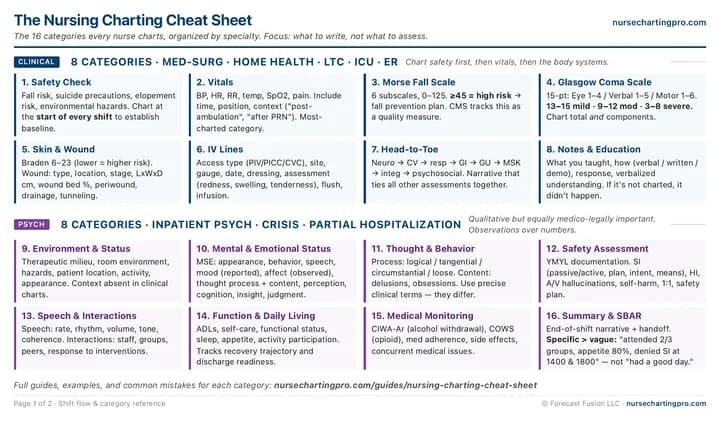
Get the free Nursing Charting Cheat Sheet
All 16 charting categories, clinical and psych, with what to write for each
Morse, Braden, Glasgow Coma Scale and SBAR at a glance
The charting mistakes that cost nurses their licenses
Tap through your assessments during the shift and get a draft of your note to review at clock-out. Your notes are cleared from your phone at the end of your shift.