By Miranda Niemas, Nursing Student (BSN candidate)
This guide is currently pending review by a licensed registered nurse.
Last updated: October 13, 2026
SBAR for Clinical (Med-Surg) Nursing: A Complete Example
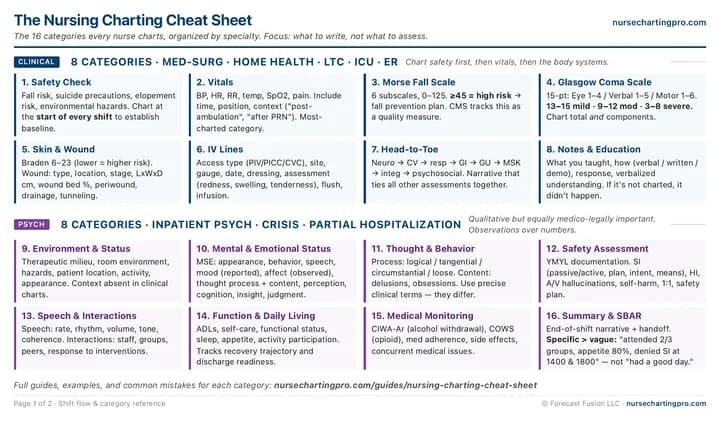
Get the free Nursing Charting Cheat Sheet
- All 16 charting categories, clinical and psych, with what to write for each
- Morse, Braden, Glasgow Coma Scale and SBAR at a glance
- The charting mistakes that cost nurses their licenses
Your first clinical handoff is in 2 hours, and you may wonder how much detail to include. You have 12 hours of vitals, two IV sites, a wound vac, a Foley, intake and output numbers, and a pain management episode that occurred at 0300 - all of which you must fit into a 3-minute SBAR. I understand that feeling. My first med-surg handoff lasted eight minutes, and the oncoming nurse interrupted me twice to ask what I was truly worried about. This page outlines how clinical SBAR differs from other specialties. You will see which details belong, which should be dropped, and how to structure a handoff with a full annotated example.
Why This Matters
Regulatory bodies: The Joint Commission, Centers for Medicare & Medicaid Services (CMS)
- National Patient Safety Goals - Hand-off Communication — The Joint Commission (2025)
- SBAR Tool: Situation-Background-Assessment-Recommendation — Institute for Healthcare Improvement (IHI) (2024)
How Clinical SBAR Differs from Psych SBAR
Trending - The Key Element of Clinical SBAR
Wound, IV, and Device Status
Medical Escalation via SBAR
Common Mistakes
Vitals without trending
A single set of vitals provides a snapshot. The trend drives clinical decisions. The oncoming nurse or physician needs to understand the trajectory, not just the current number. Trending transforms data into a clinical story.
No Clinical Judgment in Assessment
In the Assessment section, avoid merely repeating data; you already provided that information in the Background. Instead, explain what the data signifies. If your Assessment sounds like Background, you have missed the opportunity for clinical judgment.
No Specific Recommendation
SBAR without a Recommendation is just a data report. The whole point of the framework is to close with what needs to happen next - monitoring parameters, orders, and escalation thresholds. Make a specific ask.
Burying the Current Concern in Background
The fever and tachycardia represent the Situation - they explain why you are communicating. Spending three minutes on surgical history before addressing the actual concern wastes time and obscures the urgency. Lead with what changed, then provide the context.
Case Example
Scenario
You are the day shift nurse giving SBAR handoff to the oncoming evening nurse. Mr. Yamamoto is a 74 year old male, post-op day 2 from a right total hip arthroplasty. The shift was mostly stable, but he experienced a significant pain episode at 0300 that required IV morphine. His hemoglobin has been trending down, and PT came this morning for his first ambulation session. Discharge planning has started, targeting post-op day 4 if recovery stays on track. You need to hand off the full picture: vitals trend, pain management, surgical site, devices, DVT prophylaxis, functional status, and discharge plan.
Chart Entry
S - Situation: "This is Miranda, Mr. Yamamoto's nurse on 4-South. I am handing off Mr. Yamamoto in Room 508. He is a 74 year old, post-op day 2 from a right total hip arthroplasty. Overall he has been stable today, but there are three things I want you to watch: a dropping hemoglobin trend, a pain spike overnight that needed IV morphine, and his first PT session went well but he is deconditioned."

B - Background: "Vitals have been stable - BP ranged from 128/76 to 136/82 today, HR 78-86, temp peaked at 99.1 at 1000 but came back to 98.4 by 1400, resps 16-18, SpO2 95-97% on room air. His hemoglobin trend is what I want you to know: 12.8 on admission, 11.4 yesterday, 10.2 this morning. He is not symptomatic - no dizziness, no tachycardia, no orthostatic changes - but the trend is downward.

Pain management: he was controlled at 3/10 through most of the night with scheduled acetaminophen 650 mg q6h. At 0300 he attempted to reposition in bed and pain spiked to 8/10. I gave IV morphine 2 mg per PRN order - pain came down to 4/10 within 30 minutes. He has been at 4-5/10 since then with moderate discomfort on movement. Next scheduled acetaminophen is at 1800.

Surgical site: right hip incision is clean, dry, and intact. 18 staples in place, no erythema, no drainage, no signs of dehiscence. Dressing changed at 0800 per protocol. JP drain output was 45 mL sanguineous over the last 8 hours, down from 80 mL the previous shift.

IV access: 20-gauge PIV in the left forearm, placed day of surgery, site clean without redness or swelling. Running NS at 75 mL/hr. Foley in place - urine clear yellow, 400 mL output over 8 hours, adequate.

DVT prophylaxis: Lovenox 40 mg subQ daily - today's dose given at 0800. SCDs on bilateral lower extremities when in bed. PT came at 1000 for his first ambulation session - he walked 50 feet in the hallway with a front-wheeled walker, weight-bearing as tolerated on the right. He tolerated it but was fatigued after. PT plans to return tomorrow for a longer session.

Discharge planning: case management is targeting post-op day 4 for discharge to a skilled nursing facility. Family meeting is scheduled for tomorrow afternoon to discuss rehab options."

A - Assessment: "Overall he is progressing on the expected post-op trajectory, but the hemoglobin trend concerns me - 2.6-point drop over 48 hours without an obvious source. He is not symptomatic yet, but if it drops below 10 overnight I think the surgeon will want to know. The pain spike at 0300 was positional and responded well to the PRN morphine, so I do not think it represents a complication - but he will likely need the PRN again tonight when he repositions. He is deconditioned and will need encouragement to use the incentive spirometer and do ankle pumps."

R - Recommendation: "Reassess vitals at 1800 and 2200. I would set a threshold of hemoglobin below 10 or any new symptoms - dizziness, tachycardia, orthostatic drop - as a trigger to call the surgeon. Keep the scheduled acetaminophen going and use the PRN morphine for repositioning pain. Encourage incentive spirometer use at least 10 times per hour while awake. SCDs on when in bed. PT is scheduled again tomorrow at 1000. And can you remind the family about the meeting tomorrow at 1400?"
Key points from above chart entry
- Situation - three things to watch:
- Previews the key concerns up front so the oncoming nurse knows what matters most before hearing the details. This is the clinical equivalent of "here is what to pay attention to" - it frames the entire handoff.
- Background - hemoglobin trend:
- Reports three data points (12.8, 11.4, 10.2) across 48 hours instead of just the current value. The trend tells a different story than the single number. Also notes the absence of symptoms, which is clinically relevant.
- Background - pain trajectory:
- Reports the full arc of the pain event: baseline, spike trigger, intervention, response, and current state. This gives the oncoming nurse a clear picture of what happened and what to expect tonight.
- Recommendation - specific thresholds:
- Names a specific trigger for calling the surgeon (hemoglobin below 10 or new symptoms) rather than a vague "call if anything changes." This gives the oncoming nurse a clear decision point instead of leaving it to judgment under uncertainty.
Pro Tips
- Give the baseline before the current value - always: Train yourself to say "BP was X at 0600 and is now Y at 1400" instead of "BP is Y." The baseline-to-current pattern automatically creates a trend, and trends are what drive clinical decisions. This applies to vitals, labs, pain scores, drain output, and urine output.
- Report Pain as a Trajectory, Not a Snapshot: A pain score of 5/10 means nothing in isolation. What was it at the start of the shift? What triggered any spikes? What interventions were given, and how did the patient respond? The oncoming nurse needs the arc, not the number - especially if PRN medications were used during your shift.
- Say "What I Am Worried About" Out Loud: If you cannot finish the sentence "what I am worried about is..." then either the patient is genuinely stable (in which case your Assessment can say so) or you have not synthesized the data yet. Force yourself to complete that sentence before giving SBAR. That sentence IS your Assessment.
- Flag Anticipated Events for the Oncoming Shift: When the patient is due for a lab draw at 0400, a dressing change at midnight, a PT session in the morning, or a family meeting tomorrow, include these details in your Recommendation. The oncoming nurse should not have to discover scheduled events by reading through orders. Anticipating events ensures a complete handoff.
- Do Not Repeat What Is Already in the Structured Documentation: The oncoming nurse can access the medication list, allergy list, and full vital signs flow sheet in the chart. Your SBAR should synthesize and interpret information rather than recite it. If you find yourself reading the MAR aloud during handoff, you are in data-dump mode. Instead, focus on what has changed, what matters, and what needs to happen next.
Frequently Asked Questions
- What distinguishes clinical SBAR from psych SBAR?
- Clinical SBAR and psych SBAR use the same framework (Situation, Background, Assessment, Recommendation), but the type of data differs. Clinical SBAR emphasizes quantitative findings such as vital signs trends, lab values, intake and output, wound and device status, and medication responses. Psych SBAR focuses on observational findings, including mental status, behavioral observations, safety status, and therapeutic response. While the structure is consistent, the content varies by specialty.
- Should I include all vitals in the handoff?
- No, do not include every vital sign reading in the handoff; report vitals as a trend. Report the baseline (start of shift or admission), any significant changes, and the most recent values. If vitals have been stable and unremarkable, you can summarize: "Vitals stable all shift, no significant changes." If there is a trend (blood pressure rising, oxygen saturation dropping, temperature rising), report the trajectory with at least three data points so the listener can see the direction.
- How do I use SBAR to call a physician?
- To use SBAR to call a physician, lead with Situation: who you are, who the patient is, and what changed. Keep Background tight: only the information the provider needs to make a decision about the current concern. State your Assessment: "I am concerned about X because Y." Close with a specific Recommendation: "I would like orders for X and Y. Can you come see the patient?" Do not apologize for calling, do not recite the full history, and do not end with "just wanted to let you know." The provider needs Situation and Recommendation fast, especially at 2 AM.
Get the free Nursing Charting Cheat Sheet
- All 16 charting categories, clinical and psych, with what to write for each
- Morse, Braden, Glasgow Coma Scale and SBAR at a glance
- The charting mistakes that cost nurses their licenses
Chart faster with Nurse Charting Pro
Tap through your assessments during the shift and get a draft of your note to review at clock-out. Your notes are cleared from your phone at the end of your shift.
Related Guides
- The main SBAR frameworkThe complete SBAR guide includes the framework structure, component breakdown, and universal principles applicable to every specialty.
- Psych SBAR exampleSBAR adapts for psychiatric handoffs by using observational data rather than quantitative measures, focusing on mental status instead of vital signs.
- Clinical charting hubExplore the complete clinical charting overview, which includes all seven clinical categories that contribute to your SBAR handoff.
- Vital signs documentationDocumenting vital signs with trending provides the data that forms the backbone of your clinical SBAR.
- Head-to-toe assessmentConducting a structured head-to-toe assessment directly informs your SBAR Background for clinical patients.
- What WDL means in nursingWhich assessment exceptions to hand off, and when a WDL click is enough.