Mental Status Exam Terms: Definitions and Charting Examples
Mental status exam terms for nurses, from pressured speech to blunted affect and tangential thinking. What each one means and a charting example for each.
On this page 19 sections
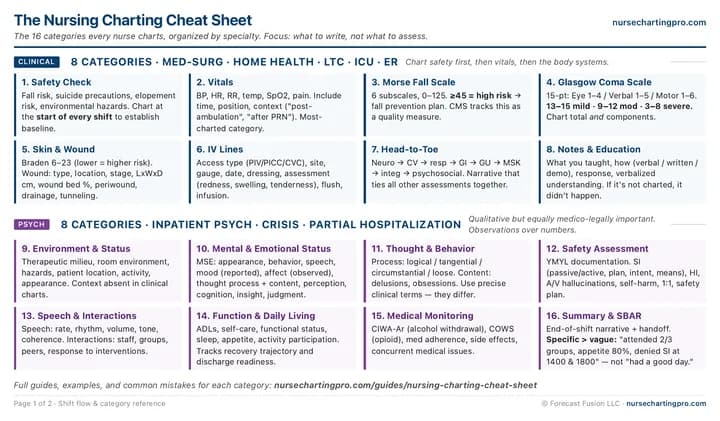
Get the free Nursing Charting Cheat Sheet
- All 16 charting categories, clinical and psych, with what to write for each
- Morse, Braden, Glasgow Coma Scale and SBAR at a glance
- The charting mistakes that cost nurses their licenses
Why this matters
- CMS Conditions of Participation (42 CFR 482.61)
- CMS State Operations Manual, Appendix AA (Psychiatric Hospitals)
Federal rules for psychiatric hospitals require the psychiatric evaluation to "contain a record of mental status," and they name nurses among the staff whose progress notes must give a "precise assessment of the patient's progress." They do not require particular words; what surveyors look for is the evidence behind the words. The Centers for Medicare & Medicaid Services (CMS) guidance for surveyors of psychiatric hospitals says: "It is not acceptable just to write 'oriented, memory intact, judgment poor, and insight nil,' without any supportive information." The same guidance says notes such as "patient slept well" or "no complaints" are observations that "do not indicate how the patient is responding to treatment."
Word choice also shapes how the next reader sees the patient. In a randomized study of 413 physicians in training, those who read a chart note written with stigmatizing language rated the patient less favorably and chose less aggressive pain treatment than those who read a neutral note about the same patient. An analysis of 40,113 admission notes at one academic medical center found that Black patients had 2.54 times the odds of having at least one negative descriptor, such as "noncompliant," in their notes as compared to White patients.
Textbooks do not all use these terms the same way, so this page follows one set of sources and says so where they differ. If your facility has its own list of MSE terms, use it. This guide covers documentation. It does not replace your facility's policy or your clinical judgment.
- 42 CFR 482.61, Condition of participation: Special medical record requirements for psychiatric hospitals Electronic Code of Federal Regulations, 2026
- State Operations Manual, Appendix AA: Psychiatric Hospitals (tags B113, B126) Centers for Medicare & Medicaid Services, Rev. 149, 2015, 2015
- Mental Status Examination Voss RM, Das JM. StatPearls, NCBI Bookshelf, 2024
- Nursing: Mental Health and Community Concepts, Chapter 4: Application of the Nursing Process to Mental Health Care Open Resources for Nursing (Open RN); Ernstmeyer K, Christman E, editors. NCBI Bookshelf, 2022, 2022
- Mental Status Exam: Definitions Association of Directors of Medical Student Education in Psychiatry (ADMSEP)
- The Mental Status Examination (Chapter 207) Martin DC. In: Walker HK, Hall WD, Hurst JW, editors. Clinical Methods, 3rd ed. Butterworths, 1990, 1990
- Bipolar Disorders Coryell W. Merck Manual Professional Version
- Delusional Disorder Keshavan MS. Merck Manual Professional Version
- Determination and Documentation of Insight in Psychiatric Inpatients Casher MI, Bess JD. Psychiatric Times. 2012;29(4), 2012
- Do Words Matter? Stigmatizing Language and the Transmission of Bias in the Medical Record Goddu AP, O'Conor KJ, Lanzkron S, et al. J Gen Intern Med. 2018;33(5):685-691, 2018
- Negative Patient Descriptors: Documenting Racial Bias In The Electronic Health Record Sun M, Oliwa T, Peek ME, Tung EL. Health Aff. 2022;41(2):203-211, 2022
How to Use These Terms
Each term below has a plain definition, the MSE section it belongs in, and a charting example. The examples all follow the same pattern: the term, then the evidence. "Affect blunted" is a label. "Affect blunted, minimal facial expression, monotone voice throughout the assessment" is a finding the next nurse can compare against.
This guide is for defining terms. For how to complete the full MSE assessment and chart each section in order, see the mental status exam documentation guide.
Appearance and Behavior Terms
- Well-groomed / disheveled: grooming and hygiene as you see them. Charting example: "Hair uncombed, clothing stained, mild body odor."
- Psychomotor agitation: purposeless, non-goal-directed activity, such as pacing, fidgeting, or hand-wringing. Charting example: "Rapidly pacing the hallway from 1400 to 1430, unable to sit for more than a minute, wringing hands."
- Psychomotor slowing: slowed movement, slumped posture, or slow speech. (Older textbooks call it psychomotor retardation.) Charting example: "Slow to rise from bed, minimal spontaneous movement, delayed responses to questions."
- Eye contact: good, intermittent, avoidant, or staring. Charting example: "Eye contact intermittent, looks at the floor when discussing family."
- Guarded: a label for a patient who limits what they share. Chart what they did. Charting example: "Answers most questions with 'I don't know' or 'I would rather not say.' Declined to discuss events before admission."
Speech Terms
Speech is how the patient talks, not what they say. Chart rate, volume, tone, and amount.
- Pressured speech: rapid speech "driven by an internal sense of urgency," which one medical reference describes as "a rapid, unstoppable flow of speech." It can be seen in cases such as mania and in stimulant intoxication. Charting example: "Speech rapid and pressured, continued talking over staff even when redirected."
- Rapid / slow: rate only, without the urgency of pressured speech. Charting example: "Speech slow, with long pauses before answering."
- Monotone: little variation in tone. Charting example: "Speech soft and monotone."
- Limited or minimal speech ("poverty of speech"): very little spontaneous speech, brief answers. Charting example: "Answers in one to three words, offers nothing further."
Some textbooks list circumstantial speech here. This page lists it under thought process, where most sources put it. The speech and interactions guide covers the rest of this section.
Mood Terms
Mood is the patient's own description of how they feel. Ask, then quote the answer.
Sources disagree on whether mood is the patient's words or the nurse's summary. This page follows the convention that mood is "documented with quotations transcribing the patient's response verbatim." That keeps your own observations on the affect line, where they belong.
- Patient's words: Charting example: "Mood: Patient states, 'I feel tired and empty.'"
- Euthymic: a normal range of mood, appropriate to the situation. It is a clinician's word, so if you use it, put the patient's words next to it. Charting example: "Mood: Patient states, 'I feel pretty good today.' Appears euthymic."
- Dysphoric: a low or unpleasant mood, such as depression, anxiety, or guilt. Charting example: "Mood: Patient states, 'I am miserable, I just want to go home.'"
- Irritable: easily annoyed or angered. Charting example: "Mood: Patient states, 'Everyone here is getting on my nerves.' Raised his voice when asked about sleep."
- Euphoric / elevated: an abnormally elevated sense of well-being. Charting example: "Mood: Patient states, 'I'm fantastic, the best I have ever felt,' after 2 hours of sleep."
Affect Terms
Affect is what you observe of the patient's emotional expression. Chart its range, how stable it is, and whether it matches the mood.
Affect range is a scale, not a set of synonyms. One psychiatry education resource orders it: intense, full, constricted, blunted, flat.
- Full (or broad): a normal range of expression that changes with the topic. Charting example: "Affect full, smiles when talking about grandchildren, tearful when talking about her husband's death."
- Constricted (or restricted): a narrower range than expected. Charting example: "Affect constricted, mildly sad throughout, brief smile once."
- Blunted: "a diminished range and intensity" of expression. Charting example: "Affect blunted, minimal facial expression, monotone."
- Flat: "no emotional expression." Do not chart flat when you mean blunted. Charting example: "Affect flat, no change in facial expression or tone during the assessment, including when discussing his discharge and his family."
- Labile: rapid changes in expression that do not fit the moment. Charting example: "Affect labile, laughing then crying within 2 minutes while describing breakfast."
- Congruent / incongruent: whether the affect matches the stated mood. Charting example: "States mood is 'great' while tearful. Affect incongruent with stated mood."
- Appropriate / inappropriate: whether the expression fits the situation. "Affect appropriate" alone tells the next reader little. Add what you saw. Charting example: "Laughing while describing her mother's death. Affect inappropriate to content."
Thought Process Terms
Thought process is how the patient thinks, or how their ideas connect.
- Linear and goal-directed: ideas connect logically and reach the point. Charting example: "Thought process linear and goal-directed, answers questions directly and completely."
- Circumstantial: excessive detail and detours, but the patient does eventually return to the original point. Charting example: "Circumstantial; described the drive to the hospital in detail before answering the original question asked about sleep."
- Tangential: wanders off the topic and never returns to it. Charting example: "Tangential. Asked about sleep, talked about her roommate and then the cafeteria, and did not answer questions about sleep despite two redirections."
- Flight of ideas: rapidly shifts from one topic to the next, often with fast speech. You can sometimes follow the thread, although not always. Often seen in mania. Charting example: "Flight of ideas; moved from the weather to airplanes to his brother's wedding in under a minute."
- Loose associations (derailment): jumping rapidly from one idea to an unrelated idea without any logical bridge. Charting example: "Loose associations; states 'I went to the post office to get my mail, but it is flying in a plane and I am going to Mexico too.'"
- Word salad: severely disorganized and virtually incomprehensible speech, the most severe loosening of associations. Charting example: "Patient stated, 'Pencil cat book sky, that's me.'"
- Thought blocking: abrupt cessation of speech without explanation in the middle of a sentence. Charting example: "She stopped abruptly mid-sentence three times, and was unable to finish her sentence."
- Perseveration: the patient returns to the same word, phrase, or subject regardless of the question. Charting example: "Returned to the topic of his car keys after each of four unrelated questions."
- Clang associations: words chosen for their sound, usually rhymes, without logical meaning. Charting example: "States 'I am fine, wine, sign, mine.'"
- Neologisms: made-up words. Charting example: quote the word and the sentence it was used in, for example, "Patient stated, 'I have to use the cralcracker to clean my room because flamflim said so.'"
The thought and behavior charting guide walks through each of these with longer examples. Disorganized is a broader term that encompasses many of the above categories.
Thought Content Terms
Thought content is what the patient is thinking about. Quote the patient directly, whenever possible.
- Delusion: a fixed, false belief not held by cultural peers and persisting in the face of objective contradictory evidence. Charting example: "States, 'The nurses are putting poison in my water.' Unable to be redirected when shown the sealed bottle."
- Persecutory (paranoid) delusion: a belief that the patient is being plotted against, spied on, or harassed. Charting example: "Patient states, 'Staff are recording everything I do for the FBI.'"
- Grandiose delusion: a false belief in great ability, importance, identity, or power. Charting example: "Patient states, 'I am the owner of the hospital and I can discharge myself.'"
- Ideas of reference: reading special meaning for oneself into ordinary events, such as a message from the television or radio. Charting example: "Patient states, 'The news person is talking to me in code.'"
- Obsessions: repeated, unwanted thoughts the patient cannot stop. Chart what the thoughts are about and what the patient does in response.
- Suicidal and homicidal ideation: part of thought content on every psych assessment. Chart what you asked, what the patient said, and the safety measures in place. The safety assessment guide covers what to chart.
"Passive" in an MSE depends on the context. It can describe passive, withdrawn behavior, or passive suicidal ideation, which is a wish to be dead without plan or intent. Write out which one you mean.
Perception Terms
- Hallucination: the perception of something in the absence of any external stimuli. Chart the sense (auditory, visual, tactile) and the content in the patient's words. Charting example: "Reports hearing a man's voice calling her name, states it started last night."
- Illusion: a misperception of something that is really there. Charting example: "States the coat on the chair looked like a person in the dark, recognized it when the light was on."
- Responding to internal stimuli: behavior that suggests the patient is hearing or seeing something others are not, such as talking to someone who is not present or looking at something that is not there. It is an observation, so chart what you saw. Charting example: "Observed at 2200 alone in room, talking and looking toward the empty corner. When asked, denies hearing voices or seeing anyone."
Cognition Terms
- Alert: awake and responsive. Chart the level of consciousness first.
- Oriented x4 (or x3): oriented to person, place, time, and situation. Some references test only the first three, so chart which ones you checked, and which part is missing if orientation is incomplete. Charting example: "Oriented to person and place only. States the year is 2019 and does not know why she is in the hospital."
- Attention and concentration: whether the patient can stay with a task, such as spelling a word backward. Charting example: "Unable to spell 'world' backward, lost track after two letters, easily distracted by hallway noise."
- Memory: immediate, recent, and remote. Chart what you tested and the result.
Insight and Judgment Terms
- Insight: the patient's understanding of their illness and their need for treatment. It is often rated as good, fair, poor, or limited, but the rating alone says little. Chart what the patient said about their illness. Charting example: "Insight limited. States, 'I am only here because my sister called the police. I do not need medication or to be in this hospital.'"
- Judgment: the patient's ability to make sound decisions. Charting example: "Judgment impaired. Plans to return home and stop all medications, and is unable to name a safety plan if symptoms return."
Insight and judgment are different findings. A patient can understand they are ill (insight) and still plan to do something unsafe (judgment). Chart them separately.
Terms That Look Alike
- Mood vs affect: mood is what the patient says; affect is what you see.
- Blunted vs flat: blunted is reduced expression; flat is none.
- Circumstantial vs tangential: did the patient get back to the question? If they did, it is circumstantial; if they didn't, it is tangential.
- Flight of ideas vs loose associations: in flight of ideas you can sometimes follow the thread; in loose associations there is none.
- Hallucination vs illusion: a hallucination is the perception that something is there when it isn't; an illusion misreads something that is there.
- Ideas of reference vs delusion: both involve reading false meaning into events. Chart the patient's words and whether they can consider another explanation. A delusion can become a fixed belief that does not change, even with evidence.
- Insight vs judgment: insight is understanding; judgment is decision-making.
When you are unsure which term fits, describe what you saw and heard. A good description is always correct, even when the label is not. These are the findings you pass on in the Assessment part of an SBAR handoff.
MSE Terms in NurseChartingPro
In NurseChartingPro, the psych charting screens offer many of these terms as options: mood and affect in the Mental and Emotional category, thought process and thought content in Thought and Behavior, and speech patterns in Speech and Interactions. Press and hold any option to see its definition. Each category has a notes field, and Speech and Interactions has a Notable Quotes field for direct patient statements, so you can chart the patient's words next to the term. For how these categories fit together, see the psychiatric nursing charting overview.
Common mistakes
Charting mood as your own label
Mood is the patient's report. If you replace it with a clinician's word, the chart loses the one part of the MSE that comes from the patient. Put your own observations on the affect line.
Charting flat when the affect is blunted
Flat means no emotional expression at all. A patient who smiles, even briefly, is not flat. The difference matters when the next nurse compares today with tomorrow.
Charting "affect appropriate" with nothing else
"Appropriate" is a conclusion. Without the observation behind it, a reviewer cannot tell what you saw or whether anything changed from the last shift.
Using a thought process term without an example
The example lets the next reader check your term. Counting redirections is also useful when you are not sure which term fits.
Charting a judgment about the patient instead of the behavior
Words like "manipulative," "attention seeking," and "noncompliant" are interpretations. They can change how the next clinician treats the patient, and they do not describe what happened. Chart the behavior and the patient's words.
Pro tips
- Follow each term with "as evidenced by"Many nurses write the term and then "as evidenced by" (AEB), followed by what they saw or heard. "Affect blunted AEB minimal facial expression and monotone voice." Check that AEB is on your facility's approved abbreviation list, or write it out.
- Quote the patient on mood every timeAsk, "How would you describe your mood today?" and write down the answer word for word. It is the fastest part of the MSE to chart, and it gives the next nurse something exact to compare against.
- Use the same scale every shiftIf your unit uses full, constricted, blunted, and flat for affect, use those words every time. Switching between "restricted," "blunted," and "flat" for the same patient makes it look like the patient changed, when only the word did.
- When in doubt, describeIf you are not sure whether a patient is tangential or circumstantial, for example, chart what they said and how many times you redirected them. A clear description is useful even when the term is not certain.
Step by step
- Ask about moodAsk the patient how they would describe their mood and chart the answer in quotation marks whenever possible.
- Describe affectChart the range, stability, and whether the affect matches the stated mood, with what you observed.
- Name the thought processChoose the term that fits and add an example, including how many redirections the patient needed. If you are uncertain about which specific term to use, chart the patient's words only.
- Quote thought contentChart delusions, obsessions, and suicidal or homicidal ideation, in the patient's words whenever possible.
- Chart the evidence for every termAfter every term, add what you saw and what the patient said.
Frequently asked questions
What is the difference between mood and affect?
What is the difference between blunted and flat affect?
What is the difference between tangential and circumstantial?
What is the difference between flight of ideas and loose associations?
What is pressured speech?
What does "passive" mean in a mental status exam?
What does "euthymic" mean?
Get the free Nursing Charting Cheat Sheet
- All 16 charting categories, clinical and psych, with what to write for each
- Morse, Braden, Glasgow Coma Scale and SBAR at a glance
- The charting mistakes that cost nurses their licenses
Chart faster with Nurse Charting Pro
Tap through your assessments during the shift and get a draft of your note to review at clock-out. Your notes are cleared from your phone at the end of your shift.


Related guides
- psychMental Status Exam ChartingHow to assess and chart each section of the MSE in order, with full examples.
- psychThought & Behavior ChartingThought process and thought content terms with longer bedside examples.
- psychSpeech & InteractionsHow to chart speech rate, volume, tone, and how the patient interacts.
- psychSafety AssessmentWhat to chart for suicidal ideation, homicidal ideation, and hallucinations.
- psychPsychiatric Nursing ChartingThe eight psych charting categories, including mental status.