By Amy Niemas, RN-BC, BSN, MSW, Clinical Content Director · Psychiatric Registered Nurse
Last updated: October 13, 2026
What WDL Means in Nursing and When It Is Not Enough
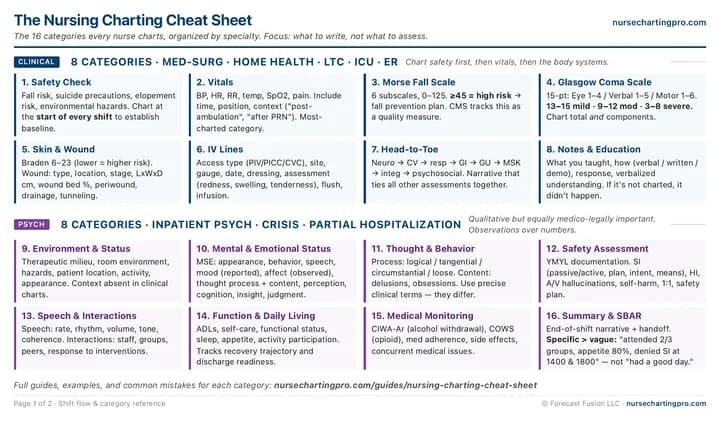
Get the free Nursing Charting Cheat Sheet
- All 16 charting categories, clinical and psych, with what to write for each
- Morse, Braden, Glasgow Coma Scale and SBAR at a glance
- The charting mistakes that cost nurses their licenses
Why This Matters
Regulatory bodies: CMS Conditions of Participation (42 CFR 482.24), State Boards of Nursing
- 42 CFR 482.24, Condition of participation: Medical record services — Electronic Code of Federal Regulations (2026)
- Romero Lama v. Borras, 16 F.3d 473 (1st Cir. 1994) — Caselaw Access Project, Harvard Law School Library (1994)
- Behavior Involving Lying and Falsification (disciplinary sanction policy) — Texas Board of Nursing, amended 2015 (2015)
- Documentation Integrity in Electronic Health Records (fact sheet) — Centers for Medicare & Medicaid Services, 2016 (2016)
- Head to Toe Assessment: A Minimum Data Set Supplement for Reducing Documentation Burden — Adrian B, Boyd D, Hager C, Head to Toe Assessment Task Force. Nursing Knowledge Big Data Science Initiative, University of Minnesota, 2025 (2025)
- Stepdown Unit Standards of Care, policy 62.03.00 — Kadlec Regional Medical Center, in a Washington State Department of Health filing, 2021 (2021)
- Nursing Fundamentals, Chapter 2: Communication — Open Resources for Nursing (Open RN); Ernstmeyer K, Christman E, editors. NCBI Bookshelf, 2021 (2021)
- Charting by exception: the legal risks — Nurses Service Organization
- Back to Normal? — Brucker MC. Nursing for Women's Health. 2021 (2021)
What WDL Means in Nursing
WDL means within defined limits. It is a single entry that stands for a whole list of normal findings your facility has written for each body system.
WDL Except
WDL vs WNL
WDL and Charting by Exception
When WDL Is Enough
When WDL Is Not Enough: What to Chart Instead
Each of these situations needs more than a WDL click. Most need "WDL except" and a specific finding.
Any Finding Outside the Definition
A Chronic Finding That Is Normal for This Patient
An Item You Could Not Assess
Something the Patient Tells You
A Reassessment After an Intervention
A Finding That Continues From an Earlier Shift
Where WDL Fits With Vital Signs and Focused Assessments
WDL in NurseChartingPro
Common Mistakes
Marking WDL without knowing your facility's definition
WDL means every item in the definition was assessed. If you do not know what the items are, you cannot know whether you assessed them. A few supporting findings after the WDL also show the next reader what you checked. Although the supporting findings are not essential if the findings are truly WDL, it is good practice to write out supporting details, especially for new nurses or nurses new to a facility.
Marking WDL for a known chronic finding
A chronic finding that is normal for this patient is still outside a definition that includes a regular rhythm. Charting it as an exception, with "unchanged," tells the next nurse what to expect and makes a real change easy to spot.
Marking WDL when you could not assess every item
WDL covers every item in the definition. If you could not assess one, WDL charts a finding you do not have. Chart only what you assessed and name what you could not.
Copying WDL forward from the last assessment
A WDL copied from the last shift can hide a change. CMS has warned that copying and auto-fill in the health record can create documentation errors. Chart what you found on your assessment.
Charting an exception once and then going quiet
The pattern across entries is what a reviewer reads. An exception charted once and never again looks like no one checked it again. Chart it at every assessment, even when it is unchanged. Also remember to chart any interventions you did to address issues present.
Pro Tips
- Read your facility's definitions once, system by system: Most flowsheets show the WDL definition when you hover over or tap the row. Read each one during orientation and write down anything that surprises you, such as whether pain or a patient's mood is part of a system's definition. After that, you will know what each click means, or which ones you need to look at again.
- Add a few findings after WDL, if possible: A WDL followed by two or three specific findings ("WDL. Lungs clear bilaterally, RR 16, SpO2 97% on room air") takes only a few minutes and shows what you checked. It also helps a reader from another facility, whose definition may differ from yours.
- Say "not assessed" when you did not assess it: This sounds like a no-brainer, but it is a common mistake. "Not assessed, patient asleep" or "not assessed, patient off unit for CT" is an honest, complete entry. It is better than a WDL that you cannot support, and it also tells the next nurse what still needs to be done.
- Use unchanged with a number: "Unchanged" alone is easy to write without looking. "Unchanged, 2+ pitting edema bilateral ankles" shows you compared this assessment against the last one.
- Hand off the exceptions, not the WDLs: At shift change, the oncoming nurse needs to know what was not normal and what is being watched. Lead with the exceptions and the trend. The WDL systems can be one sentence.
Step by Step
- Know the definition: Read your facility's WDL definition for each body system before you use it.
- Assess every item: Assess every item in the definition during this assessment. If you cannot assess one, do not mark WDL. If your facility uses it, you can chart "WDL Except" and chart the specifics about the outlying item.
- Mark WDL only when every item matches: If every item was assessed and normal, mark the system WDL. Adding two or three findings, if possible, shows what you checked.
- Chart each exception: For any finding outside the definition, including a chronic baseline finding, choose "WDL except" and chart the finding specifically.
- Chart what the patient reports: Chart symptoms the patient describes in their own words, even when your assessment matches the definition.
- Follow each exception until it resolves: Chart the exception at every later assessment, with a measurement, even when it is unchanged.
Frequently Asked Questions
- What does WDL mean in nursing?
- WDL stands for within defined limits. Marking a body system WDL means you assessed every item in your facility's written definition for that system and every item was normal.
- What is the difference between WDL and WNL?
- WDL points to a written facility definition for each body system and can change depending on the facility. WNL stands for within normal limits and is an older, more general term, used for healthy people. Check your facility's approved abbreviation list before using WNL.
- What does "WDL except" mean?
- WDL except means the system matches your facility's definition except for the findings you chart next. Chart each exception specifically, along with a measurement or description.
- Can I chart WDL if an abnormal finding is the patient's baseline?
- You cannot chart WDL for a baseline finding that is outside your facility's definition. Chart "WDL except" with the finding, note that it is the patient's known baseline, and say whether it has changed. Follow your facility's definition if it handles baseline findings differently.
- Who decides what counts as within defined limits?
- Your facility decides what counts as within defined limits. The definitions are written in facility policy and built into the health record flowsheet, and they vary between facilities.
- Is charting by exception legal?
- No federal rule requires or forbids charting by exception, and many facilities use it. The risk comes from a chart that does not show a change over time, or a WDL entry for something that was not assessed. A local rule or facility policy may also require narrative notes at set intervals.
- Can I mark WDL if I did not assess only one item?
- No, you cannot mark WDL if you did not assess every item. WDL covers every item in the definition. Chart what you assessed and note the item you could not assess and why.
Get the free Nursing Charting Cheat Sheet
- All 16 charting categories, clinical and psych, with what to write for each
- Morse, Braden, Glasgow Coma Scale and SBAR at a glance
- The charting mistakes that cost nurses their licenses
Chart faster with Nurse Charting Pro
Tap through your assessments during the shift and get a draft of your note to review at clock-out. Your notes are cleared from your phone at the end of your shift.
Related Guides
- Head-to-toe assessment chartingSample WDL definitions and common exceptions for each of 10 body systems, with a full example.
- Vital signs chartingHow to chart vital signs as values the next nurse can trend.
- Objective vs subjective chartingHow to chart what you observed along with what the patient told you.
- Skin and wound chartingHow to chart a skin finding, like sacral redness, at every assessment.
- Clinical SBAR handoffHanding off assessment exceptions on a med-surg or clinical unit.