By Amy Niemas, RN-BC, BSN, MSW, Clinical Content Director · Psychiatric Registered Nurse
Last updated: October 13, 2026
What SI/HI/AVH Means and How to Chart It (Nursing Guide)
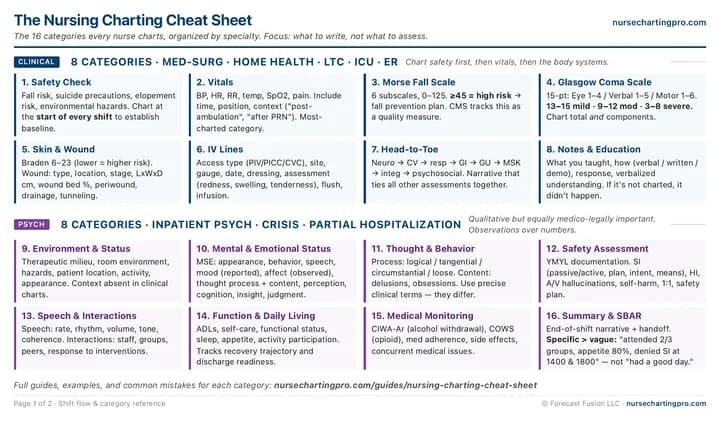
Get the free Nursing Charting Cheat Sheet
- All 16 charting categories, clinical and psych, with what to write for each
- Morse, Braden, Glasgow Coma Scale and SBAR at a glance
- The charting mistakes that cost nurses their licenses
Why This Matters
Regulatory bodies: Joint Commission National Performance Goal 8 (hospitals, from January 2026), Joint Commission National Patient Safety Goal 15.01.01 (behavioral health care organizations), CMS Conditions of Participation, State Mental Health Codes
- National Performance Goals, Effective January 2026 for the Hospital Program (Goal 8, NPG.08.01.01) — The Joint Commission (2025)
- R3 Report Issue 18: National Patient Safety Goal for Suicide Prevention (NPSG 15.01.01) — The Joint Commission, November 2018, updated December 2025 (2018)
- Association between suicidal ideation and suicide: meta-analyses of odds ratios, sensitivity, specificity and positive predictive value — McHugh CM, Corderoy A, Ryan CJ, Hickie IB, Large MM. BJPsych Open. 2019;5(2):e18 (2019)
- Does asking about suicide and related behaviours induce suicidal ideation? What is the evidence? — Dazzi T, Gribble R, Wessely S, Fear NT. Psychol Med. 2014;44(16):3361-3363 (2014)
- Empty Words in Psychiatric Records: Where Has Clinical Narrative Gone? — Gutheil TG, Simon RI. Psychiatric Times, December 2011 (2011)
- Suicidal Ideation — Rizvi A, Harmer B, Saadabadi A. StatPearls, NCBI Bookshelf (2024)
- Mental Status Examination — Voss RM, Das JM. StatPearls, NCBI Bookshelf (2024)
- Auditory Hallucinations — Thakur T, Gupta V. StatPearls, NCBI Bookshelf (2023)
- Psychosis — Calabrese J, Al Khalili Y. StatPearls, NCBI Bookshelf (2023)
- The DSM-5 diagnosis of nonsuicidal self-injury disorder: a review of the empirical literature — Zetterqvist M. Child Adolesc Psychiatry Ment Health. 2015;9:31 (2015)
- Mental Health Professionals' Duty to Warn — National Conference of State Legislatures (2022)
- 988 Suicide and Crisis Lifeline — SAMHSA / Vibrant Emotional Health (2024)
What SI, HI, AVH, and NSSI Mean
These four abbreviations cover the safety questions asked of every psychiatric patient, on every shift, and they are part of the safety assessment in psychiatric nursing charting. You will see them together in almost every psych nursing note, most often as "denies SI/HI/AVH."
SI: Suicidal Ideation
HI: Homicidal Ideation
AVH: Auditory or Visual Hallucinations
NSSI: Non-Suicidal Self-Injury
Reading "Denies SI/HI/AVH" in a Note
How to Chart a Denial of SI/HI/AVH
How to Chart When a Patient Endorses SI
The most important part of a positive entry is what you do after a positive SI response. Chart the finding, the patient's words, and your response in the order they happened, with times.
How to Chart When a Patient Endorses HI
How to Chart Hallucinations, Including Command Hallucinations
NSSI (Non-Suicidal Self-Injury): How It Differs From SI and How to Chart It
SI/HI/AVH Documentation in NurseChartingPro
Common Mistakes
Charting "denies SI/HI/AVH" with nothing else
The short version does not show what was asked, how, or what you observed. When the same line appears shift after shift, a reviewer cannot tell whether anyone asked at all. Write the denial fresh each time, with what you observed this shift.
Charting positive SI with plan and intent, without the response
"Will notify provider" does not include the initiation of the 1:1 observation. A positive finding with no documented intervention and follow-up is a major safety risk and a significant red flag in the chart.
Charting "denies AVH" when the behavior says otherwise
A denial and an observation can disagree. Chart both. Leaving out what you saw indicates that the patient was free of hallucinations when your own observations suggest otherwise.
Calling NSSI a suicide attempt, or dismissing it
Whether an act was a suicide attempt depends on the patient's intent, so ask and quote it directly. "Attention seeking" is an interpretation, not an observation, and it can lead the next reader to take real risk less seriously.
Charting HI without the target or who was told
Whether a specific person is named changes what happens next, including a possible duty to warn under state law. Chart the target, the patient's words, and every person you notified, with the time.
Pro Tips
- Read the screening tool word for word: If your facility uses a validated screener, such as the C-SSRS or the Ask Suicide-Screening Questions (ASQ), read each item exactly as written. The Joint Commission says not to change the wording of a validated tool, because even small changes can affect its accuracy.
- Ask directly, using the word suicide: Ask, "Are you having any thoughts of killing yourself?" rather than "Are you having any dark thoughts?" Softer wording asks a different question, and a patient can answer the softer question honestly and still leave out what you need to know. Asking directly has not been shown to cause or worsen suicidal thoughts.
- Write the denial fresh every shift: Do not copy a denial forward from the last shift. If the entry reads the same every time, the next reader cannot tell whether you asked. What you observed this shift is what shows the assessment happened.
- Ask what is keeping them safe (protective factors): Ask, "What has kept you going so far?" and quote the answer. "Identifies their daughter and their job as reasons to stay safe" tells the provider and the next nurse something that a denial never could, and it also shapes the safety plan and the discharge plan.
Step by Step
- Ask directly: Ask about thoughts of suicide, thoughts of harming others, and hallucinations in plain words. If your facility uses a validated screening tool, read its items exactly as written.
- Chart the answer in the patient's words: Use the patient's words, in quotations, for any positive finding, and also for a denial when the words add something. For SI and HI, chart plan, intent, and access to means separately.
- Chart what you observed: Record affect, behavior, and whether the patient appears to be responding to internal stimuli. If what you see does not fit what the patient says, chart both.
- For a denial, chart the safety check and the contingency: Record that the patient states they feel safe in the hospital and agrees to alert staff if thoughts or feelings change, plus the current observation level.
- For a positive finding, act, then notify: Start the safety measures within nursing scope, such as implementing 1:1 staffing immediately, then notify the provider. Chart each action, who you notified, the orders received, and the times.
- Set the reassessment time: Chart when you will reassess, and make sure you follow up at that time.
Frequently Asked Questions
- What does SI/HI/AVH mean in nursing?
- SI/HI/AVH stands for suicidal ideation, homicidal ideation, and auditory and/or visual hallucinations. "Patient denies SI/HI/AVH" means the patient said no when asked about thoughts of suicide, thoughts of harming others, and hallucinations. It is a routine entry in psychiatric nursing notes, but stronger charting addresses each area specifically, not all as one line.
- What does NSSI stand for?
- NSSI stands for non-suicidal self-injury: deliberately harming your own body, such as cutting or burning, but without intent to die. It is charted separately from a suicide attempt because the intent is different. Ask about both.
- What is the difference between passive and active SI?
- Passive SI is a wish to be dead without a method, plan, or intent (such as, "I wish I would not wake up"). Active SI includes thoughts of how to do it, a plan, and/or intent to act. Chart which one, in the patient's words, and chart plan and intent separately.
- Is "denies SI/HI/AVH" enough documentation?
- No, "denies SI/HI/AVH" on its own is not enough documentation. It only shows that questions were asked. A complete entry adds the question you asked, the patient's words, what you observed, the safety check (e.g., the patient states they feel safe in the hospital), the contingency (e.g., the patient agrees to alert staff if thoughts or feelings change), and the observation level (e.g., q15-minute checks for safety).
- Does asking about suicide put the idea in a patient's head?
- No, asking about suicide does not put the idea in a patient's head. A review of 13 studies found no evidence that asking about suicide causes suicidal ideation; in fact, asking may actually reduce it, because it allows the person to identify it and get support. Ask directly, using the word suicide or the words "killing yourself."
- How do I chart that a patient has no hallucinations?
- Chart what you asked and what you saw: "Denies auditory and/or visual hallucinations. Not observed responding to internal stimuli." If the patient denies hallucinations but you see behavior that suggests them, such as talking to no one or pausing as if listening, chart both their denial and what you observed.
- What are command hallucinations, and how do I chart them?
- Command hallucinations are voices that tell the patient to do something. Chart what the voices say in the patient's words, whether the patient feels able to resist, and whether they have acted on commands before. A command to hurt themselves or someone else needs an immediate safety response and provider notification.
- Can a nurse work on a safety plan with a patient who has active SI?
- Nurses often work on a written safety plan with the patient, and that work belongs in the chart. For a patient with active SI, the safety plan does not replace the immediate safety measures, the provider notification, or the full suicide risk assessment your facility requires. Check your facility's policy for who completes the safety plan.
- Do nurses have a duty to warn when a patient has HI?
- Whether a duty to warn applies depends on state law, because duty-to-warn laws are set by each state. Some require disclosure, some permit it, and a few have no such duty. At the bedside, report the patient's statement and the target to the provider and the charge nurse right away, follow your facility's policy, and chart who you notified and when.
Get the free Nursing Charting Cheat Sheet
- All 16 charting categories, clinical and psych, with what to write for each
- Morse, Braden, Glasgow Coma Scale and SBAR at a glance
- The charting mistakes that cost nurses their licenses
Chart faster with Nurse Charting Pro
Tap through your assessments during the shift and get a draft of your note to review at clock-out. Your notes are cleared from your phone at the end of your shift.
Related Guides
- Nursing charting cheat sheetEvery psych and clinical charting category on one page, including the safety assessment.
- Safety assessment chartingObservation levels, 1:1 documentation, and the full set of elements to chart after a positive SI, HI, or command hallucination finding.
- C-SSRS documentationHow to score and chart the Columbia Suicide Severity Rating Scale, the structured tool many facilities use for SI.
- Thoughts and behaviors chartingHow to describe hallucinations, delusions, and other observed behavior, without interpreting it.
- SBAR for psychiatric nursingWhere SI, HI, and AVH findings go in a psych handoff, with a complete example.
- Psychiatric nursing charting overviewThe eight psych charting categories, including the safety assessment where these findings are charted.